Episode 27 · Slide 1Episode 27 · Slide 1 · meditation helps quiet the fight-or-flight response
Episode 27 · Slide 1
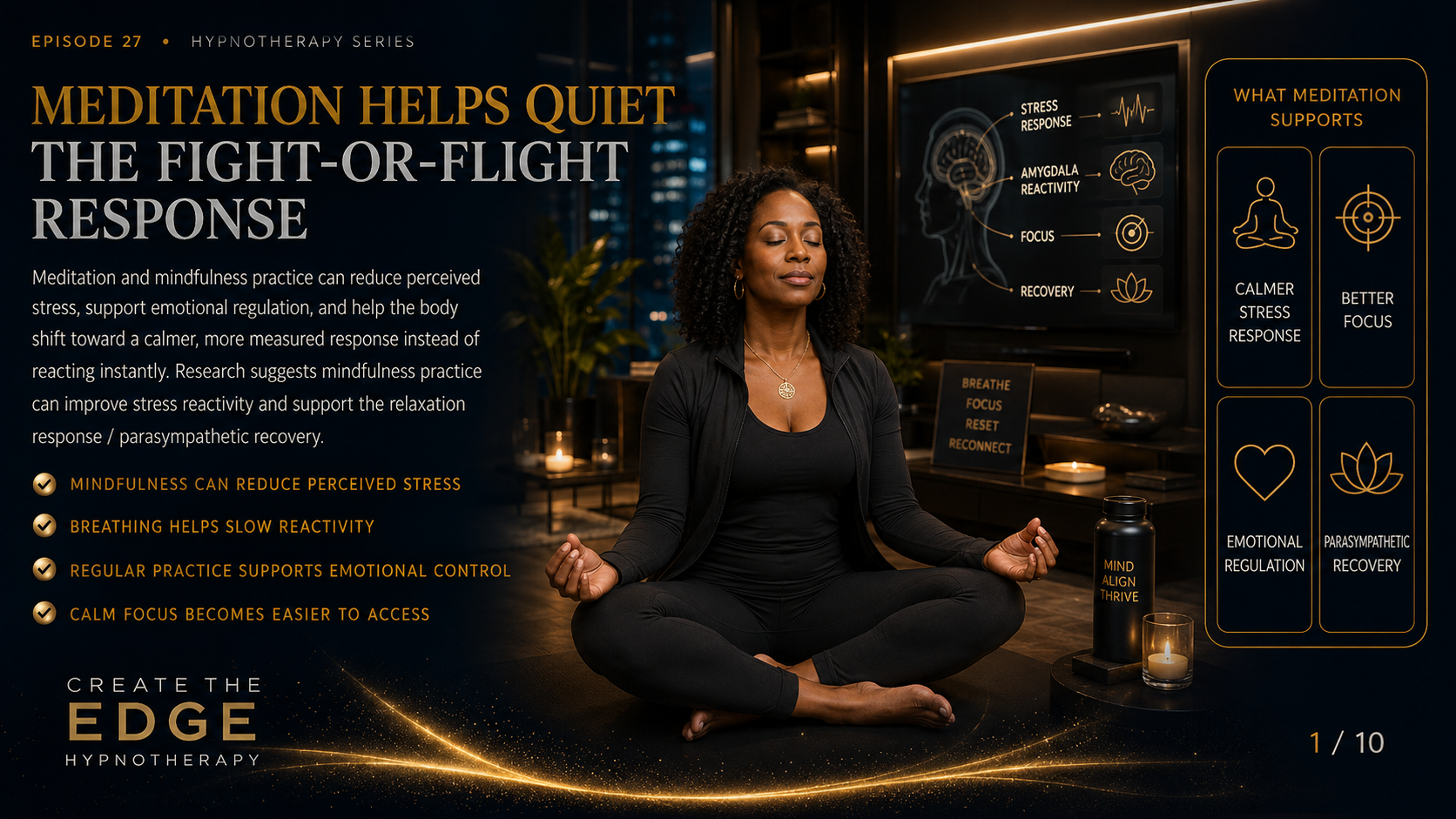
MEDITATION HELPS QUIET THE FIGHT-OR-FLIGHT RESPONSE
Meditation and mindfulness practice can reduce perceived stress, support emotional regulation, and help the body shift toward a calmer, more measured response instead of reacting instantly to every trigger.
Research supports what practitioners have long observed: regular mindfulness practice can improve stress reactivity and support the relaxation response, helping the parasympathetic nervous system recover more quickly after stress.
This episode explores the science and practice of meditation and yoga as tools for building a calmer inner baseline: not to avoid difficulty, but to meet it with more steadiness.
Reflect
1. What is your current relationship to meditation or mindfulness practice? Have you tried it?
2. Where in your day do you feel most reactive, most triggered, most in fight-or-flight?
3. What would it mean to have a reliable way to return to calm when stress arises?
4. What has stopped you from developing a consistent calming practice in the past?
5. What would a daily five-minute meditation practice realistically look and feel like for you?
Episode 27 · Slide 2Episode 27 · Slide 2 · focus gets stronger when the mind learns to return
Episode 27 · Slide 2
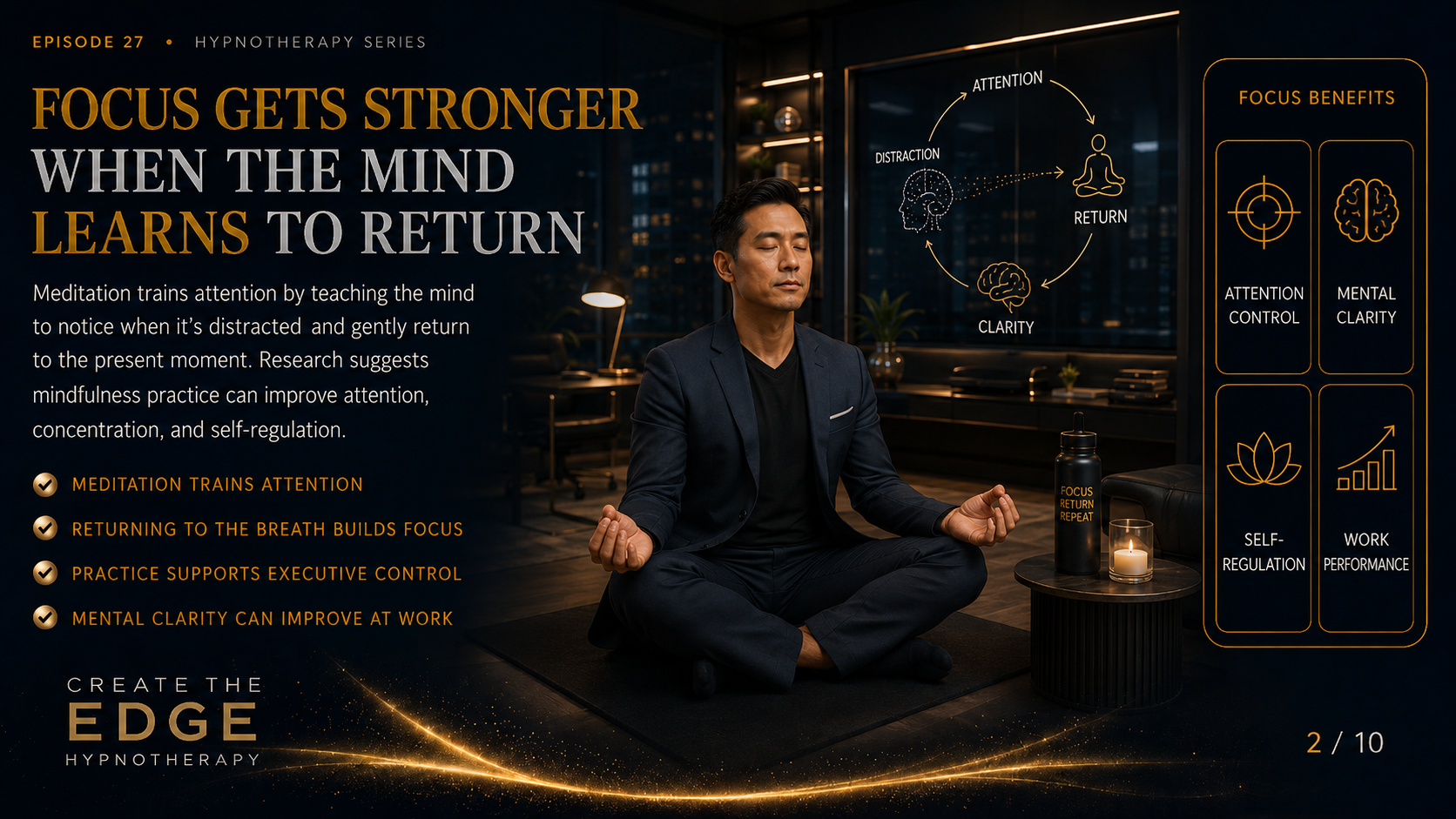
FOCUS GETS STRONGER WHEN THE MIND LEARNS TO RETURN
Meditation trains attention by teaching the mind to notice when it has wandered and gently return to the present moment. This seemingly simple act, noticing and returning, is at the core of what builds focus over time.
Research suggests that even brief, regular mindfulness practice can improve attention, concentration, and self-regulation. The mind, like the body, responds to consistent training.
What changes is not the presence of distraction, it will always be there, but your relationship to it. You develop the capacity to notice the drift without being swept away by it.
Reflect
1. How would you describe your current ability to focus? What most often pulls your attention away?
2. Have you ever experienced a state of deep, effortless focus? What were you doing?
3. What would stronger concentration make possible in your professional or personal life?
4. How might training your attention through meditation support other areas of self-improvement you are working on?
5. What is one simple way you could begin practicing returning your attention to the present moment today?
Episode 27 · Slide 3Episode 27 · Slide 3 · breath is the bridge between the mind and the body
Episode 27 · Slide 3
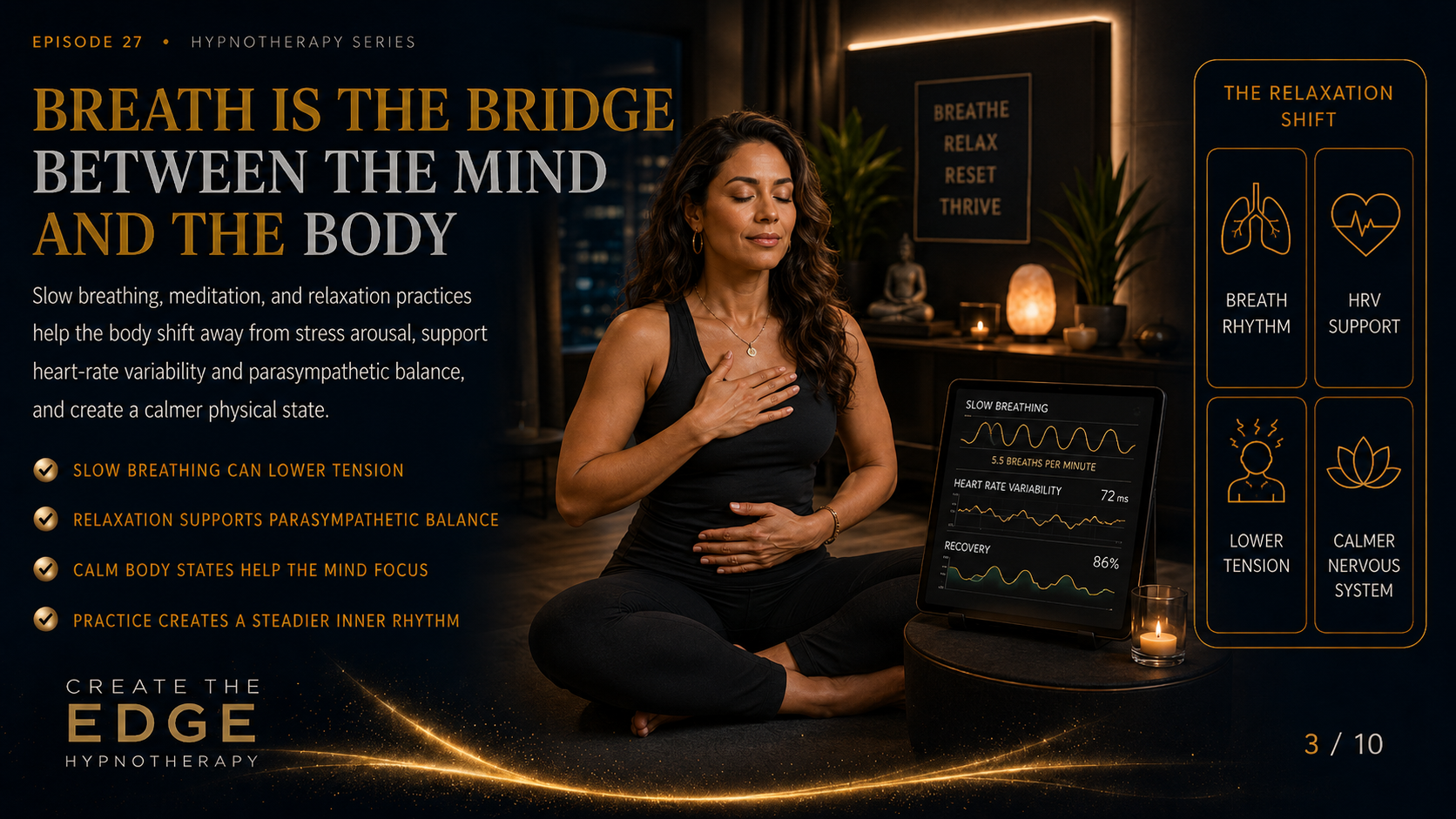
BREATH IS THE BRIDGE BETWEEN THE MIND AND THE BODY
Slow, deliberate breathing is one of the most direct ways to shift the nervous system from a state of arousal toward one of recovery. When you slow the breath, you slow the heart rate, reduce muscle tension, and create space between stimulus and response.
This is not a metaphor. The breath is the one bodily function that is both involuntary and voluntary: it runs on its own, but you can take conscious control of it at any moment. That makes it a uniquely accessible tool for self-regulation.
Five minutes of conscious slow breathing can meaningfully shift your physiological state. It does not require any equipment, any special location, or any particular skill level. It requires only your attention.
Reflect
1. When was the last time you paid deliberate attention to your breath? What did you notice?
2. What happens in your body when you take three slow, deep breaths right now?
3. In what situations do you most need access to your breath as a calming tool?
4. How might building a breathwork habit change your stress response over time?
5. What is one moment in your typical day where you could practice five conscious breaths?
Episode 27 · Slide 4Episode 27 · Slide 4 · yoga builds strength through slow, intentional movement
Episode 27 · Slide 4
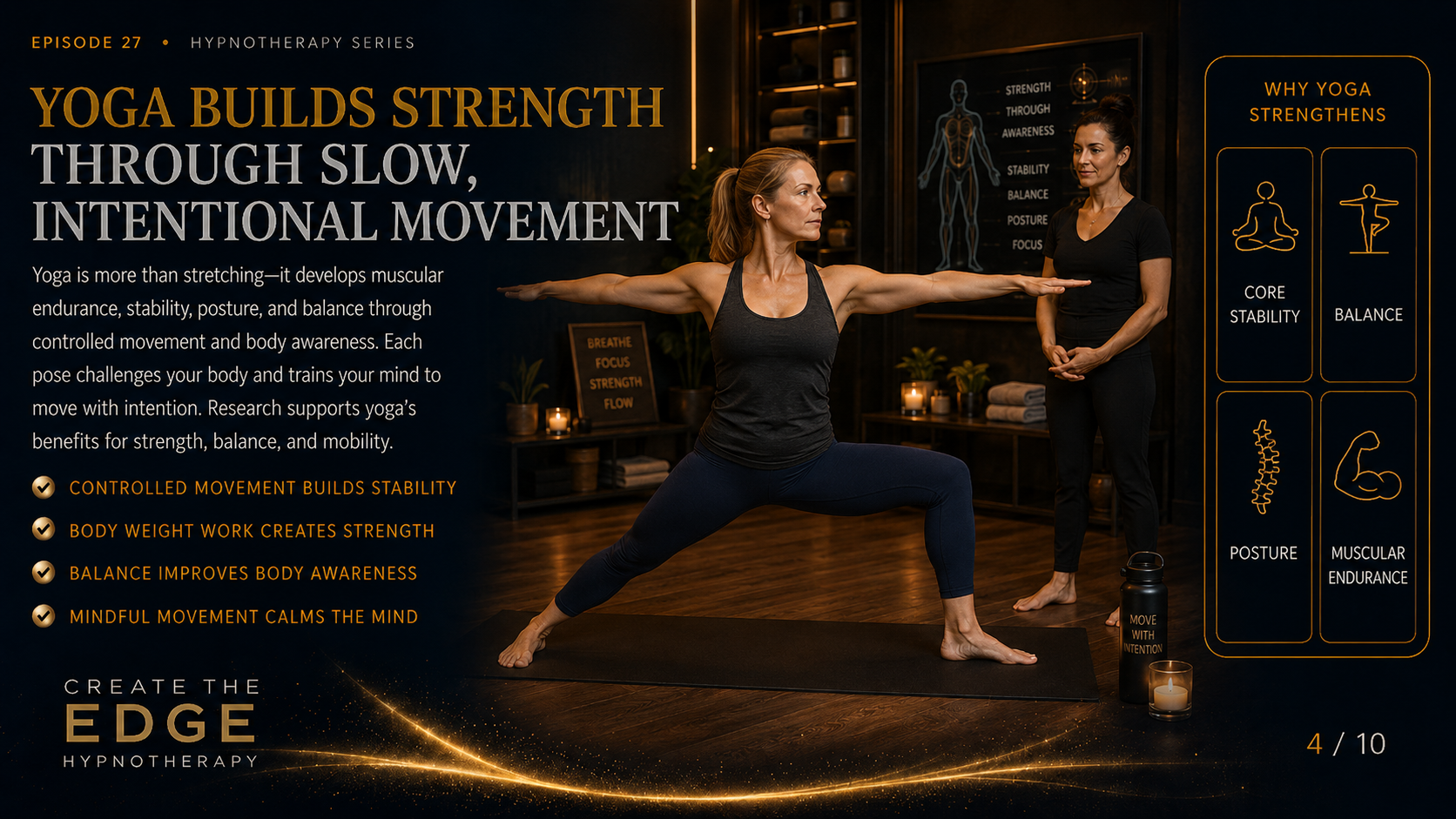
YOGA BUILDS STRENGTH THROUGH SLOW, INTENTIONAL MOVEMENT
Yoga is far more than stretching. It develops muscular endurance, core stability, balance, and postural awareness through controlled movement and sustained body attention. Each pose challenges the body while simultaneously training the mind to move with intention rather than force.
Research supports yoga's benefits for strength, balance, and mobility, particularly for people who are building or rebuilding their relationship with physical activity. The practice meets you where you are and invites you to grow steadily from there.
The integration of breath with movement is what makes yoga distinctly different from conventional exercise. The breath becomes the guide. The mind becomes an active participant rather than a bystander.
Reflect
1. Have you tried yoga before? What was your experience?
2. What appeals to you about movement that integrates breath and mindfulness?
3. What relationship do you currently have with physical activity? Is it joyful, obligatory, or absent?
4. How might a movement practice that is slow and intentional support your overall health goals differently than high-intensity exercise?
5. What would a yoga practice that genuinely worked for your life look like right now?
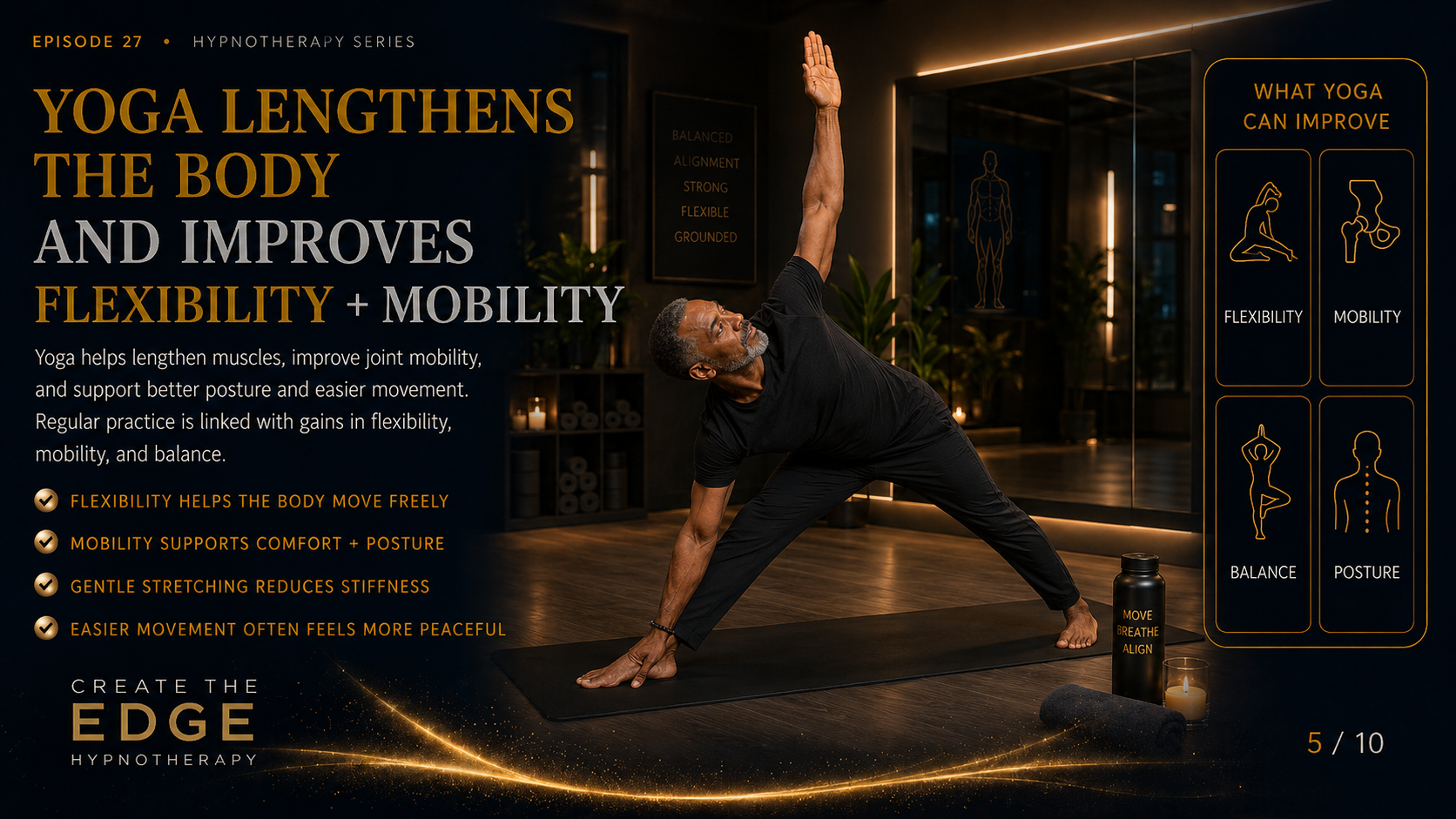
Episode 27 · Slide 5Episode 27 · Slide 5 · yoga lengthens the body and improves flexibility and mobilit
Episode 27 · Slide 5
YOGA LENGTHENS THE BODY AND IMPROVES FLEXIBILITY AND MOBILITY
Regular yoga practice is linked with meaningful gains in flexibility, joint mobility, and balance. For many people, particularly those who have spent years in sedentary patterns, the first weeks of gentle yoga reveal how much held tension the body was carrying without its owner's full awareness.
Improved flexibility is not just about touching your toes. It is about moving through life with less effort, less discomfort, and more physical ease. It is about being able to do the things you want to do, without your body being the limiting factor.
Easier movement often produces a quieter mind. When the body stops fighting itself, the nervous system follows.
Reflect
1. Where do you carry the most physical tension in your body? When did you last notice it?
2. How would greater flexibility and ease of movement change your daily experience?
3. What physical activities are currently limited by stiffness, pain, or lack of mobility?
4. How might regular gentle movement change your relationship to your body over three months?
5. What would it mean to feel genuinely at ease in your physical body, able to move freely and without apology?
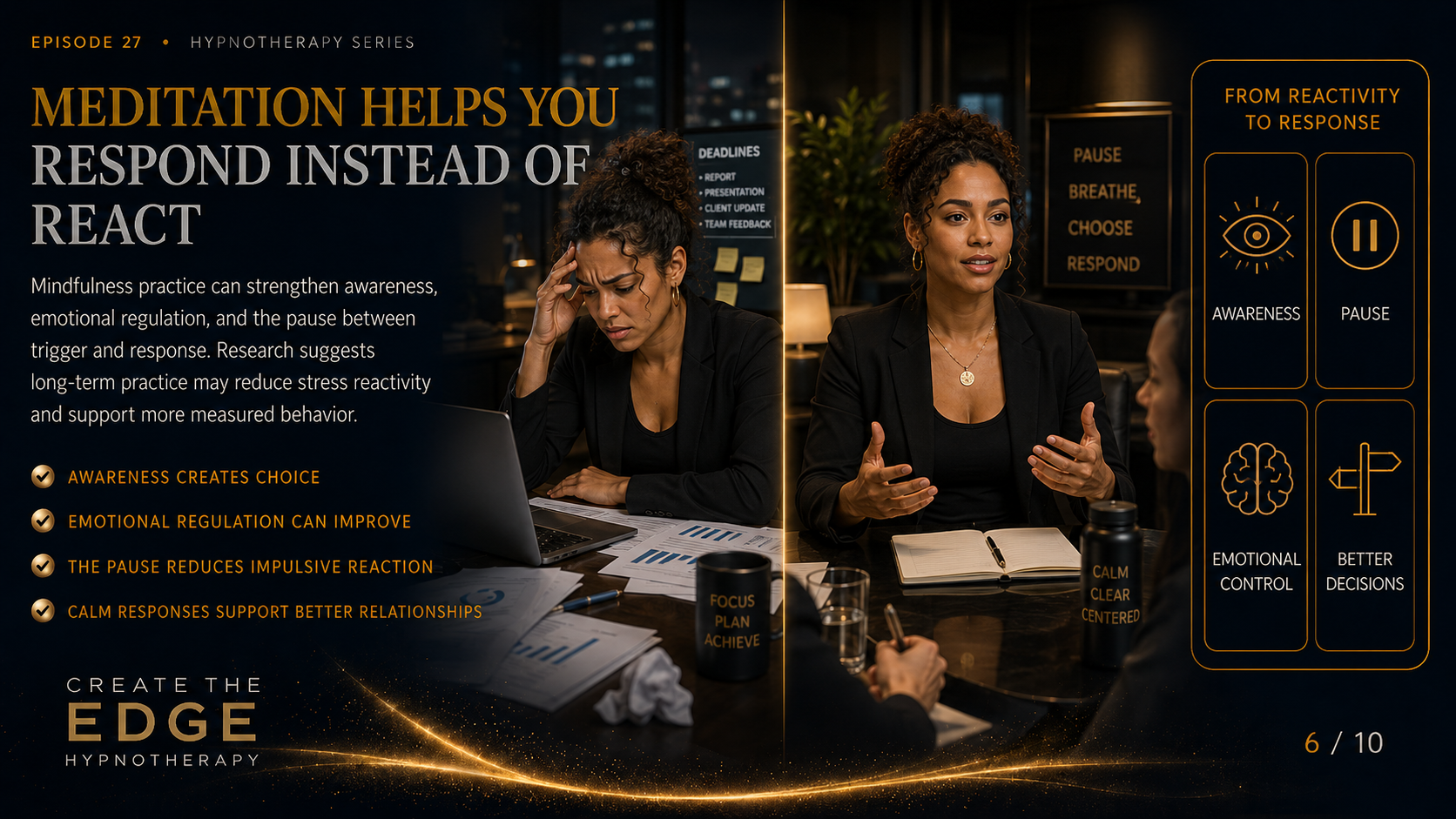
Episode 27 · Slide 6Episode 27 · Slide 6 · meditation helps you respond instead of react
Episode 27 · Slide 6
MEDITATION HELPS YOU RESPOND INSTEAD OF REACT
Mindfulness practice can strengthen the pause between trigger and response: that half-second of awareness that allows a choice rather than an automatic reaction. Over time, that pause grows. Reactions become responses. Impulses become decisions.
Research suggests that long-term practice reduces stress reactivity and supports more measured, considered behavior in daily life. This is not about becoming emotionally flat. It is about becoming more intentional.
The people around you benefit when you respond rather than react. Your health benefits. Your relationships benefit. And the quality of your own inner life improves when you are no longer being driven by every passing impulse.
Reflect
1. Think of a recent moment when you reacted in a way you later regretted. What would a response have looked like instead?
2. What trigger most reliably pulls you out of your most thoughtful self?
3. What does it feel like in your body in the moment just before a reactive choice?
4. How might a consistent meditation practice change your most challenging interpersonal dynamics?
5. What would your life look like if you consistently responded from your wisest self rather than your most reactive one?
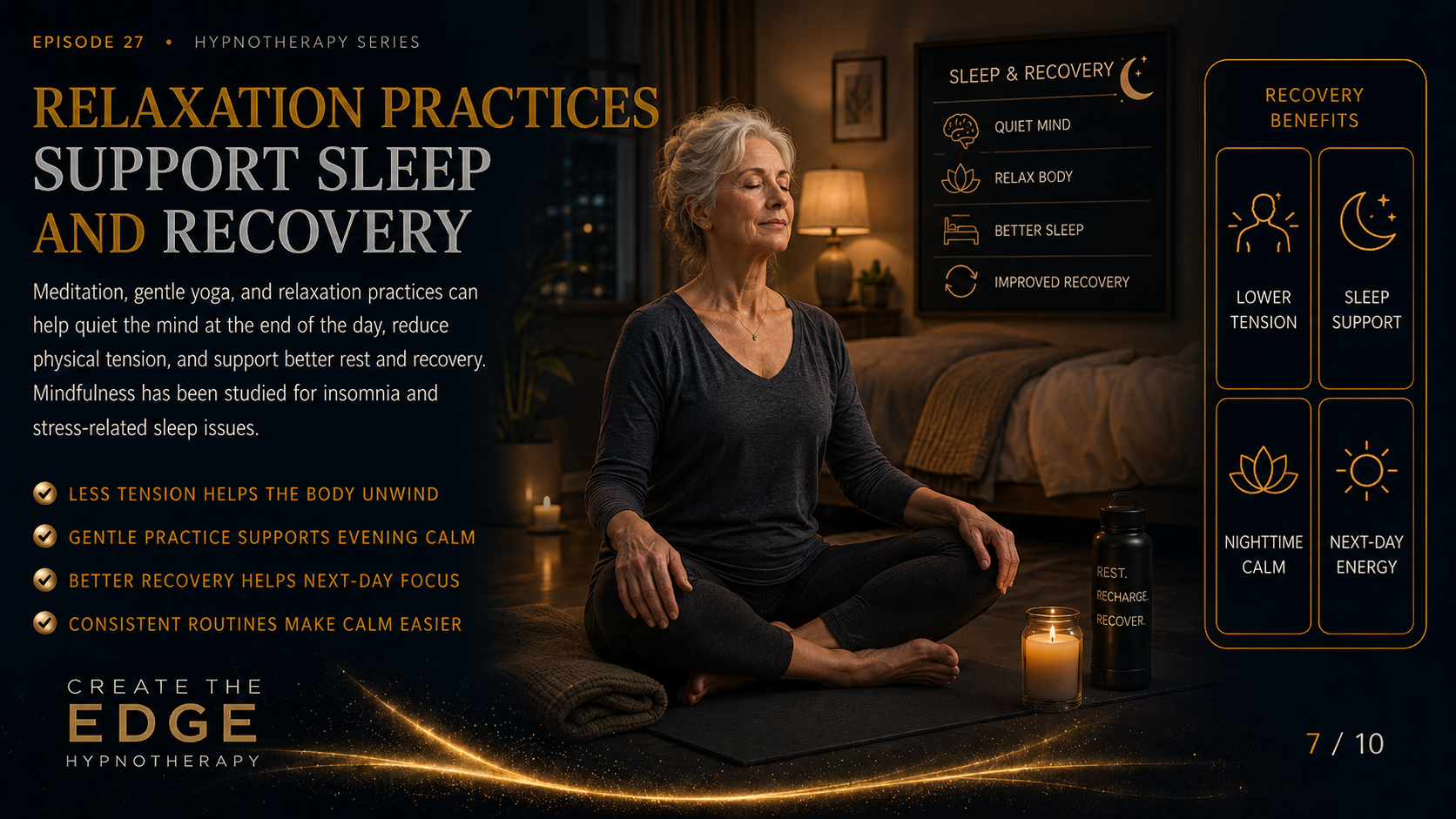
Episode 27 · Slide 7Episode 27 · Slide 7 · relaxation practices support sleep and recovery
Episode 27 · Slide 7
RELAXATION PRACTICES SUPPORT SLEEP AND RECOVERY
Meditation, gentle yoga, and breathwork before bed can quiet the nervous system, reduce physical tension, and support the kind of deep rest that allows genuine recovery. For many people, the inability to settle at night is one of the most significant barriers to overall wellbeing.
Mindfulness has been studied for its effects on insomnia and stress-related sleep disruption, with consistently encouraging results. Not as a replacement for medical care when that is needed, but as a meaningful supportive practice.
The quality of your sleep affects virtually everything: your mood, your food choices, your concentration, your emotional resilience, and your physical recovery. A practice that improves sleep is a practice that improves almost everything else.
Reflect
1. How is your sleep quality right now? What most often disrupts it?
2. What does your pre-sleep routine currently look like? Does it support rest or interfere with it?
3. Have you ever had a period of consistently good sleep? What was different about that time?
4. What calming practice, even five minutes before bed, might begin shifting your sleep quality?
5. How would consistently better sleep change your energy, your mood, and your choices during the day?
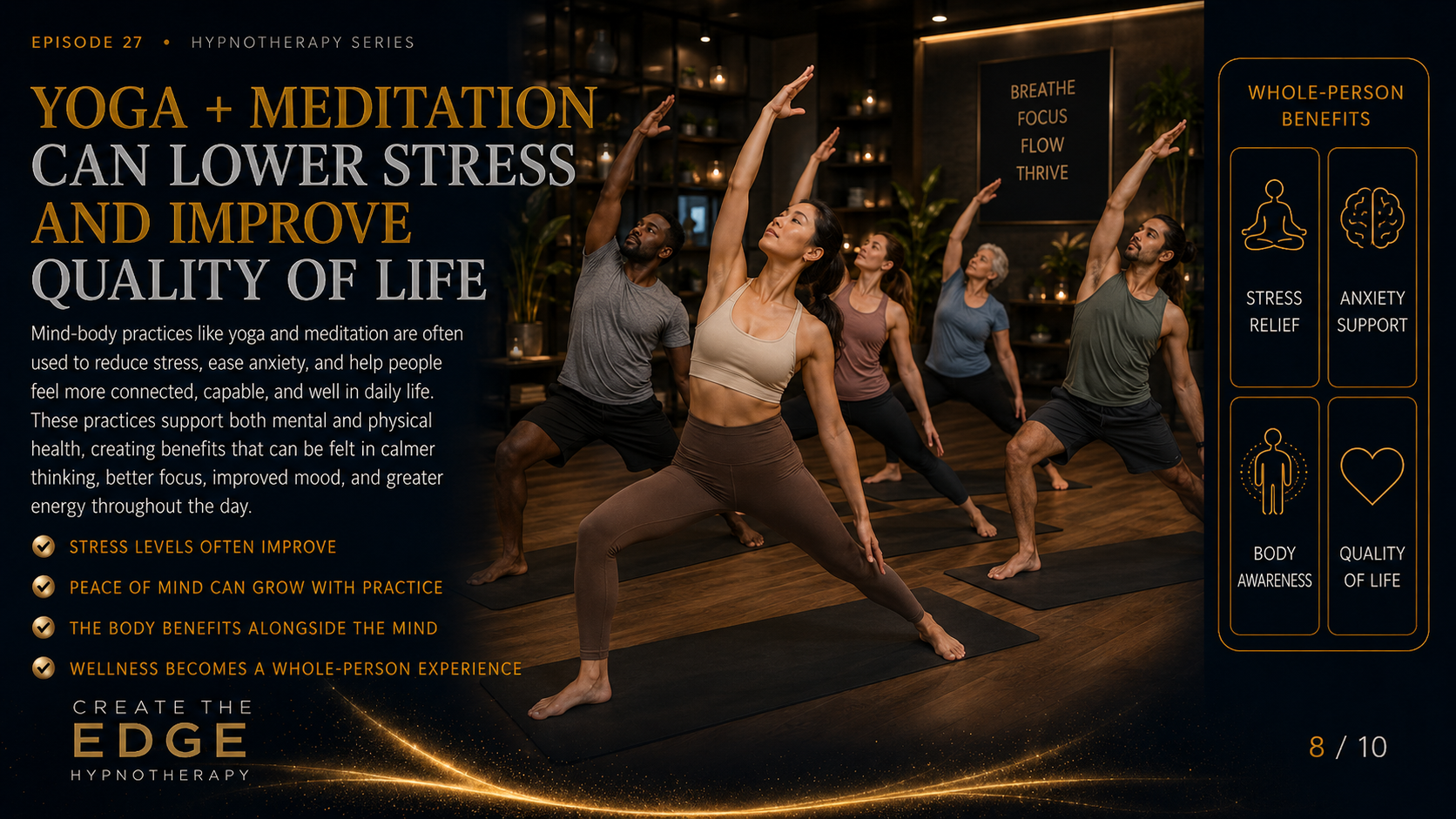
Episode 27 · Slide 8Episode 27 · Slide 8 · yoga and meditation can lower stress and improve quality of
Episode 27 · Slide 8
YOGA AND MEDITATION CAN LOWER STRESS AND IMPROVE QUALITY OF LIFE
Mind-body practices like yoga and meditation are among the most well-researched approaches to stress reduction and quality of life improvement. They work not by removing stress from life but by building the internal capacity to meet it without being overwhelmed.
People who practice consistently report improvements across multiple domains: better focus, lower anxiety, improved mood, more energy, deeper relationships, and a greater sense of meaning and presence in daily life.
These are not small things. And they are available to anyone willing to begin with whatever they have: five minutes, a breath, a single gentle stretch.
Reflect
1. What area of your quality of life do you most want to improve right now?
2. How connected do you feel to your own body on a typical day?
3. What would your life feel like if stress were something you could meet with more capacity and less fear?
4. What is one thing you could begin this week that would move you toward greater daily wellbeing?
5. How might a regular mind-body practice support every other goal you are working toward?
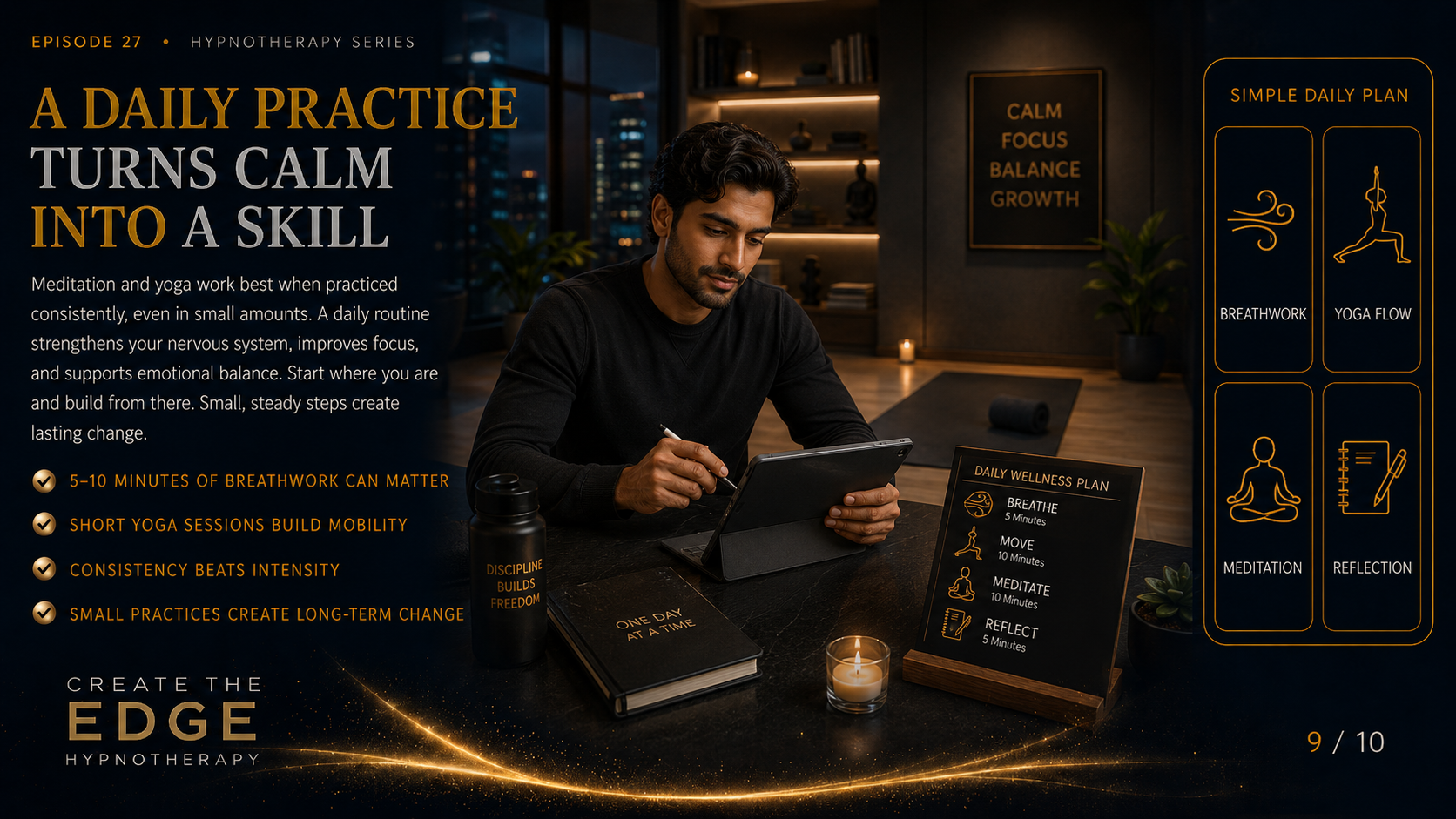
Episode 27 · Slide 9Episode 27 · Slide 9 · a daily practice turns calm into a skill
Episode 27 · Slide 9
A DAILY PRACTICE TURNS CALM INTO A SKILL
Calm is not a personality trait reserved for certain people. It is a skill, and like all skills it responds to practice. The nervous system that learns to return to calm repeatedly, in small moments throughout the day, becomes more resilient over time.
You do not need to meditate for an hour. You do not need a perfect practice. Five minutes of breathwork, ten minutes of gentle yoga, five minutes of quiet reflection: these small investments, made consistently, compound over time into something significant.
Start where you are. Use what you have. Do what you can. And trust that consistency beats intensity in this, as in almost everything else.
Reflect
1. What does a realistic daily practice look like for you right now, given your schedule and energy?
2. What time of day feels most natural for a brief meditation or movement practice?
3. What has gotten in the way of daily practice in the past? How might you address that obstacle differently?
4. What would it feel like to have a daily practice that is small enough to actually sustain?
5. How might committing to a seven-day practice this week change how you feel by the end of it?
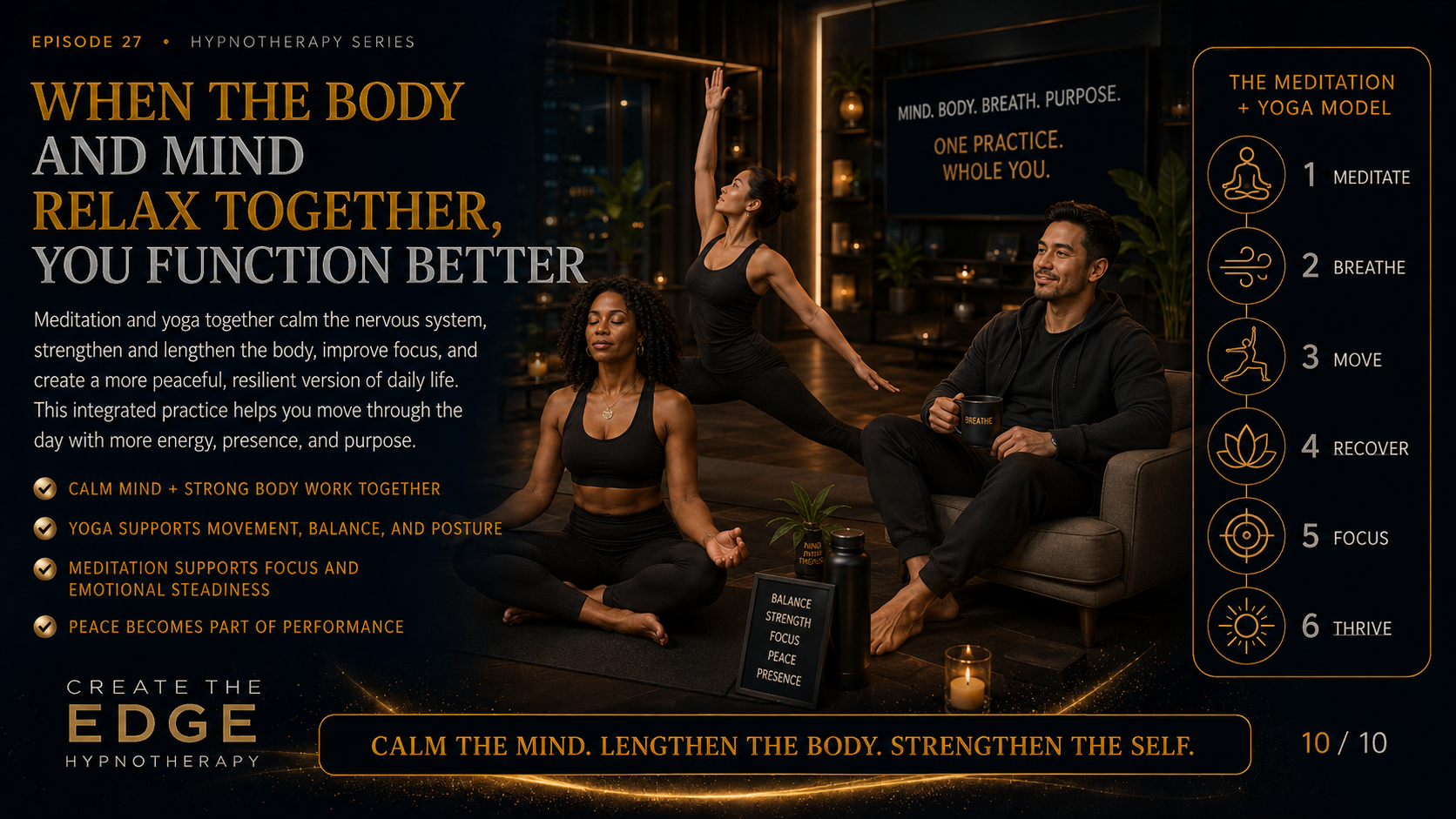
Episode 27 · Slide 10Episode 27 · Slide 10 · when the body and mind relax together, you function better
Episode 27 · Slide 10
WHEN THE BODY AND MIND RELAX TOGETHER, YOU FUNCTION BETTER
When meditation and yoga are woven together, they create a practice that is greater than the sum of its parts: calming the nervous system, strengthening and lengthening the body, sharpening focus, and building the kind of resilient daily presence that transforms how you experience everything.
This integrated practice does not require perfection. It requires only a genuine willingness to show up for yourself in small, consistent ways. That willingness, sustained over time, produces real results.
The next episode continues the journey into the specific types of hypnotherapy available, so you can find the approach that best fits where you are and what you most need right now.
Reflect
1. What does your ideal daily practice, combining body, breath, and mind, look and feel like?
2. What are you most committed to beginning or deepening as you complete this episode?
3. What has changed in how you understand your body's need for deliberate recovery?
4. How would a consistent mind-body practice change your relationship to the transformation you are working toward?
5. What will you do differently tomorrow because of what you have engaged with here?