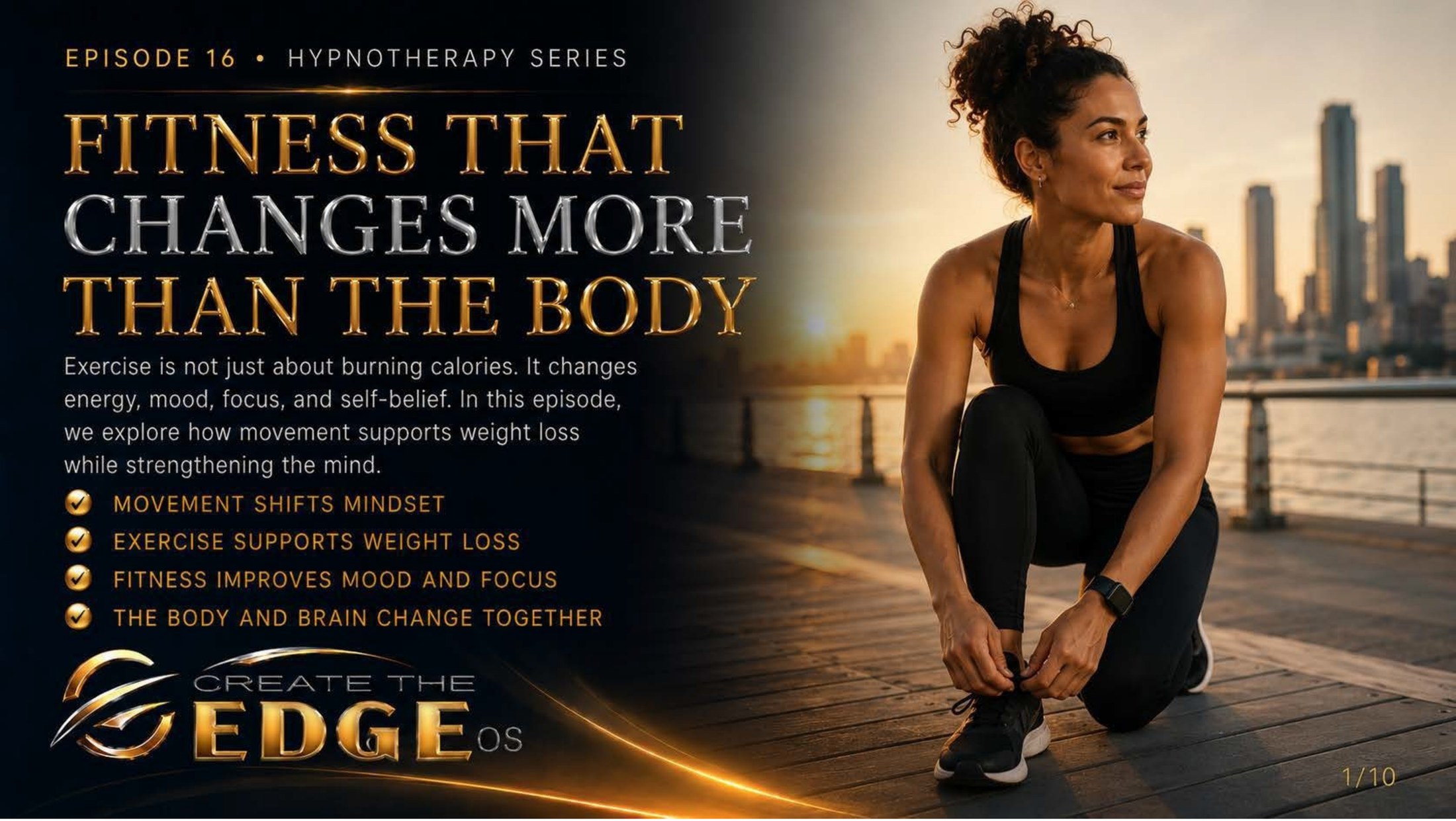
On the slideExercise is not just about physical change. It changes energy, mood, focus, and self-belief. How movement supports wellbeing while strengthening the mind: movement shifts mindset · fitness supports overall health · fitness improves mood and focus · the body and brain change together.
Episode 16 · Slide 1
Fitness That Changes More Than the Body
Look at her in this image — crouched on a pier at sunrise, lacing her shoes with the whole city glowing behind her. She isn’t braced for punishment. She isn’t performing obligation. Her face is lifted toward the light with an expression that belongs somewhere between anticipation and peace — the expression of someone who has found a relationship with movement that feels like something she’s giving herself rather than something she’s forcing herself through.
That distinction — giving versus forcing — is the entire chapter. Because most of us were handed a story about exercise very early on, and for many of us it wasn’t a kind story. It was a story about deficiency: about the body being not enough, needing correction, requiring discipline to be acceptable. Movement, in that story, was the tool of correction. The medicine for the sin of existing in the body you have.
And that story makes movement exhausting in a way that has nothing to do with physical exertion. It makes every skipped workout a moral failure. It makes every workout a transaction: I did this, so now I’ve earned that. It reduces the extraordinary, complex, joyful experience of a human body in motion to a bookkeeping exercise. And then people wonder why they can’t seem to maintain a consistent practice. It’s because nobody can sustain something they fundamentally experience as punishment.
This chapter is about something completely different. It’s about what actually happens when you move your body — to your brain chemistry, your mood, your nervous system, your sense of your own capability, your relationship with who you are. Not just the physical changes but the internal ones. The ones that happen in the conversation between your body and your mind when you give them the experience of moving together toward something, rather than away from something.
The four things the slide names are real and supported by genuine science: movement shifts mindset, fitness supports overall wellbeing, exercise improves mood and focus, and the body and brain change together. We’re going to follow each one through this chapter honestly, with curiosity and care. And by the end, I hope the woman lacing her shoes on the pier makes a different kind of sense to you. Not an aspirational image of someone else’s discipline. A glimpse of what it looks like when movement becomes something you actually want.
Take my hand. We’re going to find your version of that pier.
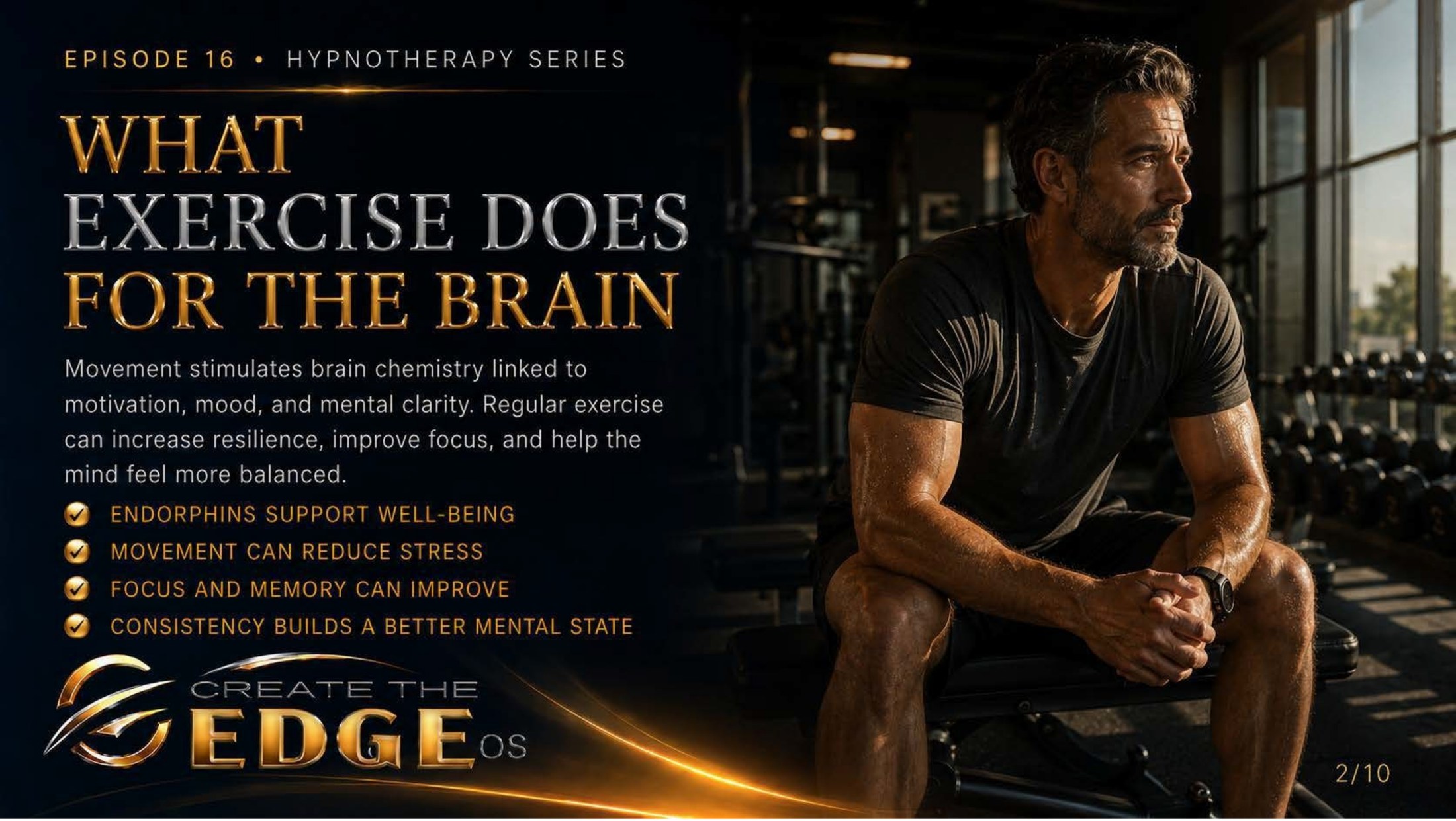
On the slideMovement stimulates brain chemistry linked to motivation, mood, and mental clarity. Regular exercise can increase resilience, improve focus, and help the mind feel more balanced: endorphins support wellbeing · movement can reduce stress · focus and memory can improve · consistency builds a better mental state.
Episode 16 · Slide 2
What Exercise Does for the Brain
Look at him in this gym, sitting in the particular stillness that comes after real physical effort — not collapsed, not depleted, but settled. The kind of settled that doesn’t come from sitting quietly and trying to feel better. It comes from having moved, from having given the body what it’s been waiting for, from having literally changed the chemistry of your brain through the act of movement.
Because that’s what exercise actually does, and it’s worth understanding at this level: it changes your brain chemistry. Endorphins — the neurotransmitters most commonly associated with the “runner’s high” — are only part of the story. Exercise also increases dopamine, serotonin, and norepinephrine: the brain chemicals most linked to motivation, mood regulation, and the feeling that life is worth showing up for. When you move, you’re not just exercising your muscles. You’re literally medicating your brain with the most natural pharmacy available.
The stress reduction piece is one I want to stay with for a moment, because for many people this is the most immediately useful benefit. Stress lives in the body as physical tension — in the shoulders, the jaw, the chest, the belly. It is physiological, not just psychological. And movement — real movement, the kind that works the muscles and elevates the heart rate and makes you breathe — discharges that physiological tension in a way that thinking about it simply cannot. You cannot think your way out of stress that lives in your body. But you can move your way through it.
Focus and memory improvements from regular exercise are now well-documented. Exercise increases blood flow to the prefrontal cortex — the part of the brain responsible for decision-making, attention, and executive function. It literally improves the organ you use to make the choices you care about. When people say they think more clearly after a workout, they’re not imagining it. They’re experiencing a real neurological shift.
And consistency builds a better mental state. Not one dramatic workout that transforms everything, but the steady, accumulated effect of regular movement over time. Each session adds to a neurological baseline. Over weeks and months, the brain that moves regularly begins to function differently — more resilient, more balanced, more naturally inclined toward the things that support it. The payoff compounds.
Take my hand. We’re not talking about the body. We’re talking about the mind. And the most efficient way to take care of the mind, it turns out, is to take care of the body it lives in.
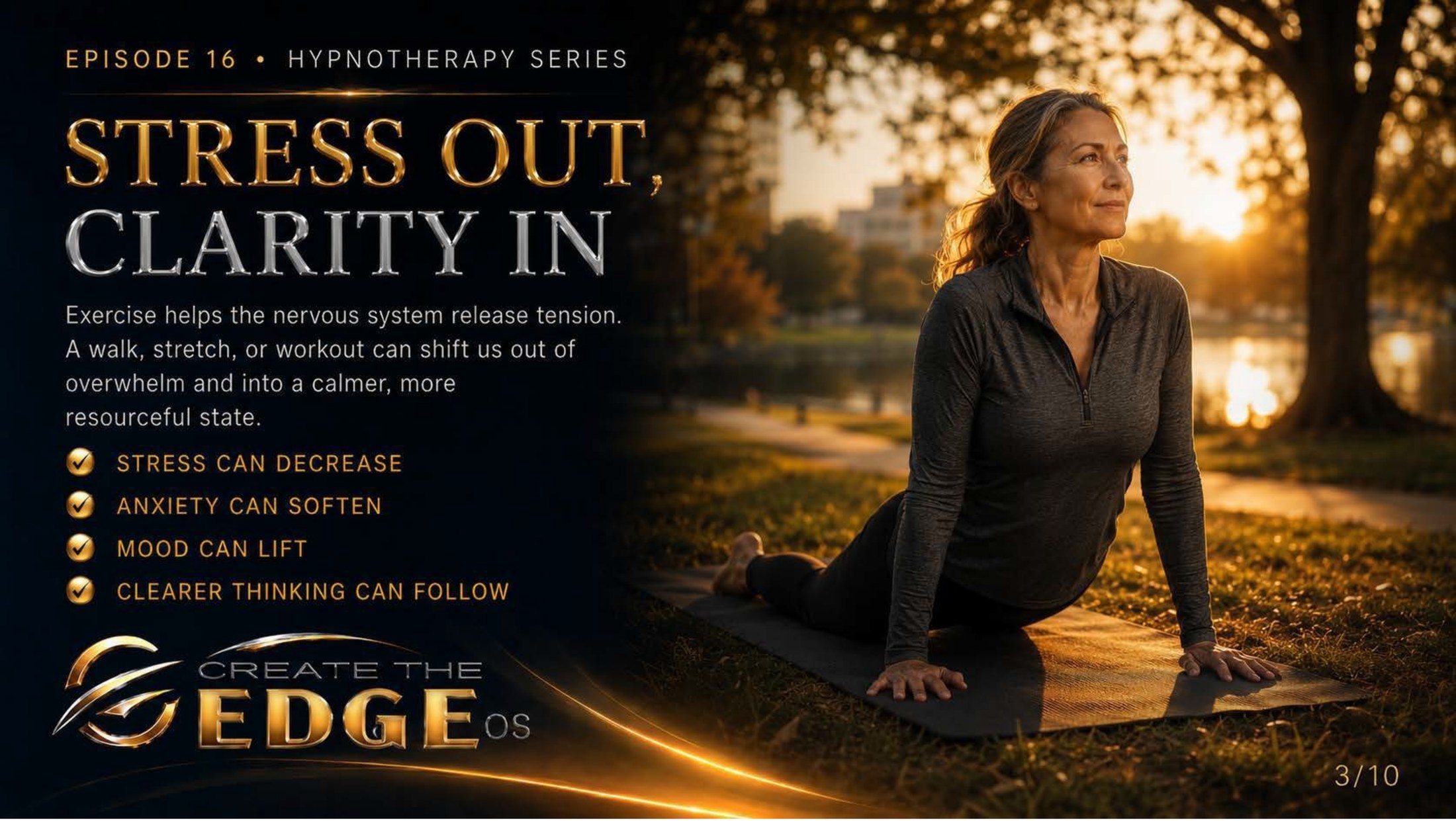
On the slideExercise helps the nervous system release tension. A walk, stretch, or workout can shift us out of overwhelm and into a calmer, more resourceful state: stress can decrease · anxiety can soften · mood can lift · clearer thinking can follow.
Episode 16 · Slide 3
Stress Out, Clarity In
Here she is in the golden light of late afternoon, moving through a yoga stretch in a park, the whole image carrying that particular quality of a person who has given themselves permission to let the day’s tension go. Not suppressed it. Not thought their way past it. Let it go — through the body, the way tension has to leave. Through movement.
Anxiety is a nervous system state. This is important to understand, because we often treat anxiety as though it’s a thought problem — something to be reasoned with, analyzed, resolved through the right internal conversation. And while the mind’s content certainly matters, the nervous system’s state is physiological. When anxiety has your body in its grip — tight chest, racing heart, shallow breath, muscles braced for something that isn’t coming — you can’t think your way out of that grip. You have to move your way through it.
This is one of the oldest understandings in human experience, long predating any formal science: when you’re agitated or overwhelmed, you move. You walk it off. You work it out. You run until your legs are tired and your thoughts are quieter. The nervous system knows how to discharge what it’s holding. Movement is one of the most reliable ways to give it permission to do so.
The sequence the slide describes is not aspirational — it’s physiological: stress decreases as the body moves and cortisol levels begin to fall. Anxiety softens as the nervous system shifts from sympathetic activation toward parasympathetic regulation. Mood lifts as brain chemistry changes in the ways we discussed on the last slide. And clearer thinking follows, almost inevitably, once the fog of a dysregulated nervous system begins to clear.
I want to say something practical about this: you don’t have to do a lot of movement for this to work. A twenty-minute walk changes your nervous system. A short yoga flow changes your nervous system. Dancing in your kitchen changes your nervous system. The body doesn’t require heroic effort to begin releasing what it’s been holding. It requires consistent, patient, genuinely kind invitations to move.
Take my hand. The next time you feel the weight of a difficult day settling into your body, remember: you don’t have to sit with it. You can move through it. Not away from it — through it. There’s a difference, and your body already knows the way.
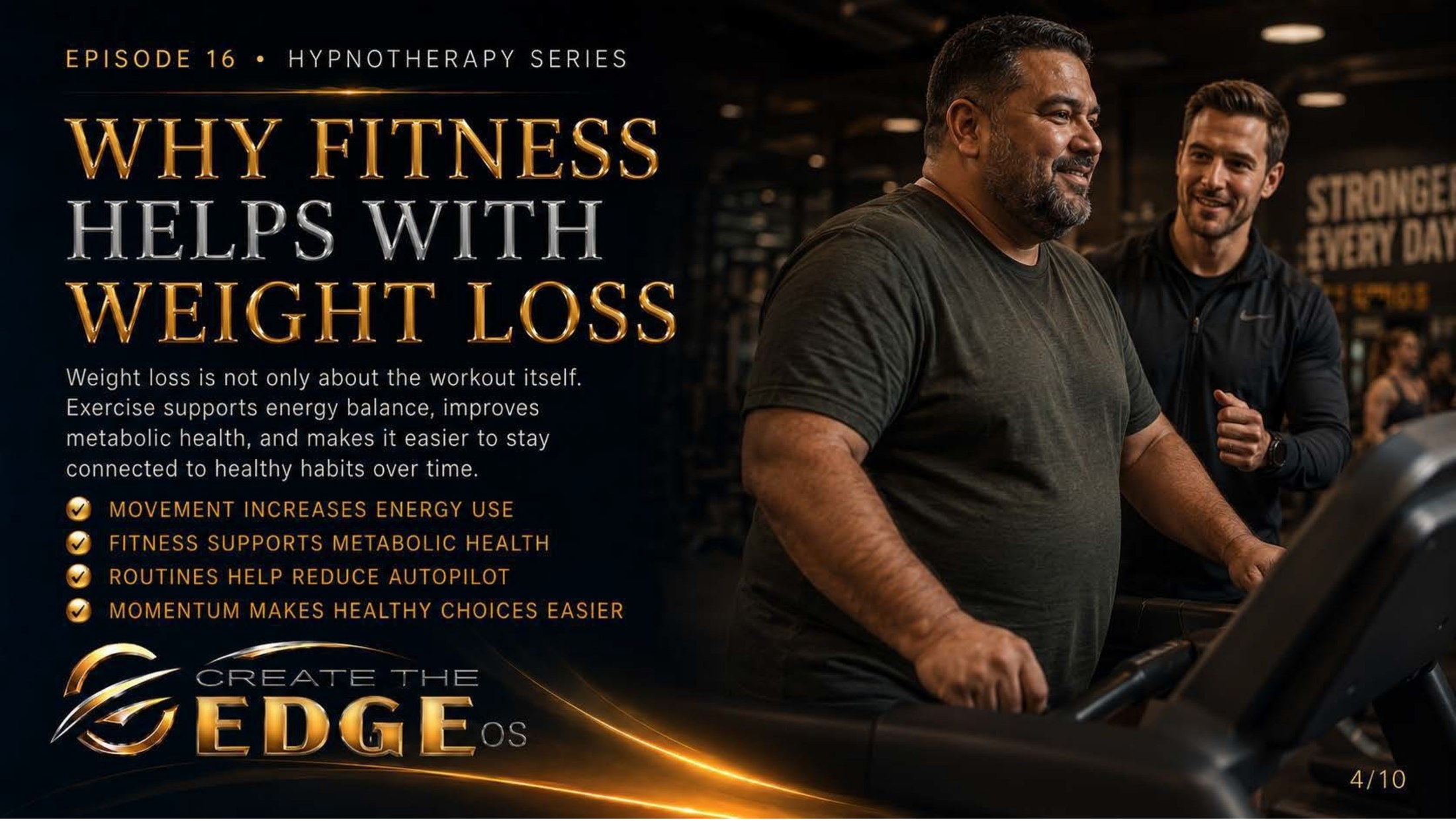
On the slideExercise supports energy balance, metabolic health, and makes it easier to stay connected to healthy habits over time. The connection runs deeper than the workout itself: movement supports energy use · fitness supports metabolic health · routines help reduce autopilot · momentum makes supportive choices easier.
Episode 16 · Slide 4
Why Fitness Supports Overall Wellbeing
Look at them — two people on treadmills, one of them with a coach alongside him, the whole image radiating the particular energy of showing up. Not crushing it. Not performing for anyone. Just showing up, one step at a time, with support. That’s the scene this slide is really about: the showing up, not the dramatic result.
The relationship between regular movement and overall wellbeing is real and worth understanding clearly. When you move your body consistently, your metabolism — the system by which your body converts energy — functions more efficiently. This isn’t about burning more calories or shrinking faster. It’s about your body operating the way it was designed to operate: with regular physical demand that keeps its systems running well. Like a car that runs better when it’s driven.
The momentum piece is something I find genuinely fascinating. Regular movement doesn’t just affect the body directly — it affects the choices that follow. People who move regularly tend to sleep better, which affects mood and decision-making the next day. They tend to feel more physically alive, which makes nourishing themselves feel more natural. They tend to have more energy, which makes the next workout feel more accessible. The choices compound, not because of willpower but because the momentum of caring for yourself creates more occasions to care for yourself.
Routines help reduce autopilot in a specific and valuable way: when movement is a consistent part of your week, it stops being a decision you have to make each time. It becomes what you do. And the cognitive load of making that decision — should I go? do I feel like it? maybe tomorrow? — dissolves when the routine is established enough that going is simply what happens on Tuesday mornings. The routine does the deciding. You just follow it.
And the coach in this image is worth noticing. Support accelerates everything. The person who has someone alongside them — whether a coach, a friend, a class, a community — is not weaker for needing that. They’re wiser. Human beings are designed to move together, and having someone with you makes both the showing up and the staying easier.
We don’t fail, we fall forward. If the relationship with movement has been complicated — inconsistent, shame-laden, all-or-nothing — today is just the next place to begin. Not the last place that failed, but the next place to try. Take my hand. Let’s go.
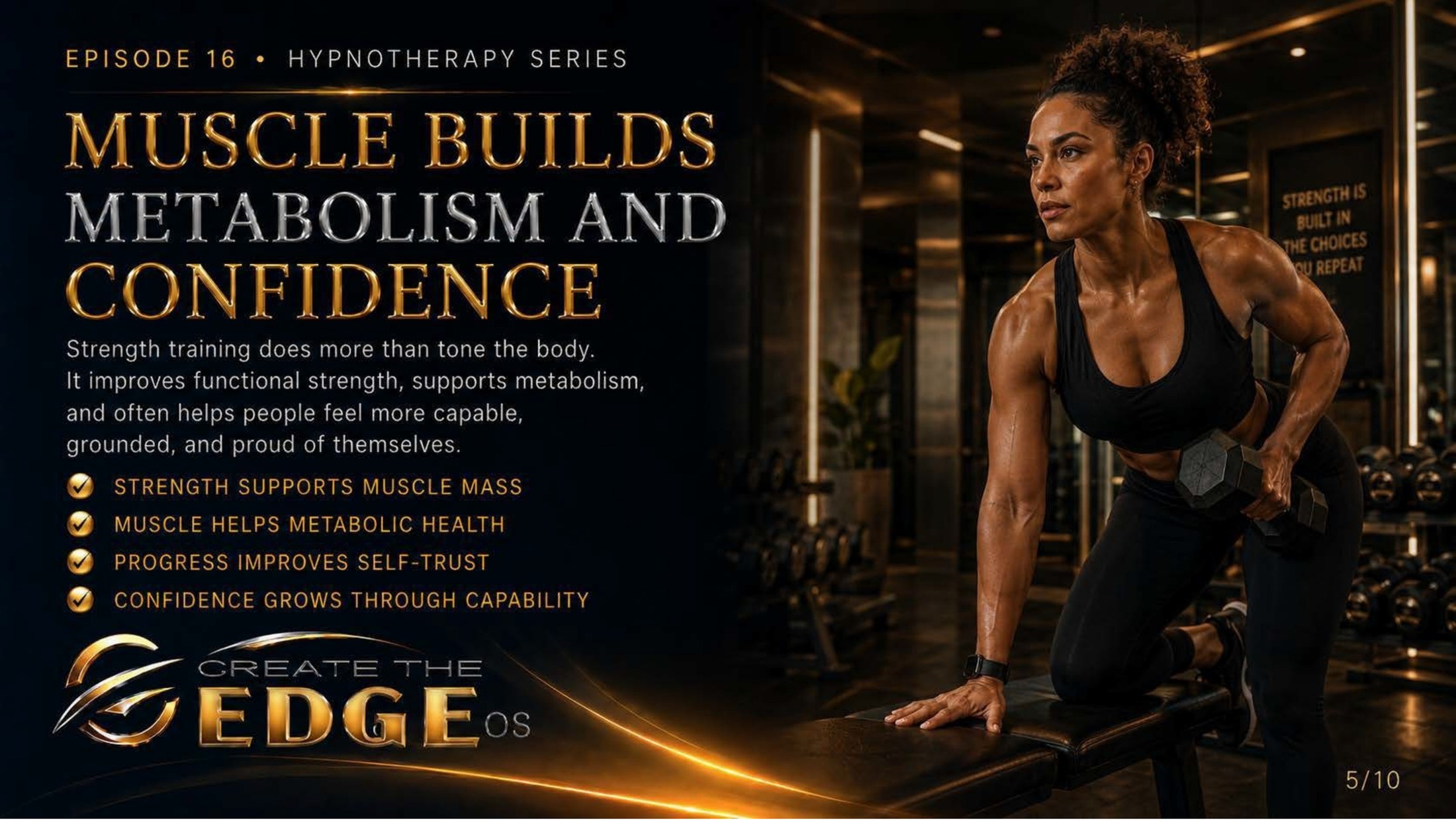
On the slideStrength training does more than change the body. It improves functional strength, supports metabolic health, and often helps people feel more capable, grounded, and proud of themselves: strength supports muscle · muscle helps metabolic health · progress improves self-trust · confidence grows through capability.
Episode 16 · Slide 5
Muscle Builds Metabolism and Confidence
Look at her — strong and focused in that gym, moving with the kind of deliberate intensity that belongs to someone who has found something they’re genuinely building. Behind her on the wall: strength is built in the choices you repeat. Not the choices you make once and feel good about. The ones you repeat. The ones that become, over time, who you are.
Strength training has a reputation that sometimes keeps people from it — the idea that it’s for a particular type of person, or that it requires a particular kind of body to begin, or that the goal is a particular kind of result. None of that is true. Strength training is for anyone with muscles, which is everyone, and the changes it produces run far deeper than the visible ones.
The confidence piece is the one I want to stay with, because it’s the one that changes everything else. When you train consistently and begin to notice that you can do things you couldn’t do before — lift more, hold longer, recover faster — something happens in your relationship with your body that is qualitatively different from any external change. You start to trust it. Not as an aesthetic object to be managed but as a capable, developing, surprising system that responds to what you ask of it.
Progress improves self-trust. This is such an important phrase. Self-trust around the body is something many of us have lost — through histories of pushing past limits, through years of treating the body as an adversary, through the accumulated experience of promising to exercise and then not following through. Strength training offers a specific, measurable, undeniable form of progress. You can lift this weight today that you couldn’t lift three months ago. That fact is real. And real, verifiable progress builds real trust in a way that aesthetic goals alone rarely can.
Confidence grows through capability. Not through how you look, not through what the scale says, not through external validation, but through the direct experience of your body becoming more capable over time. That confidence doesn’t stay in the gym. It walks with you. It sits at your desk. It speaks up in meetings. It makes different choices under pressure. The body’s growing confidence becomes the self’s growing confidence.
Take my hand. You don’t have to start strong. You just have to start. The strength comes from the choices you repeat, and the first choice to repeat is simply showing up.

On the slideWalking, cycling, and other forms of cardio can improve endurance, circulation, and mental energy. They also help many people feel more emotionally steady and alive: cardio supports heart health · endurance can increase · energy often improves · movement can lift your mood.
Episode 16 · Slide 6
Cardio Supports Heart, Energy, and Mood
Look at him moving through the golden evening light along the waterfront, his pace easy and purposeful, the whole image carrying that specific energy of a person who has made movement a natural part of how they move through the world. Not a special event. Not a performance. Just — how he goes. That ease is built. It used to take effort. Now it’s simply what he does, and the doing of it returns something to him that sitting still cannot.
Cardiovascular exercise — walking, cycling, swimming, dancing, any sustained movement that elevates the heart rate — has such a broad range of benefits that it’s almost impossible to summarize without underselling it. Heart health is the obvious one: the heart is a muscle, and like all muscles it responds to regular demand by becoming stronger, more efficient, more capable. A stronger heart does its job with less effort. That efficiency expresses itself as more energy throughout the day.
But the mood piece is what I want to emphasize most here, because it’s the most immediately and reliably felt. People who exercise regularly consistently report feeling more emotionally steady than people who don’t. Not happier in a simple, uncomplicated way — but more resilient. Better able to absorb difficulty without being overwhelmed by it. Quicker to return to baseline after a hard moment. The clinical literature supports this strongly: regular aerobic exercise is one of the most effective interventions known for mood, anxiety, and emotional regulation.
And there’s something specific about moving through space — particularly outdoors, particularly at a pace that allows you to notice what’s around you — that has a quality of perspective-giving that other forms of movement don’t quite replicate. The problems that felt enormous at your desk can look different on a walk. The body’s movement through space seems to help the mind process what it’s been stuck in. There’s a reason walking has been a thinking practice for philosophers across millennia. The body moving helps the mind move.
Energy often improves with regular cardio — not immediately, not in the first tired weeks, but over time. The counterintuitive truth of a consistent movement practice is that it generates the energy it seems to consume. The body that moves regularly becomes more efficient at producing and managing energy. The fatigue that exercise initially costs pays itself back with interest.
Take my hand. You don’t have to run. You just have to move. At whatever pace, in whatever form, for whatever duration you can genuinely sustain today. The body will meet you where you are and, given time and consistency, will gradually take you further.
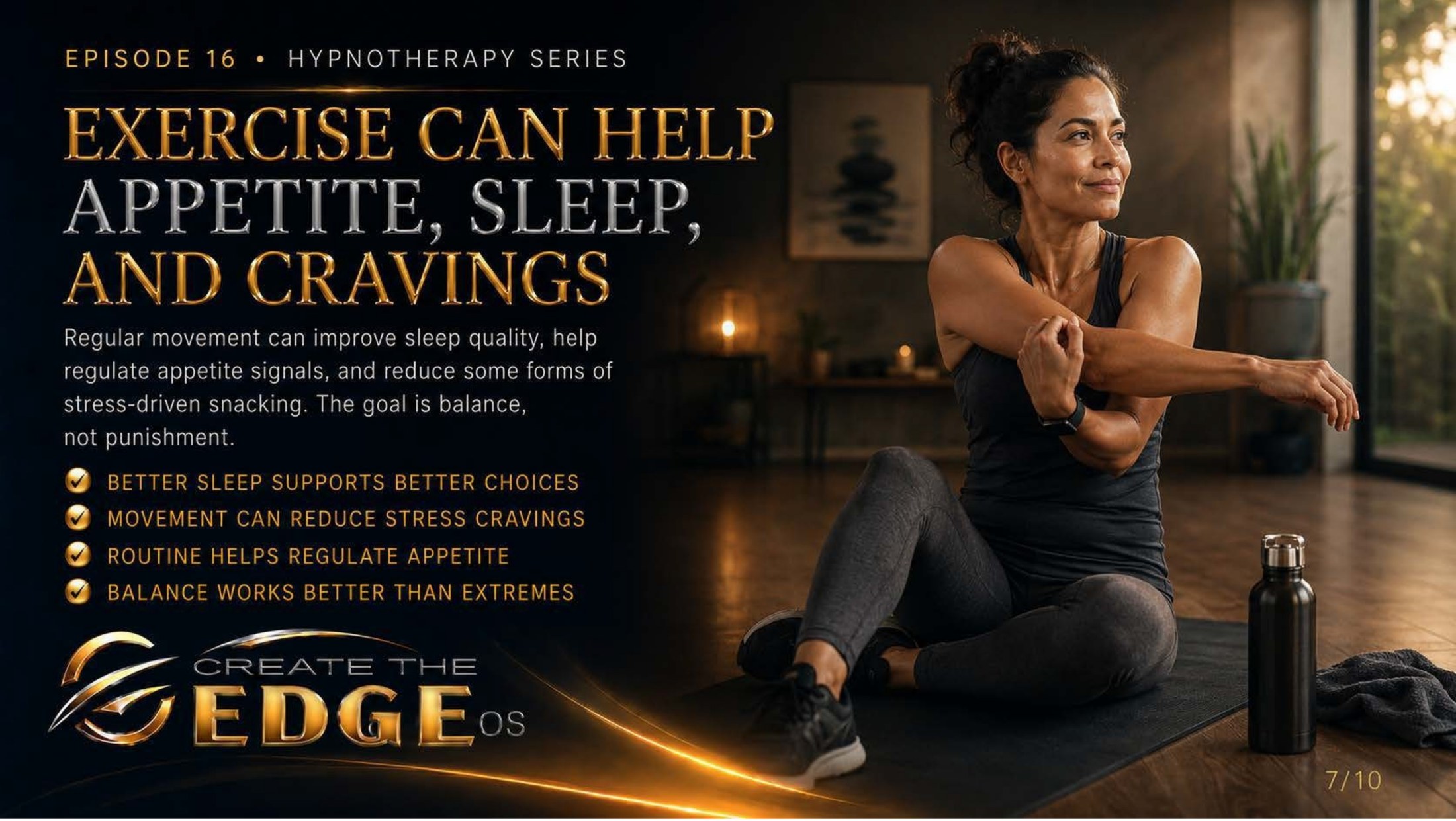
On the slideRegular movement can improve sleep quality, help regulate appetite signals, and reduce some forms of stress-driven reactivity. The goal is balance, not punishment: better sleep supports wellbeing · movement can reduce stress reactivity · routine helps regulate many body systems · balance works better than extremes.
Episode 16 · Slide 7
Exercise Can Help Appetite, Sleep, and Stress
Here she is, stretching in a warm, quiet room, the mood of the image entirely different from the high-energy gym scenes earlier in this chapter. This is the gentler side of fitness — the movement that isn’t about performance or intensity but about care. Maintenance. The daily practice of keeping the body well. And this kind of movement, it turns out, does some of the most important work of all.
Sleep is foundational to almost everything we’ve talked about in this book: mood regulation, self-trust, emotional resilience, the capacity to make choices from a resourced place rather than a depleted one. And regular exercise is one of the most consistently reliable ways to improve sleep quality. Not quantity necessarily, but quality — the depth and restfulness of sleep, the ability to actually restore rather than just lying down for hours.
The appetite regulation piece is worth naming carefully and honestly. Regular movement can help the body’s hunger and fullness signals function more clearly — not because exercise controls you, but because a body that moves regularly tends to be more attuned to its own signals. This is about listening to the body more accurately, not overriding it. There’s a meaningful difference between the two, and this chapter is firmly on the side of listening.
I want to be particularly clear about the slide’s most important framing: the goal is balance, not punishment. Exercise that comes from a punishing relationship with the body — the kind driven by shame, by “making up for” yesterday, by the belief that you owe your body something — doesn’t produce the benefits we’ve been talking about. It produces a different kind of stress. The body knows the difference between being moved with love and being driven with a whip. The nervous system responds accordingly.
Balance works better than extremes. This applies to intensity, to frequency, to the expectations we bring to a movement practice. The person who moves consistently at a sustainable pace, in a form they genuinely find pleasurable or at least genuinely tolerable, for a duration they can maintain over time, will experience dramatically more benefit than the person who swings between extreme effort and complete avoidance. Sustainability is everything. And sustainability requires kindness.
Take my hand. Whatever the relationship with movement has been, today we begin with balance and gentleness and the honest acknowledgment that any movement offered from a place of care is good movement. Let’s build from there.
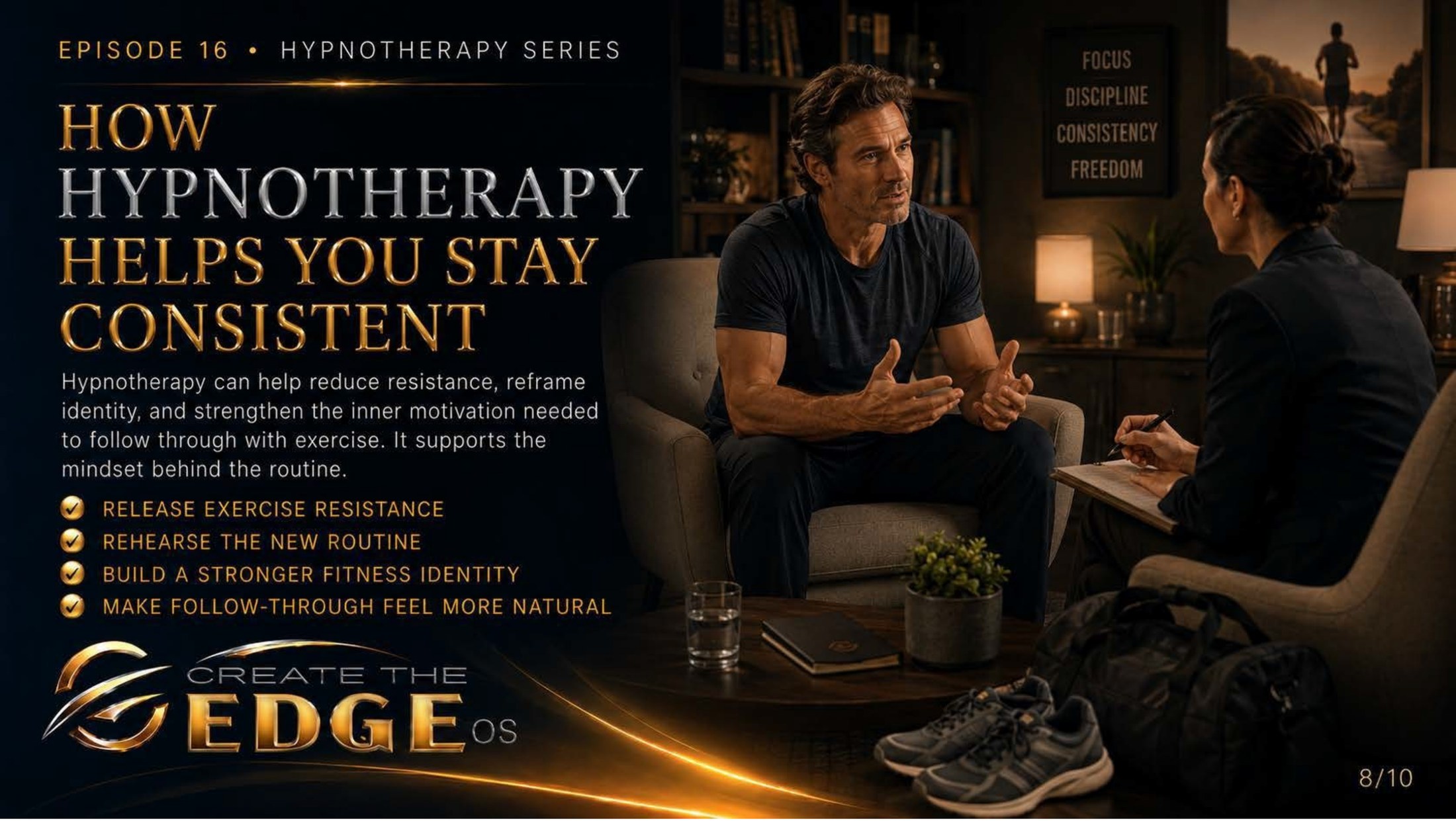
On the slideHypnotherapy can help reduce resistance, reframe fitness identity, and strengthen the inner motivation needed to follow through with exercise. It supports the mindset behind the routine: release exercise resistance · rehearse the new routine · build a stronger fitness identity · make follow-through feel more natural.
Episode 16 · Slide 8
How Hypnotherapy Helps You Stay Consistent
Look at this image — two people in deep conversation, the man leaning forward with the particular openness of someone working something out at a level below the surface. Behind him on the wall: focus. discipline. consistency. freedom. And at his feet: running shoes. The shoes are there. The conversation is about what’s stopping him from putting them on.
Because here is the honest truth about exercise resistance: it rarely lives where people think it does. It’s not laziness. It’s not lack of information. It’s not even lack of desire — most people who struggle to maintain a movement practice genuinely want to move more. The resistance lives in the subconscious, in old associations and beliefs formed long before the conscious mind was keeping track.
Maybe movement was always connected to punishment in your history — exercise assigned as a response to something you ate, or fitness used as a tool of control or shame. Maybe gym environments carry associations with judgment or comparison or failure. Maybe past injuries or illness created a subconscious equation between movement and pain or danger. Maybe the identity of “someone who exercises” was never available to you — never modeled, never assigned, never claimed. These associations don’t respond to willpower. They respond to the kind of gentle, deep repatterning that hypnotherapy is designed to reach.
Rehearse the new routine is the technique I find most powerfully practical. In a focused, relaxed hypnotic state, you can mentally and emotionally rehearse the experience of moving — lacing your shoes, stepping outside, feeling the early resistance dissolve, finding the rhythm of the movement, completing the practice, feeling how you feel afterward. You’re building a neural pathway for an experience before the experience actually happens. And when the real moment comes, your nervous system has been there before.
Building a stronger fitness identity is perhaps the deepest work. Not changing your behavior, but changing who you are in relation to movement. Shifting the internal story from “I’m someone who should exercise more” — which is about lack and obligation — to “I’m someone who moves” — which is just a fact about who you are. Identity-based change is the most durable kind. Hypnotherapy reaches the level where identity actually lives.
Take my hand. The shoes are there. The conversation about what’s stopping you is the most important workout you haven’t done yet. Let’s have it.

On the slideLasting change is often built through small, repeatable actions. Short workouts, planned walks, and simple rituals can reshape identity and create powerful long-term results: start small · repeat what works · track the wins · let momentum grow.
Episode 16 · Slide 9
Small Routines Create Big Change
Look at him at his desk in the quiet of an evening, writing in what is clearly not a journal of ambitions but a journal of actions: morning walk, workout, healthy meals, meditate, read. Simple things, written down, checked off. On his mug: focus, build, grow, repeat. Behind him: consistency builds change. The whole image is a portrait of the most unglamorous and most reliable truth in all of self-development: small things done consistently are how everything that lasts actually gets built.
We have a culture that prizes dramatic transformation — the before and after, the complete overhaul, the sudden awakening. And those stories are compelling. They are also misleading about how change actually works in real lives, in real bodies, over real time. Real change is built in the ordinary. In the ten-minute walk when you didn’t feel like it. In the gentle stretch before bed. In the workout you did even though it wasn’t impressive. Done consistently, these small things become the architecture of a different life.
Start small. This is the instruction that most people skip in their eagerness to begin dramatically and most people need most desperately. Starting small is not a consolation prize for people who can’t do more. It’s the strategy that actually produces lasting results, because small starts can be sustained, and sustained action is what changes identity, and changed identity is what makes the action eventually feel automatic.
Repeat what works. This is such practical wisdom. Once you find a form of movement, a time of day, a duration, a setting that genuinely works for you — don’t keep changing it in search of optimization. Repeat it. The optimization is in the repetition. Every time you do the thing that worked, you deepen the groove. The routine becomes more itself with every recurrence.
Track the wins — not to perform for anyone, not to hold yourself accountable through fear, but because the human brain is genuinely motivated by evidence of progress. When you can look back and see that you moved four times this week, that you’ve moved consistently for a month, that you can do something today you couldn’t do six weeks ago — that evidence builds something real. It builds the identity of someone who does this. And identity is the engine of consistency.
Let momentum grow. Don’t try to manufacture it. Just do the small thing today and let the momentum that accumulates from consistent small things carry you forward. The momentum knows where it’s going. Your only job is to keep showing up. Take my hand. Let’s take the small step today.
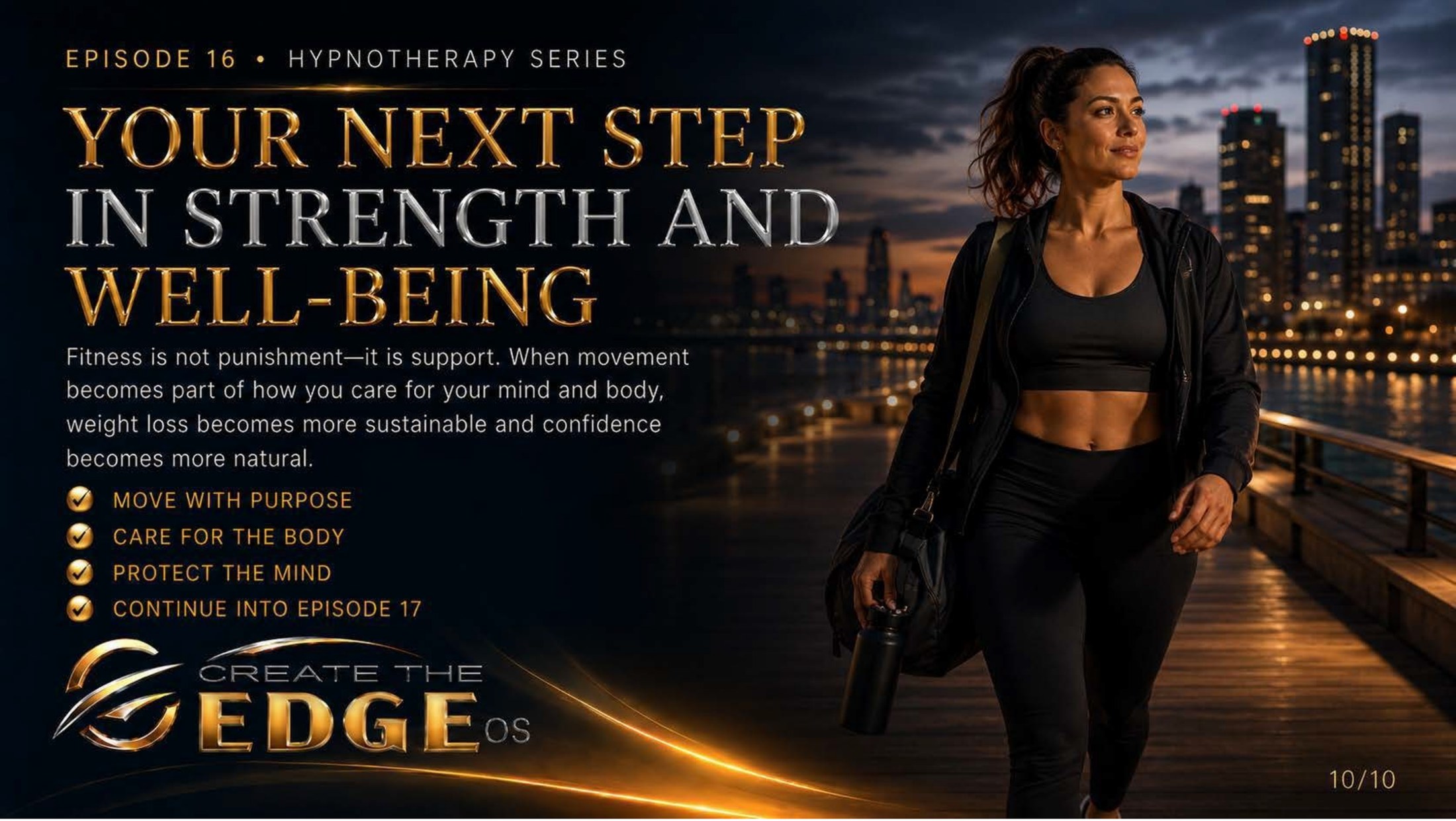
On the slideFitness is not punishment — it is support. When movement becomes part of how you care for your mind and body, confidence becomes more natural: move with purpose · care for the body · protect the mind · continue into Episode 17.
Episode 16 · Slide 10
Your Next Step in Strength and Wellbeing
Look at her walking through the night city, her stride easy and confident, the whole image carrying the energy of someone who has finished something and is moving forward into what’s next. Not fleeing. Not exhausted. Just — moving. With purpose. With herself. The city is alive around her and she is entirely at home in her own body, in her own stride, in her own particular way of moving through the world.
The slide makes the statement I most want you to carry away from this chapter: fitness is not punishment — it is support. Read that again and let it land. Every time you’ve ever used exercise as a way of punishing yourself, correcting yourself, making up for yourself — that was a misuse of something that was designed to care for you. Movement is how the body maintains itself, recovers itself, expresses itself, heals itself. It is support. It has always been support. We just forgot.
When movement becomes part of how you care for your mind and body — not part of how you punish or correct or compensate — the relationship with it changes entirely. It stops being something you have to do and starts being something you actually want. Not every day, not every session — the motivation will still ebb and flow, because you’re human. But the underlying orientation shifts from “I must” to “I choose this because it serves me.” And that shift changes everything about how sustainable it is.
Move with purpose. This doesn’t mean intensity or ambition — it means intentionality. Moving because you’ve chosen to, in a form that genuinely calls to you, toward something that matters to you. Care for the body — not reshape it, not punish it, not force it into something it isn’t. Care for it the way you would care for anything precious: with attention, with gentleness, with patience, with the knowledge that care compounds over time.
Protect the mind. This is the piece we’ve built this entire chapter toward. The mind you carry with you through every challenge in this book — the mind that does the inner work of changing patterns and building self-trust and choosing differently under pressure — that mind is protected and strengthened by the body it lives in. Moving your body consistently is, among other things, one of the most reliable forms of mental self-care available to you.
So here is my hand, one more time, reaching out from beside you on the road rather than from some arrived destination. I have a movement practice. It has changed over the years and it will keep changing. Some weeks are better than others. The shoes still sit by the door on the hard mornings. And I keep putting them on. We don’t fail, we fall forward, and we go together — into Episode 17 and the next dimension of this ongoing becoming. Let’s keep moving.