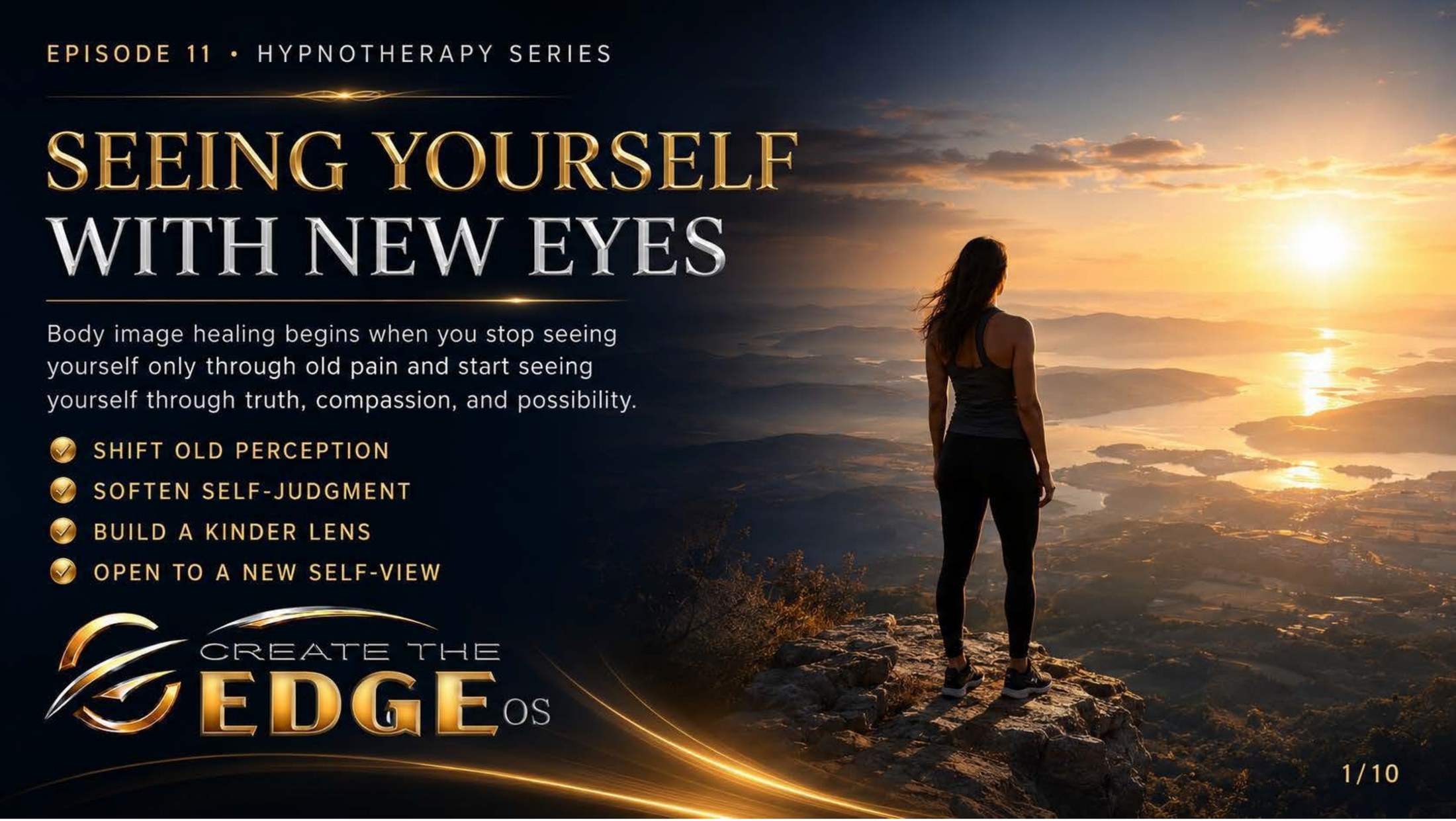
On the slideBody image healing begins when you stop seeing yourself only through old pain and start seeing yourself through truth, compassion, and possibility: shift old perception · soften self-judgment · build a kinder lens · open to a new self-view.
Episode 11 · Slide 1
Seeing Yourself With New Eyes
I want you to picture the woman on this slide for a moment. She is standing at the very edge of a mountain, the whole world spilling out beneath her in gold, a river of light cutting through the valley far below. She isn’t checking her reflection. She isn’t sucking in, or tugging at her shirt, or running the old math in her head. She’s just… standing there, breathing, taking in the dawn. And here’s the thing I need you to notice: she got to that edge with the same body she might have spent years criticizing in a mirror.
That’s the quiet miracle this chapter is built on. The body you’ve been at war with is the same body that has carried you up every mountain you’ve ever climbed. It is not your enemy. It never was. The problem was never the body. The problem was the lens — the cracked, smudged, inherited lens you were handed and told to see yourself through.
Read the four steps glowing on the slide: shift old perception, soften self-judgment, build a kinder lens, open to a new self-view. Notice that not one of them says change your body. Every single one is about changing the way you see. That is the entire revolution of this chapter, and I don’t use that word lightly. We are not going to fix you, because you were never broken. We are going to clean the glass.
Maybe you know exactly the lens I mean. The one that walks into a room and immediately finds the worst photo angle. The one that hears a compliment and translates it into an insult. The one that can look at a body that has survived heartbreak, illness, childbirth, exhaustion, and decades of just showing up — and find only the flaws. If you know that lens, I want you to know something gentle and true: you didn’t build it. It was installed.
And here is the part that should make you sit up a little straighter. Anything that was installed can be uninstalled. Anything you learned to see, you can learn to see differently. The brain that wrote the cruel script is the very same brain that can write a kinder one. That’s not wishful thinking — that’s how perception actually works, and the rest of this chapter is going to walk you through it, slide by slide.
I won’t pretend I came to this easily. There were years I couldn’t pass a mirror without flinching, years my body felt like evidence of everything that had gone wrong. I remember the version of me who would have read this page and rolled her eyes. So if part of you is skeptical right now, good — bring her along too. We don’t leave the doubtful parts of ourselves at the trailhead. We take them with us, and we let the view do the convincing.
Because here’s what I’ve learned, and what I’ll keep my hand out for through this whole chapter: we don’t fail, we fall forward. Every harsh thought you’ve ever had about yourself was a step — a clumsy, painful step, but a step — toward the moment you finally decided you’d had enough of seeing yourself through someone else’s eyes.
So take my hand. We’re going to climb to that edge together. And when we get there, you’re going to see yourself with new eyes — not because your body changed, but because you did.

On the slideThe way we see our body is often shaped by subconscious beliefs, memories, and emotions — not just by what the mirror shows: old beliefs influence perception · emotions color the image · the mirror is filtered through memory · hypnotherapy works below the surface.
Episode 11 · Slide 2
Body Image Lives Beneath the Surface
Look closely at this image, because it’s telling the truth in a way words sometimes can’t. A woman sits in the foreground, calm and present. But behind her, drifting up like things underwater, are the ghosts — a little girl with her arms crossed, a younger self in a mirror, and floating all around them the words: not enough. too much. not good enough. be perfect. they’ll judge you. remember what she said. That’s not decoration. That’s a portrait of what’s actually happening every time you look at yourself.
Because here’s the secret the slide names plainly: body image lives beneath the surface. When you stand in front of a mirror, you think you’re seeing your body. You’re not. You’re seeing your body run through a filter — a filter made of old beliefs, buried memories, and emotions you might not even have words for. The mirror shows light and shape. Your mind supplies the story.
Think about what that really means. Two women can stand in front of the identical mirror, in the identical light, in nearly identical bodies — and one feels peace while the other feels shame. The glass didn’t change. The lens behind their eyes did. Body image was never about the body. It was always about the beliefs the body got wrapped in.
And those beliefs are slippery, because they don’t announce themselves. They don’t say, “This is a belief I picked up at age nine from a comment at a family dinner.” They just feel like truth. They feel like reality. That’s exactly why willpower alone so often fails here — you can’t out-discipline a belief you don’t even know is running. You can’t fight a ghost you can’t see.
This is precisely where hypnotherapy earns its place, and the slide says it directly: it works below the surface. The conscious mind — the part reading these words — is brilliant at logic, but it’s not where these patterns live. The patterns live deeper, in the part of you that absorbed the messages before you were old enough to question them. To change the image, you have to go where the image is actually made.
I find something strangely freeing in that, and I hope you will too. If the harshness lives beneath the surface, then it isn’t the real you — it’s a layer over the real you. The little girl with her arms crossed in this picture isn’t who you are. She’s who got hurt. And she can be reached, and reassured, and finally allowed to put her arms down.
So we’re not going to spend this chapter scrubbing harder at the mirror. That never worked and it never will. We’re going to go beneath it. We’re going to find the beliefs in the dark water and bring them up into the light, where they lose almost all their power. Because a belief you can finally see is a belief you can finally choose to keep — or release.
Take a breath with me here. You’re not crazy for feeling the way you’ve felt. You were responding, honestly and humanly, to a lens you never chose. And now, together, we go looking for where it came from.

On the slideHealing does not mean forcing yourself to love every detail overnight. It means creating safety, neutrality, and honesty in the way you look at yourself: reduce emotional charge · move from shame to neutrality · create a safer reflection · let kindness grow naturally.
Episode 11 · Slide 3
The Mirror Can Become Neutral
I want to take the pressure off you right now, because I think a lot of well-meaning advice has actually made this harder. Somewhere along the way, “body positivity” turned into a new rule: you must love every inch of yourself, instantly, fiercely, or you’re doing it wrong. And for so many women, that command lands as just one more way to fail. If you can’t leap from self-hatred to self-love in a single bound, you feel broken all over again.
So look at what this slide actually promises, because it’s so much kinder and so much more honest. The mirror can become neutral. Not adoring. Not euphoric. Neutral. The woman in this image isn’t gazing at her reflection with fireworks in her eyes. She’s looking at herself with a soft, steady, almost peaceful expression — the look of someone who has simply stopped fighting.
Neutral is the bridge. Nobody tells you that, but it’s the whole secret. You do not have to sprint from “I hate what I see” to “I love what I see.” That gap is too wide, and trying to leap it is how people fall. Instead, you cross a bridge in the middle, and that bridge is neutrality — a place where the mirror is just a mirror, and your reflection is just information, not a verdict.
Read the steps and feel how gentle the slope is: reduce emotional charge, move from shame to neutrality, create a safer reflection, let kindness grow naturally. Notice that last phrase — naturally. Kindness isn’t something you force at gunpoint. It’s something that grows, the way a garden grows, once you’ve stopped pouring poison on the soil. Your only job is to stop the poison. The kindness comes on its own.
Let me show you what “reducing the charge” looks like in real life. Right now, a glance in the mirror might set off a whole cascade — a flash of shame, a spike of comparison, a rerun of an old cruel comment. That’s the emotional charge. Neutrality is what happens when you slowly disconnect that wire. The reflection stays the same; the explosion stops. You can look, and just… keep breathing.
And here’s the beautiful, almost sneaky part: once the mirror stops being a war zone, kindness has room to move in. You can’t feel tenderness toward yourself while you’re bracing for an attack. But take away the attack, create a little safety, and warmth shows up like a cat creeping back into a room that’s finally gone quiet. You don’t have to chase it. You just have to make it safe enough to return.
So if you’ve been exhausted by the pressure to love yourself, set it down for now. That can come later, and honestly, it often does — but it’s the destination, not the toll you pay to get on the road. For this chapter, all I’m asking is that the mirror gets to be neutral. That you get to look without flinching. That’s not a small thing. For some of us, that’s everything.
Take my hand on this one especially, because I know how far it can feel. I haven’t arrived either — I still have mornings the old charge tries to fire. But neutral I can do, most days now. And neutral, it turns out, is a place you can actually live. We go there together.

On the slideMany painful body-image stories were learned from family, culture, media, and comparison. Hypnotherapy helps loosen those borrowed messages: recognize inherited beliefs · separate truth from conditioning · release outside pressure · create your own meaning.
Episode 11 · Slide 4
Releasing the Labels You Inherited
This might be my favorite image in the whole chapter, because it shows the moment of freedom in motion. A woman walks away down a sunlit path, and behind her, torn loose and tumbling into the wind, are the labels: not thin enough. perfect is the goal. comparison steals joy. cultural standards. family opinions. you should look better. what will people think. She isn’t carrying them anymore. She’s walking out of the gray, broken city and into the green hills, and the labels are falling away like paper in a storm.
Look at every one of those labels and ask yourself the question that changes everything: which of these did I write? Not one. You wrote none of them. They were handed to you. Not thin enough came from somewhere. What will people think came from someone. Every cruel standard you carry has a return address, and the address is never your own heart — it’s family, culture, media, comparison.
The slide names the work cleanly: recognize inherited beliefs, separate truth from conditioning, release outside pressure, create your own meaning. And it starts with that word inherited. Because you can grieve an inheritance you didn’t want. You can decline it. Just because something was passed down to you does not mean you’re obligated to carry it for the rest of your life and hand it to the next generation.
Let me tell you why this matters so personally. I know what it is to absorb a voice that told me what I’d never be — a voice that should have been building me up and chose, instead, to tear me down. For a long time I thought that voice was telling the truth about me. It took me years to understand: it was never the truth. It was just loud. And loud is not the same as true.
That’s the separation this slide is asking you to make — truth from conditioning. Conditioning is anything you believe simply because you heard it enough times. Truth is what holds up when you actually examine it. “I’m not good enough” feels true because it’s old and familiar, but hold it up to the light and ask: good enough for what? according to whom? measured by a standard invented by people who profit from my insecurity? Watch how fast it starts to dissolve.
And here’s where it gets a little funny, in the way the truth often is. So many of the “standards” we torture ourselves with aren’t even consistent. They contradict each other. They change every decade. They’re different in different countries, different eras, different rooms. We’re breaking our own hearts trying to win a game whose rules were made up, are rigged, and keep changing. At some point the only sane move is to stop playing.
Look again at that path she’s walking. The labels don’t fall away because she fought them. They fall away because she stopped holding on. That’s the whole technique. You don’t have to wrestle each belief to the ground. You just have to recognize it isn’t yours, loosen your grip, and keep walking. The wind does the rest.
So take my hand, and let’s start setting them down — one borrowed label at a time. You came into this world without a single one of these beliefs. The goal isn’t to become someone new. It’s to walk far enough down the road that you finally remember who you were before the world started labeling you.

On the slideAs self-talk becomes gentler, body image often softens too. The mind stops attacking the body and starts supporting healing: notice harsh self-talk · install kinder language · build emotional safety · support consistent change. Affirmations on the slide: I am worthy · I treat myself with kindness · I am growing and healing · I trust my journey · I support my body · I am enough · I choose me.
Episode 11 · Slide 5
From Inner Critic to Inner Ally
Here she is again, but look how the scene has changed. She’s curled in a warm chair by a window, journal open, pen moving, golden light pouring in. And floating in the air around her, written in soft glowing script, are the new words: I am worthy. I treat myself with kindness. I am growing and healing. I trust my journey. I support my body. I am enough. I choose me. Even her coffee mug says it. This is what it looks like when the voice in your head finally switches sides.
Because that’s the leap this slide is naming: from inner critic to inner ally. For a lot of us, the voice we hear most often all day long is the cruelest voice we know. It narrates our reflection, our choices, our worth, in a tone we would never use on a friend, a child, a stranger on the street. We’d be horrified to hear it spoken to someone we love. And yet we let it run, unchallenged, about ourselves.
So let me ask you the question that has cracked this open for so many women: would you speak to your best friend the way you speak to yourself? Would you stand beside her at a mirror and list her flaws? Would you tell her she’s not enough? Of course not — the thought is almost violent. So why is it acceptable when the target is you? You are not the one human being on earth who deserves your cruelty.
The slide lays out the path: notice harsh self-talk, install kinder language, build emotional safety, support consistent change. And it begins, always, with noticing. Most harsh self-talk runs on autopilot, below your awareness, like background noise you stopped hearing years ago. The first act of freedom isn’t silencing the critic — it’s simply catching it. “Oh. There’s that voice again. I hear you.”
And then — this is the part people get wrong — you don’t scream back at the critic. You don’t fight fire with fire. You install something kinder, gently, repeatedly, until the new language starts to feel as natural as the old. That’s what those glowing affirmations are. They’re not magic spells. They’re new grooves, worn into the mind one honest repetition at a time, until the kinder thought becomes the first thought instead of the afterthought.
Notice that the affirmations on this slide aren’t arrogant or fake. They don’t say “I’m perfect” or “I’m better than everyone.” They say I am growing and healing. I trust my journey. I am enough. That’s the tone of a real ally — not a cheerleader screaming lies, but a steady friend telling you the truth on the days you can’t see it yourself. An ally doesn’t inflate you. An ally steadies you.
And here’s the quiet ripple effect the slide points to: as the self-talk softens, the body image softens too. They’re wired together. The mind that stops attacking the body frees the body to stop bracing. When the voice inside becomes an ally, the whole nervous system exhales. You stop living in a war and start living in a partnership — and a body that’s no longer under siege can finally begin to heal.
So I’ll reach out my hand here, the way a good ally would, and I’ll go first: I am worthy. I am growing and healing. I choose me. Now your turn — not because you feel it yet, but because the feeling follows the words, the way warmth follows the lighting of a fire. We say it together until one day you notice it’s become your own voice. And I haven’t arrived either. I still practice this one daily. We practice together.

On the slideIn session, the body relaxes, the mind becomes more focused, and new subconscious associations can begin to replace old body-image patterns: relax and focus · access subconscious patterns · reframe old beliefs · reinforce healthier perception.
Episode 11 · Slide 6
How Hypnotherapy Changes Perception
Let me pull back the curtain on this image, because I think the picture of hypnotherapy in most people’s heads is pure Hollywood — swinging watches, snapping fingers, clucking like a chicken. Look at what’s actually shown here instead: a person reclined in a comfortable chair, deeply relaxed, while glowing pathways of light rise from the mind toward open, peaceful images. That’s the truth of it. It’s not control. It’s access.
The slide spells out the mechanism with real honesty: relax and focus, access subconscious patterns, reframe old beliefs, reinforce healthier perception. So let me walk you through what each of those actually means, because once you understand it, the mystery falls away and what’s left is something almost beautifully simple.
It starts with relaxation — genuine, deep, body-and-mind relaxation. This matters more than it sounds. When you’re tense, the critical, guarding part of your mind stands at the door like a bouncer, refusing entry to any new idea. When you relax that deeply, the bouncer finally sits down. The door to the subconscious — the place where body image actually lives — swings gently open.
Then comes access. Remember the dark underwater image from earlier, all those old beliefs drifting beneath the surface? In a focused, relaxed state, you can finally reach them. Not by force, not by digging up every painful memory, but by gently arriving at the level where the patterns are stored. You go to where the wiring is, instead of shouting at it from across the house.
And once you’re there, you can reframe. This is the heart of it. An old belief like “my body is the problem” isn’t deleted with a magic word — it’s gently questioned, loosened, and offered a truer story to settle into. New associations get to form: the body as ally instead of enemy, the reflection as neutral instead of threatening. You’re not erasing your mind. You’re updating it, the way you’d update an old map that no longer matches the territory.
Finally, you reinforce. This is why hypnotherapy is a practice and not a one-time trick. New perception, like a new path through a field, becomes a road only by being walked again and again. Each session, each repetition, deepens the groove until the healthier perception stops being effortful and starts being automatic — the new default, the first thing you reach for instead of the old.
I want to be clear-eyed and honest with you here, because you deserve that: hypnotherapy is not a magic wand, and no ethical practitioner would ever promise you it is. It’s a tool — a genuinely powerful one — for reaching the part of the mind that ordinary willpower simply can’t touch. It works with you, never on you. You are always the one in the chair, always the one choosing. It just helps you reach the controls you couldn’t reach before.
So if you’ve ever wondered why you can know something is true — “my body is fine, these standards are nonsense” — and still not feel it, this is your answer. Knowing lives upstairs, in the conscious mind. Feeling lives downstairs, in the subconscious. Hypnotherapy is simply how you get the upstairs truth all the way down the stairs to where it can finally change how you feel. And we can learn to walk those stairs together.

On the slideSeeing yourself differently often happens through repetition — moment by moment, reflection by reflection, thought by thought: small shifts matter · practice creates familiarity · kindness reduces shame · new perception becomes natural.
Episode 11 · Slide 7
Practicing a Kinder Reflection
Look at the progression in this image, because it’s the whole truth of how change actually happens, laid out in a row. A woman stands before a line of glowing mirrors — and in the first reflection she’s guarded, arms crossed, tense. But mirror by mirror, reflection by reflection, her posture softens, her arms open, until the final reflection shows her standing easy, warm, almost smiling. Same woman. Same body. Different seeing — arrived at one reflection at a time.
That’s what the slide means by practicing a kinder reflection. Not achieving it in one heroic morning. Practicing it. The word matters, because it gives you permission to be a beginner, to be clumsy, to have days you fall back into the old crossed-arms stance — and to simply practice again tomorrow. You don’t fail at this. You practice it.
Read the steps and feel how they take all the pressure off: small shifts matter, practice creates familiarity, kindness reduces shame, new perception becomes natural. Start with that first one — small shifts matter. You don’t have to overhaul your entire self-image by Friday. You just have to make this glance a little kinder than the last one. One degree warmer. That’s it. That’s a win. Stack enough one-degree turns and you end up facing an entirely new direction.
Here’s the brain science underneath the magic, and it’s genuinely good news: your mind believes what it rehearses. The reason the harsh reflection feels so automatic is simply that you’ve practiced it ten thousand times. It’s not truer than kindness — it’s just more rehearsed. Which means the kinder reflection isn’t weaker or more naive. It’s just newer. And newness is cured by exactly one thing: repetition.
That’s the gift hidden in the phrase practice creates familiarity. Right now, kindness toward yourself might feel awkward, even fake — like wearing a coat that isn’t yours. That awkwardness isn’t a sign it’s wrong. It’s a sign it’s unfamiliar. And unfamiliar becomes familiar the only way anything ever does: by showing up again, and again, and again, until one day the coat fits and you forget you ever borrowed it.
And watch what the third step promises — kindness reduces shame. This is the engine of the whole thing. Shame is heavy, and it makes you want to hide, to look away, to avoid the mirror entirely. But every small act of kindness shaves a little weight off the shame. And as the shame lightens, you can look longer, look softer, look more honestly — which lets in more kindness, which lightens more shame. It’s a spiral, finally turning the right direction.
I love that this slide is so unglamorous about it, because that’s exactly why it works. There’s no dramatic breakthrough being sold here, no single tearful morning where everything transforms. There’s just the quiet, faithful, deeply human work of choosing the slightly kinder thought, this time, and then again the next time. Reflection by reflection. Thought by thought. That’s not less powerful than a breakthrough. That’s more — because it lasts.
So here’s my hand on the practice itself: we don’t fail, we fall forward. The mornings you slip back to crossed arms aren’t failures — they’re just reps you didn’t finish, and the next reflection is always waiting to begin again. I still practice this. I’m still walking my own line of mirrors. We move down the row together, one kinder glance at a time.

On the slideWhen body image becomes more compassionate, daily choices often change too — care, movement, rest, and self-care become acts of support instead of punishment: choose nourishment · reduce all-or-nothing thinking · support the body kindly · strengthen trust through action.
Episode 11 · Slide 8
Seeing Your Body as an Ally
Look at the warmth in this image. A woman stands in a sunlit kitchen, calm and unhurried, tending to a meal with what can only be called care. There’s no tension in her shoulders, no grim discipline on her face. She looks like someone doing something kind for someone she loves — because she is. The someone is herself. This is what it looks like when the body stops being a project to fix and becomes a partner to support.
The slide names the shift at the center of everything: care, movement, rest, and self-care become acts of support instead of punishment. Sit with that contrast, because it’s enormous. So much of what we do to our bodies, we do against them — as penance, as correction, as a way to whip them into acceptability. This slide points to a completely different posture: tending the body the way you’d tend a garden you love, not the way you’d discipline an unruly enemy.
I want to be careful and honest with you here, because this is tender ground for so many women, and I won’t pretend otherwise. This chapter is not about plans, or numbers, or rules, or restriction — there are none of those here, and there never will be. This is about something underneath all of that: the relationship. The emotional posture you bring to your own body. Whether your daily care comes from a place of war or a place of kindness. That’s the only thing we’re tending on this page.
Notice the second step especially: reduce all-or-nothing thinking. This one quietly runs so much suffering. All-or-nothing is the voice that says one imperfect choice means the whole day is ruined, so you may as well abandon yourself completely until some mythical fresh start. It turns being human into failing. And the antidote isn’t more discipline — it’s gentleness, the radical permission to be a flawed human being who is still, always, worthy of care.
Because here’s what kindness does that punishment never could: kindness is sustainable. You cannot hate yourself into lasting change — fear and shame might force a sprint, but they always collapse, and they collapse with interest. Support, though, you can keep up. Acts of genuine care don’t burn you out, because they fill the same tank they draw from. A body that feels supported instead of punished is a body that can finally relax its grip.
Look at that last step — strengthen trust through action. Trust between you and your body isn’t rebuilt with a declaration; it’s rebuilt the way all trust is, through small kept promises. Each time you choose rest when you’re exhausted instead of pushing through, each time you respond to a real need with care instead of criticism, you’re sending your body a message it may not have heard in years: I’ve got you. I’m on your side now.
And slowly — it is always slowly — the body starts to believe you. The bracing eases. The relationship that was all conflict starts to feel, for the first time in a long time, like a partnership. Like two old adversaries who finally laid down their weapons and realized they’d been on the same side the whole time. They were always on the same side. The war was the misunderstanding.
So take my hand here with extra gentleness, because I know how loaded this territory can be. If your relationship with food, eating, or your body ever feels frightening or out of your control, please reach for real, trained human support — you deserve a person, not a page. There’s a caring helpline waiting for you in the goals section just ahead. There’s no shame in that call. The bravest thing isn’t going it alone. It’s letting someone walk beside you. We were never meant to do this in isolation.

On the slideHealing often feels subtle at first — less comparison, less panic around appearance, more steadiness, more self-trust, and more room to simply be: more calm · less comparison · greater steadiness · growing self-trust.
Episode 11 · Slide 9
What Change Begins to Feel Like
Look where she is now. The woman on this slide walks a quiet path beside the sea at golden hour, flowers spilling along the way, the light low and warm and forgiving. She isn’t striking a pose. She isn’t performing. She’s just… walking, easy and unhurried, with room to breathe. This is the image of someone who has stopped fighting herself — and I want you to notice how ordinary the peace looks. That’s the point.
Because the slide tells you the truth that nobody puts on a poster: healing often feels subtle at first. We expect transformation to arrive like a thunderclap — a single morning where we wake up loving ourselves, fireworks, a montage. That’s not how it comes. It comes quietly. It comes as an absence — the panic that didn’t fire, the comparison that didn’t hook, the cruel thought that, for once, simply didn’t show up.
Read the markers on the slide, and notice they’re measured in less as much as more: more calm, less comparison, greater steadiness, growing self-trust. The early wins are often things that stop happening. You scroll past a photo and don’t spiral. You catch your reflection in a window and just… keep walking. You get dressed without the whole exhausting interrogation. These are not small. These are the ground shifting beneath you.
This is why I want to teach you, right now, how to recognize your own progress — because the subtle kind is so easy to miss. The old harshness was loud; it announced itself constantly. Its absence is quiet, and quiet things slip by unnoticed. So you have to learn to catch the silence. You have to learn to notice the dog that didn’t bark. That noticing is itself part of the healing.
Look especially at “more room to simply be.” Think about how much space the old war took up — the mental real estate rented out, all day, to monitoring and judging and comparing your own body. Healing gives that space back to you. Imagine what returns to a life when that enormous background hum finally goes quiet: attention for the people you love, energy for the work that matters, presence for the actual sunrise instead of anxiety about how you look watching it.
And here’s the part I most want you to hold onto: steadiness is the real prize, more than any peak of self-love could ever be. A peak feeling is wonderful, but it comes and goes with the weather. Steadiness stays. It’s the difference between a single perfect day and a foundation you can stand on through all the imperfect ones. Self-trust isn’t a high. It’s a floor that holds. And a floor is what lets you finally stop bracing for the fall.
I won’t sell you a fairy tale, because you’d see right through it and you’d be right to. There will still be hard days. There will be mornings the old lens snaps back into place and the path looks gray again. That’s not relapse — that’s being a human being with a history. The difference is that now you know the gray is the old lens lying, not the truth, and you know the steadiness is still there underneath, waiting for you to find your feet again.
So take my hand and keep walking this seaside path with me. Look for the quiet wins — the panic that didn’t come, the comparison that lost its grip, the small unremarkable peace of a morning that didn’t turn into a battle. We don’t fail, we fall forward, and we celebrate the subtle victories out loud, because they are the realest ones there are. I haven’t arrived. I’m still walking too. But the path is so much kinder now, and there’s room on it for both of us.
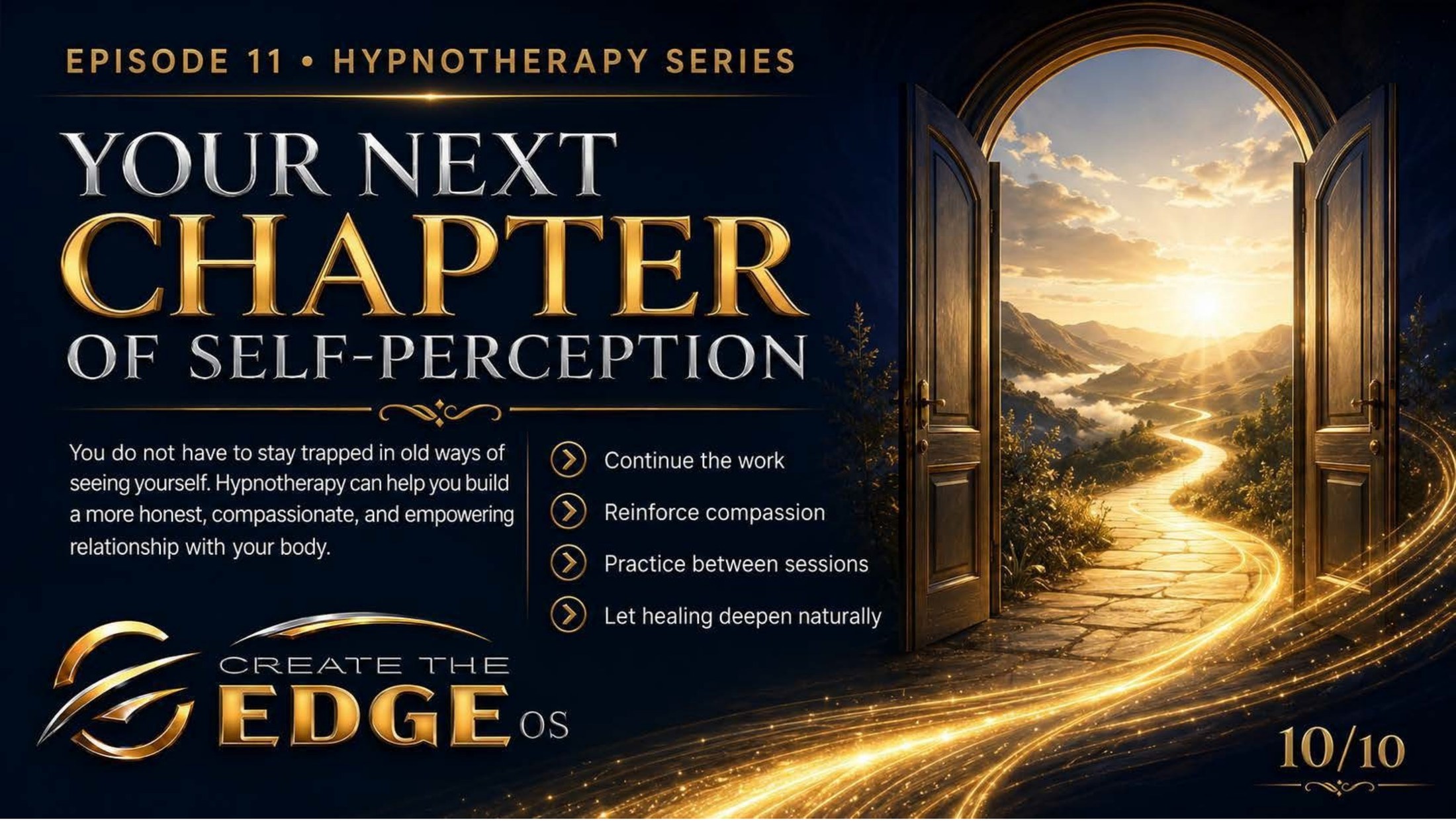
On the slideYou do not have to stay trapped in old ways of seeing yourself. Hypnotherapy can help you build a more honest, compassionate, and empowering relationship with your body: continue the work · reinforce compassion · practice between sessions · let healing deepen naturally.
Episode 11 · Slide 10
Your Next Chapter of Self-Perception
Look at the doors. Two great doors stand wide open, and beyond them a golden path winds out through misted mountains toward a rising sun — light literally streaming along the road like a river you’re invited to follow. After everything in this chapter, the image leaves you exactly here: at a threshold, with the door open, and a lit path waiting. Nobody is going to push you through. But nobody is holding it shut anymore either.
The slide says the words I most want you to carry out of this chapter: you do not have to stay trapped in old ways of seeing yourself. Read it again, slowly. You do not have to stay. The lens you inherited, the labels you carried, the critic who narrated your reflection — none of it is a life sentence. It was a room you were locked in. And this whole chapter has been about putting the key back in your own hand.
Notice what kind of relationship the slide promises is possible: honest, compassionate, and empowering. Not perfect. Not delusional. Honest — you get to see yourself clearly, without the funhouse-mirror distortion of old pain. Compassionate — you get to meet what you see with kindness instead of contempt. Empowering — you get to be the author of your own self-image instead of the captive of someone else’s. That’s the inheritance worth claiming.
Read the four invitations on the door: continue the work, reinforce compassion, practice between sessions, let healing deepen naturally. Every one of them points through the threshold, not back from it. This isn’t a finish line you’ve crossed — it’s a doorway you’re stepping through. The work of seeing yourself with new eyes isn’t a destination you arrive at. It’s a path you walk, and it keeps opening up the farther you go.
And notice that last, merciful phrase — let healing deepen naturally. There’s that word again: naturally. You don’t have to force what comes next, or grit your teeth through it, or get it perfectly right. You’ve cleaned the glass. You’ve loosened the labels. You’ve started turning the critic into an ally. Now you let it deepen the way roots deepen — quietly, steadily, mostly out of sight, simply because you keep showing up to the practice.
Let me say something straight to you, woman to woman, as we stand in this doorway together. I know the version of you that didn’t believe any of this was possible — I’ve been that version. I know what it is to look in a mirror and find only evidence against yourself. And I know, because I’ve lived the slow walk out of it, that the door really does open. Not all at once. Not without hard days. But it opens. The light on that path is real.
So here is my hand, one more time, the way I’ve held it out through this whole chapter — not from the far side of some finish line, because I haven’t arrived and I never will fully arrive, but from right here beside you on the road. I’m still practicing the kinder reflection. I’m still catching the old lens. We don’t fail, we fall forward, and we go together, because nobody was ever meant to walk this path alone.
The doors are open. The path is lit. You do not have to stay trapped in old ways of seeing yourself — and the workbook on the next pages is where you take the first real step through. Not someday. Now. With new eyes, and my hand in yours, let’s walk into your next chapter of self-perception. I’ll be right here, the whole way.