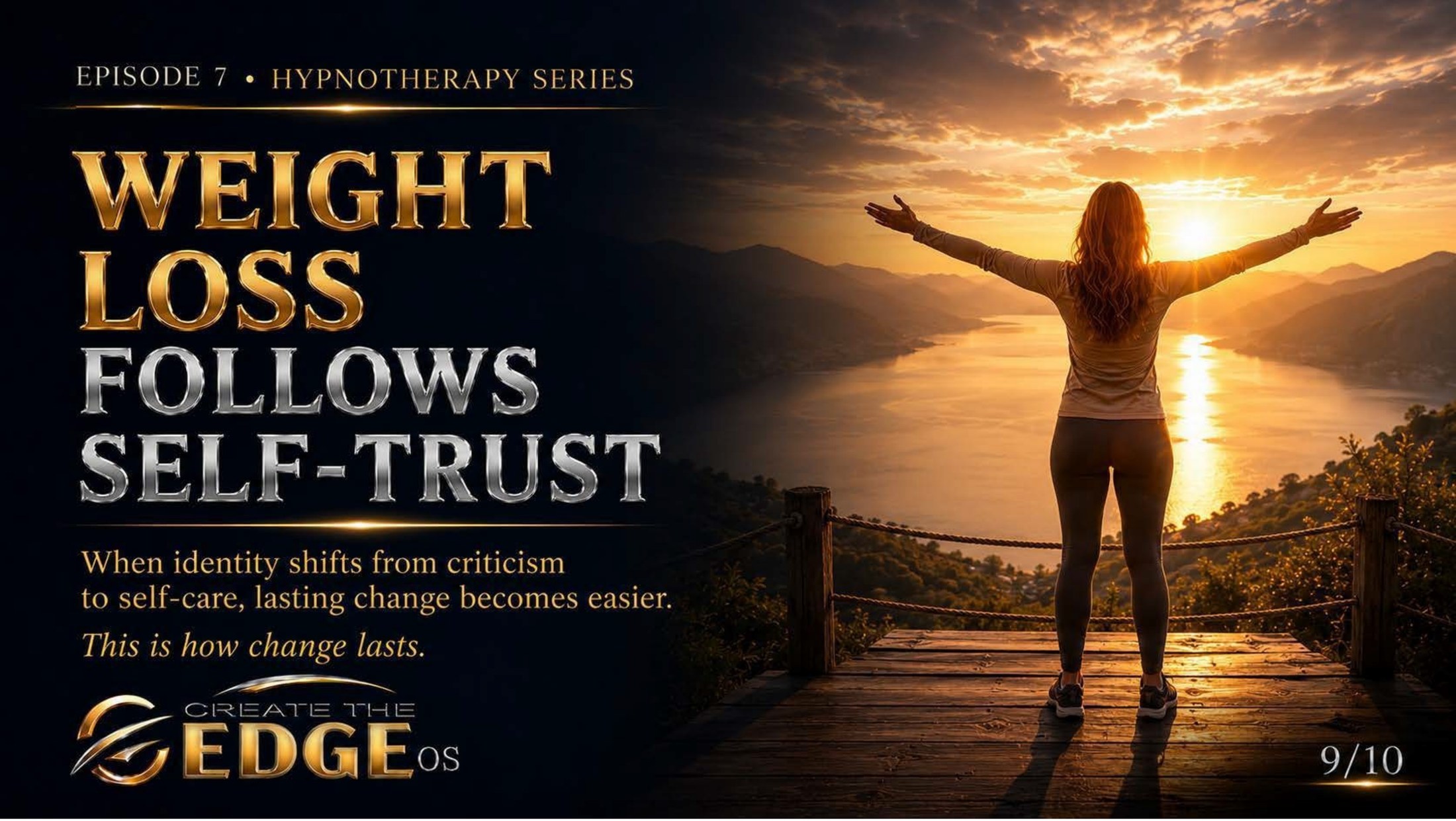
On the slideA supportive session helps calm the mind, uncover food triggers, and build healthier patterns that feel more natural: conversation and goal setting · identify emotional eating patterns · gentle guided hypnosis · positive reinforcement and next steps.
Episode 8 · Slide 1
What to Expect in a Weight-Loss Hypnotherapy Session
Episode 8 · Slide 1
Fear of the unknown is its own kind of prison, and I’ve watched it keep good people standing in the parking lot for years — sometimes their whole lives — too uncertain about what actually happens to ever walk through the door.
So this chapter is going to do something simple and freeing: it’s going to take you by the hand and walk you all the way through a weight-loss hypnotherapy session, start to finish, so there are no surprises left. No mystery. No dread of the unknown. By the time we reach the end, you’ll know exactly what the room feels like, what we do in it, and — most importantly — how safe and in charge you remain the entire time.
Look at the woman in this image, walking a golden mountain path toward a sunrise breaking over a valley. She’s not anxious about what’s ahead. She’s simply walking, because she knows the path. That’s what knowledge does to fear — it dissolves it. And that’s what this chapter gives you.
Read the four landmarks the slide lays out, because they’re the shape of the whole journey we’ll take together: conversation and goal setting, identify emotional eating patterns, gentle guided hypnosis, positive reinforcement and next steps.
Notice how human that sequence is. It begins with a conversation — two people talking. It moves into gently understanding your own patterns. It opens into the relaxed, focused state where the real shift happens. And it closes by reinforcing the good and pointing you forward. There is nothing strange or frightening anywhere in it. No pocket watch. No loss of control. No “going under” into some void. Just a supportive, collaborative process, done with you, every step of the way.
And notice the words the slide uses for what the work does: it helps you build healthier patterns that feel more natural. Not forced. Not white-knuckled. Natural. Because everything we’ve learned across these chapters comes together here, in the room, in the actual practice that turns understanding into change.
So let me settle your nerves the way I settle a new client’s on their first visit: there is nothing here to be afraid of. You stay awake. You stay aware. You stay in control. And you are accompanied, with care, the entire time. Take my hand. Let me walk you through the door, and show you exactly what waits on the other side. It’s gentler than you think, and far more hopeful.

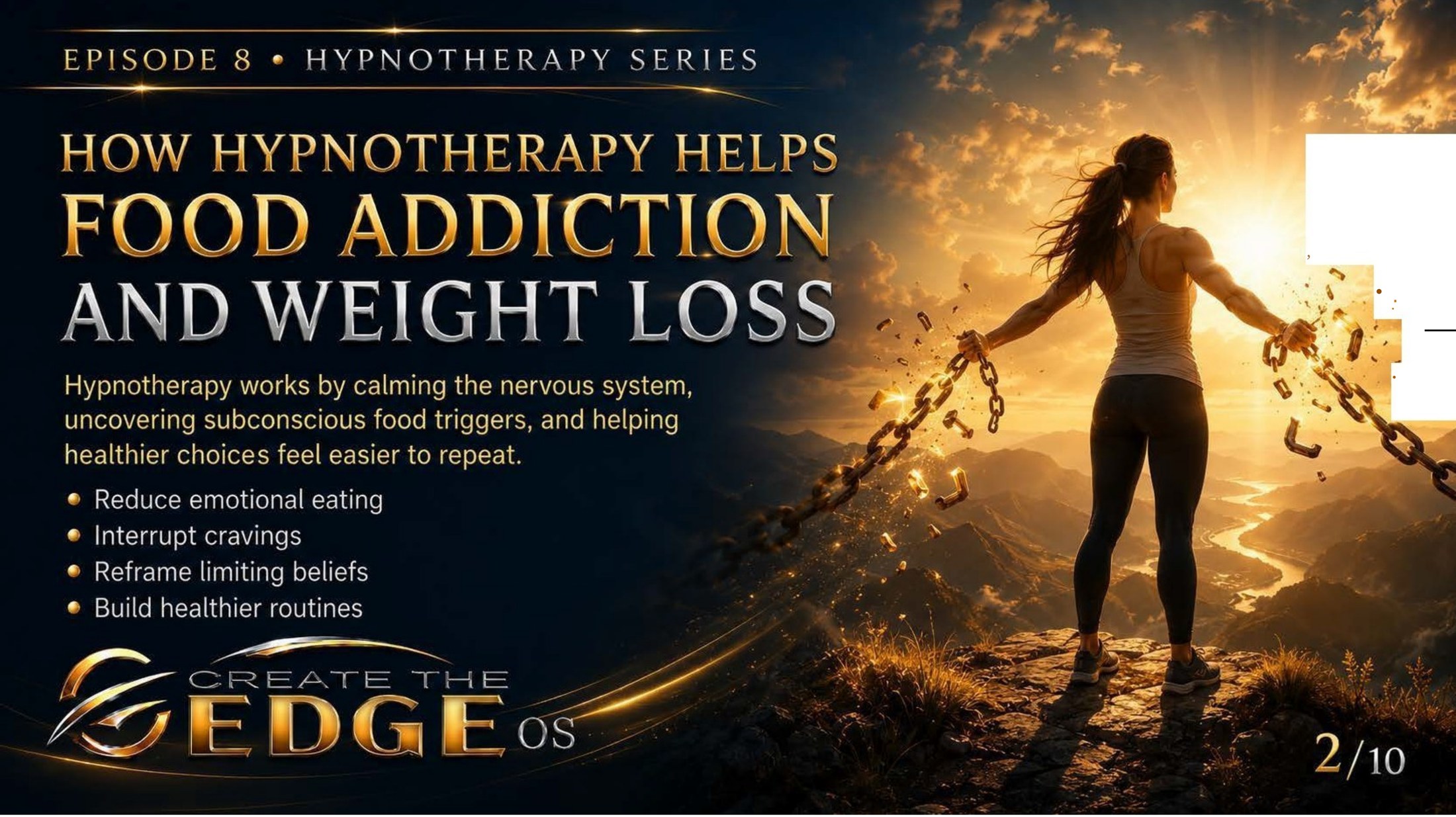
On the slideHypnotherapy works by calming the nervous system, uncovering subconscious food triggers, and helping healthier choices feel easier to repeat: reduce emotional eating · interrupt cravings · reframe limiting beliefs · build healthier routines.
Episode 8 · Slide 2
How Hypnotherapy Helps Food Addiction and Weight Loss
Episode 8 · Slide 2
Before we step inside the room, let’s be clear about why this approach reaches what willpower and diets never could. Look at the woman in the image — chains of light breaking and falling away from her wrists as she faces the sunrise. The slide names exactly how the freeing happens: hypnotherapy works by calming the nervous system, uncovering subconscious food triggers, and helping healthier choices feel easier to repeat.
Each of those three is doing something a diet simply cannot. Let me show you, because understanding the how is what finally makes the hope believable.
Calming the nervous system. So much difficult eating is driven by stress, by a body stuck in alarm. A diet only adds more stress — more rules, more pressure, more fear of failing. Hypnotherapy does the opposite: it calms the system at its root. And a calm nervous system makes calm choices. This alone changes everything, because it removes the very fuel that powered the old patterns.
Uncovering subconscious food triggers. Remember, the real decisions happen below awareness — the mind eats before the mouth. You cannot change a trigger you can’t see. Hypnotherapy gently brings those hidden triggers into the light, where they can finally be understood and reconditioned, instead of running silently in the dark forever.
Helping healthier choices feel easier to repeat. And this is the payoff — not forcing healthy choices through exhausting effort, but rewiring the patterns so the good choices start flowing more naturally. Easier to repeat. Less of a fight. More like simply who you are.
Now read the four results the slide promises, and notice they are exactly the threads we’ve been weaving through these chapters, now gathered into one practice: reduce emotional eating, interrupt cravings, reframe limiting beliefs, build healthier routines. Emotional eating eased. Cravings interrupted with that precious pause. Old limiting beliefs reframed into empowering ones. Healthier routines built through gentle repetition.
Do you see? This isn’t a gimmick or a quick fix. It’s the careful, root-level work of changing the patterns that actually drive behavior — which is the only kind of change that ever lasts. The chains in that image aren’t breaking through force. They’re breaking because the woman is finally being freed at the level where the chains were forged. That’s what happens in the room. Let’s go inside and see how.
On the slideThe first appointment is supportive, conversational, and focused on understanding your goals, patterns, and readiness for change: discuss goals and history · identify triggers and habits · clarify what you want to change · create a personalized session plan.
Episode 8 · Slide 3
Inside Your First Session
Episode 8 · Slide 3
Let me take you into the very first appointment, because this is where most of the fear lives — and where it dissolves fastest. Look at the image: two people in a warm, lamp-lit room, one listening attentively with a notebook, the other relaxed in a comfortable chair, soft light, books, a cup of tea. This is what a first session actually looks like. Not a clinical procedure. A conversation. The slide says it plainly: the first appointment is supportive, conversational, and focused on understanding.
Here’s what surprises almost everyone: there’s usually no hypnosis at all in the first part. We just… talk. Like two human beings. Because before we go anywhere deep, I need to understand you — your story, your struggle, your hopes. Look at the four things this conversation gently covers.
Discuss goals and history. What brought you here? What’s the struggle really been like, in your own words, not the polished version? What have you tried? What do you long for? I listen the way I learned to listen as a small girl crossing a classroom toward someone who was hurting — with my whole attention and zero judgment. For many people, simply being heard like this, without shame, is already the beginning of healing. So few of us have ever had someone truly listen to our struggle with food without judging it.
Identify triggers and habits. Together, with curiosity rather than criticism, we begin to map your patterns. When do you reach for food that isn’t hunger? What sets it off? What does the loop look like for you specifically? You’re the expert on your own life — I’m just the guide helping you see what’s been running beneath the surface.
Clarify what you want to change. We get specific about the destination, because the deep mind works best when it knows where it’s going. Not a vague “I want to be better,” but a clear, felt sense of the freedom you’re reaching for.
Create a personalized session plan. And then — and this matters — we build a plan for you. Not a one-size-fits-all script. Your patterns, your goals, your pace. This is collaborative from the very first minute. You’re not a patient being processed. You’re a partner in your own transformation.
Notice the word the slide leads with: readiness for change. We meet you exactly where you are. There’s no pressure, no rush, no being pushed somewhere you’re not ready to go. The first session is simply two people, sitting together, beginning to understand the path forward. By the end of it, the fear of the unknown is usually gone — replaced by something that feels a lot like relief, and the quiet hope of finally, maybe, this could be different.

On the slideA key part of treatment is noticing what drives eating behavior beneath the surface: stress and overwhelm · boredom and loneliness · reward and comfort · habit loops and cues.
Episode 8 · Slide 4
Understanding Food Triggers and Patterns
Episode 8 · Slide 4
Here’s a piece of the work that does more healing than people expect — simply bringing into the light what has been driving the eating in the dark. Look at the woman in the image, sitting thoughtfully by the golden lake, surrounded by glowing symbols of the forces at play. The slide names the heart of it: a key part of treatment is noticing what drives eating behavior beneath the surface.
Beneath the surface. That’s the territory diets never visit and the entire reason they fail. They police the behavior at the surface while completely ignoring what’s driving it underneath. We do the reverse — we go underneath, with gentleness and curiosity, and we get to know the real drivers. Look at the four the slide names, and notice that none of them is really about food at all.
Stress and overwhelm. So often the reach for food is really a reach for relief from a wound-up, overloaded system. The food is trying to soothe a stress the body doesn’t know how else to calm. The real driver isn’t hunger — it’s an overwhelmed nervous system crying out for comfort.
Boredom and loneliness. Sometimes food fills an empty hour, or stands in as a companion when no one else is there. I know that loneliness one personally — food as a warmth that never says no, never leaves. The real driver is an aching for stimulation, or for connection, that has nothing to do with the body’s need for fuel.
Reward and comfort. Sometimes food is the only reliable reward in a hard, depleting life — the one small pleasure you can count on at the end of an exhausting day. The real driver is a deep, legitimate need to feel good, to be comforted, in a life that may not be offering much else.
Habit loops and cues. And sometimes it’s pure autopilot — the trigger-routine-reward loop running on a worn groove, fired by a cue you don’t even consciously notice. The real driver is simply a deeply grooved pattern doing what patterns do.
Here is why this understanding is so powerful, and so kind: once you can see what’s really driving the eating, you stop blaming your character and start addressing the actual need. You’re not a weak person who loves food too much. You’re a human being with real, valid needs — for calm, for connection, for comfort, for reward — who learned to meet them through food because that’s what was available. That’s not a flaw to be ashamed of. It’s a pattern to be understood, with compassion. And what we understand with compassion, we can finally change with grace.

On the slideMost people experience hypnosis as deep relaxation with focused attention. You remain aware, safe, and able to respond: relaxed body · focused mind · still aware and in control · positive suggestions for change.
Episode 8 · Slide 5
What Guided Hypnosis Feels Like
Episode 8 · Slide 5
Now we arrive at the part everyone wonders and worries about most: what does it actually feel like to be hypnotized? Let me put your mind completely at ease, because the reality is so much gentler and more ordinary than the movies led you to believe. Look at the woman in the image — reclined in a comfortable chair under soft golden light, eyes closed, deeply at peace, a candle glowing nearby. That serene, restful state is what guided hypnosis actually is. The slide says it perfectly: most people experience hypnosis as deep relaxation with focused attention.
That’s it. That’s the whole mysterious thing. Deep relaxation, plus focused attention. You have been in and out of this exact state your whole life — it’s the feeling of being lost in a wonderful book, the drive home you don’t quite remember because the deeper part of you was steering, those golden minutes right before sleep when your mind drifts and glows. Nobody ever taught you to use it on purpose. That’s all we’re doing.
Now read the four descriptions on the slide, because they dismantle every fear one by one.
Relaxed body. Your body sinks into a deep, comfortable ease — the kind of rest many of my clients say is the first real rest they’ve had in months. Shoulders down from around the ears. Breath slow. Nothing to do, nowhere to be.
Focused mind. And yet the mind isn’t foggy or gone — it’s focused, gathered, like a flashlight beam aimed at one thing instead of scattered in forty directions. You’re actually more present, not less.
Still aware and in control. Underline this one, star it, because it’s the fear that keeps people away: you remain fully aware and in control. You are not unconscious. You are not under anyone’s power. You hear every word. You can speak. You can shift in your seat, open your eyes, or end it at any moment you choose. I am not the driver — I’m the gentle voice guiding while you hold the wheel the entire time.
Positive suggestions for change. And in that relaxed, focused, fully-aware state, we offer gentle, positive suggestions — the new beliefs, the calmer responses, the healthier patterns — to the part of your mind that’s finally open enough to receive them. We don’t implant anything against your will; that’s not possible and never would be. We simply offer better options, and the deeper part of you, in its own wisdom, chooses them.
So set the cartoon down for good. There is no losing control, no clucking like a chicken, no being made to do anything. There is only a deeply relaxed, focused, aware you — safe, awake, in charge — receiving gentle suggestions for the change you came for. It’s one of the most peaceful experiences you can have. Many people, honestly, can’t wait to do it again.

On the slideSessions help create space between the urge and the action, so the mind can choose a new pattern: pause before reacting · calm the craving · reframe the trigger · choose a healthier response.
Episode 8 · Slide 6
Rewiring the Food Response
Episode 8 · Slide 6
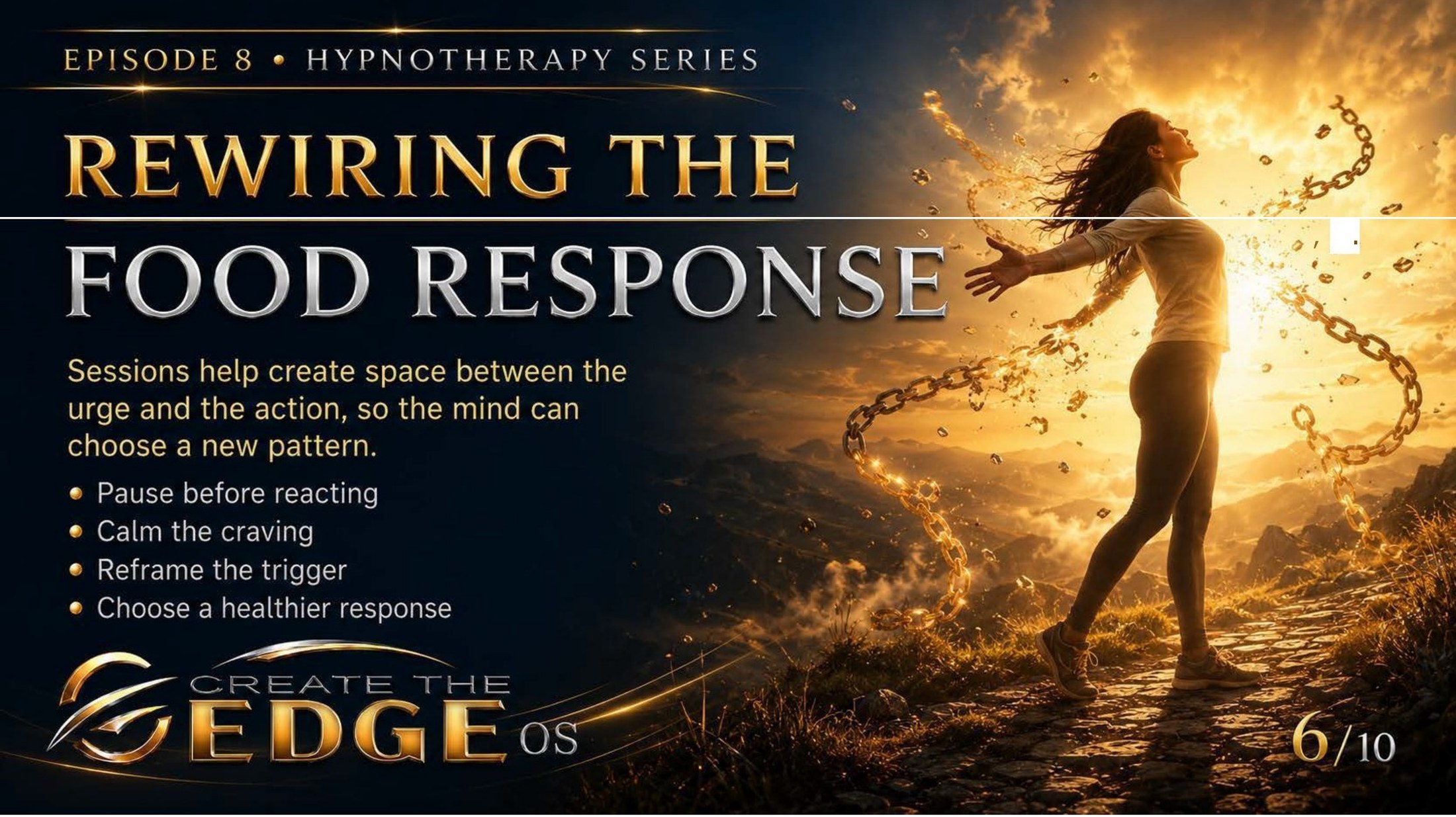
Now let’s look at the actual mechanism of change that happens in the relaxed state — the precise thing that gets rewired. Look at the woman in the image, golden chains dissolving into light all around her as she opens to the sky. The slide reveals the heart of the whole method in one phrase: sessions help create space between the urge and the action, so the mind can choose a new pattern.
Space between the urge and the action. If you remember nothing else about how this works, remember that. The entire reason a craving feels overpowering is that it collapses the gap between wanting and doing into nothing — you’re eating before you ever chose to. So the work isn’t to fight the urge with brute force. It’s to gently reopen that gap — to put a little space back between the impulse and the action, because in that space, choice lives, and choice is freedom.
Look at the four steps the slide names — you’ll recognize them, because this is the pattern-interrupt we’ve been building, now installed at the deep level where it actually holds.
Pause before reacting. In session, we rehearse this again and again until it becomes wired in — the small, automatic pause that breaks the instant urge-to-action motion. Not forced in the moment, but practiced in the relaxed state until it becomes your new natural first response.
Calm the craving. We teach the nervous system to settle when the craving rises, so its desperate intensity drops from a roar to a voice you can actually reason with. This gets rehearsed in the calm state until your body learns it as a reflex.
Reframe the trigger. We change what the trigger means at the subconscious level — so the cue that used to scream “you must eat now” gets gently rewired into “this is just a feeling passing through, and I can choose how to meet it.”
Choose a healthier response. And in the reopened space, with the craving calmed and the trigger reframed, a genuine choice becomes possible — and we rehearse you making that choice, vividly, in imagination, until the new response feels familiar and the deep mind files it under “things I know how to do.”
Pause. Calm. Reframe. Choose. Here’s why doing this in the relaxed, focused state works when doing it through willpower alone doesn’t: in that state, the new pattern gets written down where the old pattern lives — in the deep, automatic mind — instead of staying stuck up at the exhausted surface. We’re not asking you to fight the old wiring in the heat of the moment, forever. We’re rewiring it at the source, so the new response becomes the automatic one. The chains dissolve not because she strained against them, but because they were finally unmade at the level where they were forged.
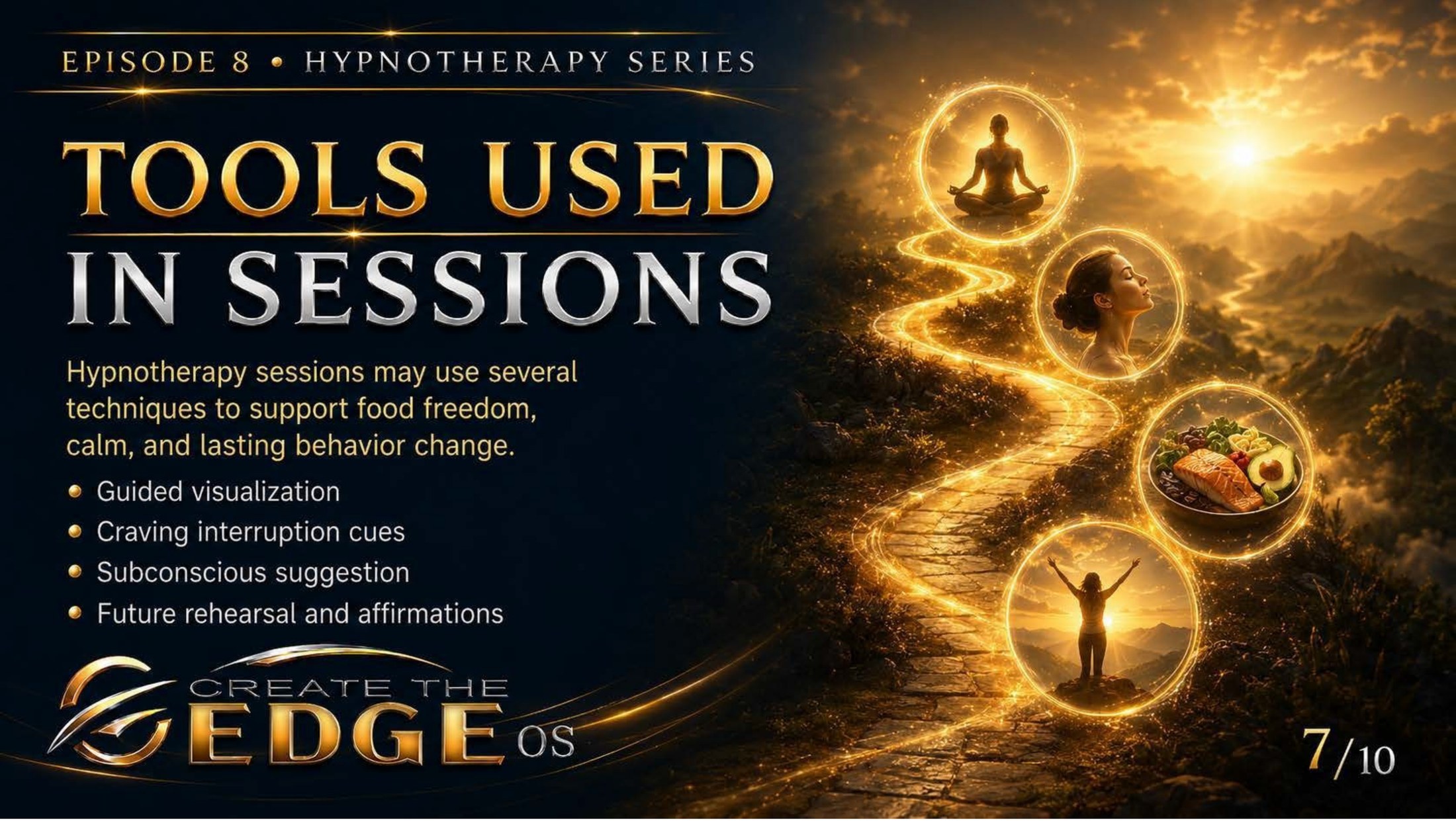
On the slideHypnotherapy sessions may use several techniques to support food freedom, calm, and lasting behavior change: guided visualization · craving interruption cues · subconscious suggestion · future rehearsal and affirmations.
Episode 8 · Slide 7
Tools Used in Sessions
Episode 8 · Slide 7
You might be curious about the actual tools — the techniques that do the work in the relaxed state. Let me pull back the curtain, because there’s nothing secret or strange here; these are gentle, time-tested methods, and knowing them takes away the last of the mystery. Look at the glowing path of images in the slide — meditation, peace, nourishment, joy — and the four tools listed beside it.
Guided visualization. This is the heart of it, and it’s exactly what it sounds like — I guide you to vividly imagine, in rich sensory detail, the change you’re creating. Because here’s the remarkable truth about the deep mind: it doesn’t fully distinguish between a vividly imagined experience and a real one. So when we vividly rehearse you calm around food, confident in your body, free in your choices — your deep mind begins to treat it as something you’ve already done, something familiar and safe. We’re building the new reality in imagination first, so it feels like home when you live it.
Craving interruption cues. We install simple, personal cues — a word, a breath, a gesture — that you can use in the moment a craving strikes to trigger that pause and reset. Little anchors, planted in the calm state, that you can reach for in the storm. They work because they were wired in while your deep mind was open and receptive.
Subconscious suggestion. The gentle offering of new beliefs and patterns directly to the deep mind — the empowering “I care for my body,” “I can trust myself,” “I choose calm” — planted in soil soft enough to receive them, where surface affirmations never reach.
Future rehearsal and affirmations. And we practice the future before you live it — rehearsing you handling the holiday table, the stressful evening, the old triggering moment, with calm and choice. We rehearse the new you until she feels real. So that when the real moment comes, you’re not facing it for the first time — you’ve already practiced it, again and again, in the safe space of the session.
Visualize. Cue. Suggest. Rehearse. Notice that not one of these tools involves force, restriction, or shame. They’re all about gently building the new pattern in the deep mind — making the healthier response familiar, safe, and natural before you ever have to use it in real life. That’s the elegance of this work: by the time you face the old challenge in your actual day, you’ve already walked through it dozens of times in the calm of the session. You’re not improvising under fire. You’re simply doing the thing you’ve practiced — the thing that now feels like you.
On the slideReal change lasts when the inner story changes — from shame and struggle to support, self-respect, and belief: I can trust myself · I care for my body · I can respond differently · I can create lasting change.
Episode 8 · Slide 8
Building a Healthier Identity
Episode 8 · Slide 8
Here is the deepest work of all, the thing that makes everything else hold — and it’s about who you believe yourself to be. Look at the woman in the image, arms thrown wide on the mountaintop above a glowing valley, completely free. The slide tells you the truth at the center of all lasting change: real change lasts when the inner story changes — from shame and struggle to support, self-respect, and belief.
Let me explain why this is the part that makes the difference between change that sticks and change that slips away. Every behavior flows from an identity — from the story you tell about who you are. As long as your inner story is “I’m someone who struggles with food, who can’t be trusted, who always fails, who’s just made this way,” every healthy choice is fighting upstream against that story, and the story usually wins. You can change a behavior for a while, but if the identity underneath still says “this isn’t who I am,” the old self eventually reasserts itself.
So the most powerful thing we do in session isn’t change a behavior — it’s change the story. We shift the inner narrative from shame and struggle to support, self-respect, and belief. And from that new story, the new behaviors flow naturally, because now they’re simply what someone like this does. Read the four new declarations on the slide — these are the new identity, planted at the deepest level:
“I can trust myself.” Rebuilding the self-trust that years of dieting destroyed. Learning, deep down, that you are not an untrustworthy prisoner to be controlled, but a person whose own wisdom can be relied upon.
“I care for my body.” The shift from treating your body as an enemy to subdue to treating it as a home to honor. From criticism to care. From punishment to tenderness.
“I can respond differently.” The freedom of knowing you are no longer trapped in the old automatic reactions — that the pause exists, that choice is real, that you can meet the old triggers in a brand-new way.
“I can create lasting change.” Perhaps the most important of all, especially if you’ve “failed” before — the restored belief that change is genuinely possible for you, that you are not the exception, that lasting freedom is within your reach.
Sit with those four for a moment, and notice which one your deep self most needs to believe — maybe the one that’s hardest to say out loud right now. That’s the one we’d plant first. Because when the inner story changes from shame to belief, you don’t have to force the new life into existence. It grows, naturally, from the new person you’ve become. That’s why this lasts when diets don’t — we don’t just change what you do. We change who you are, at the level of the story. And a changed story changes everything that grows from it.

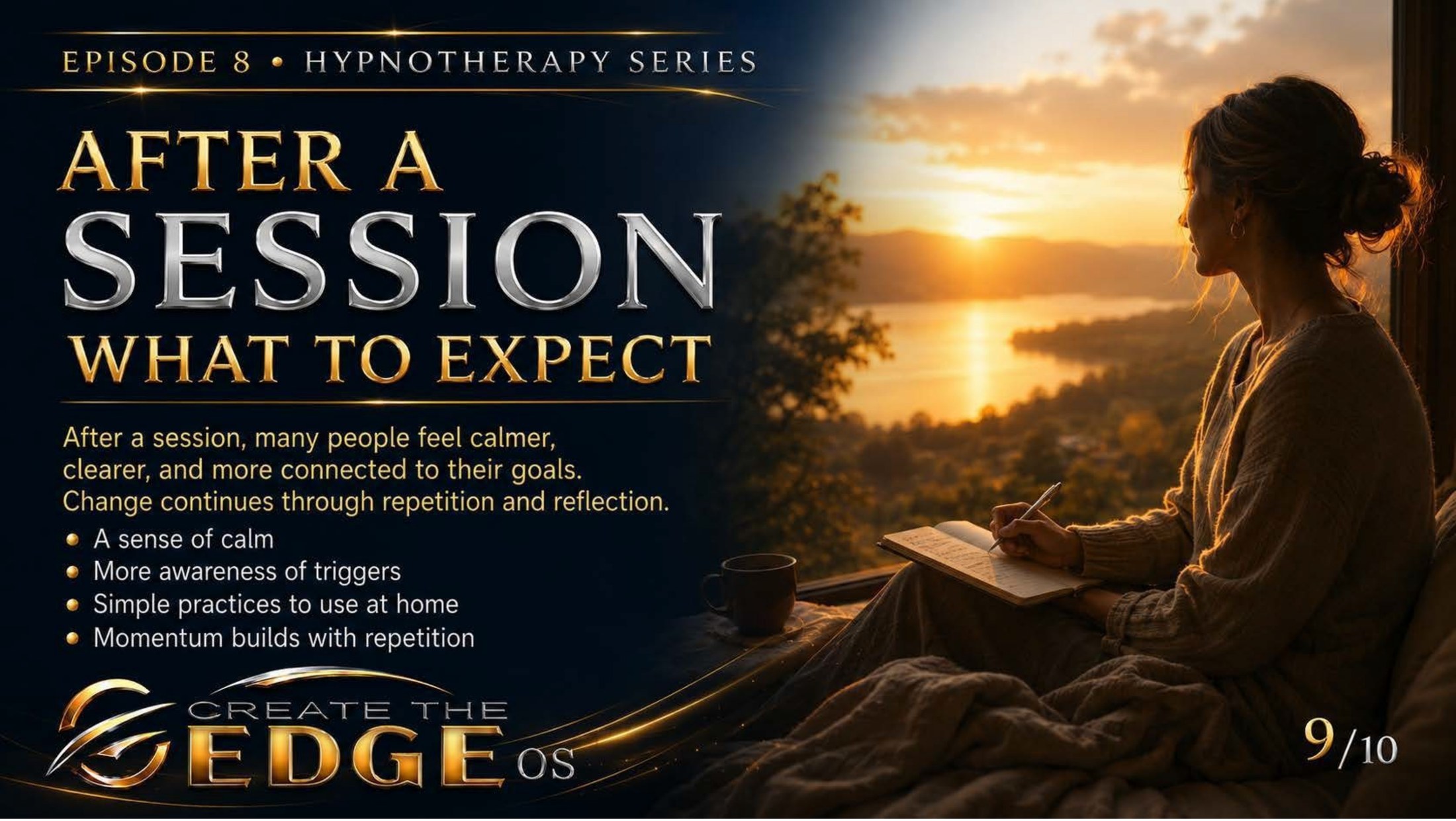
On the slideAfter a session, many people feel calmer, clearer, and more connected to their goals. Change continues through repetition and reflection: a sense of calm · more awareness of triggers · simple practices to use at home · momentum builds with repetition.
Episode 8 · Slide 9
After a Session: What to Expect
Episode 8 · Slide 9
So the session ends — what then? What does it feel like to walk back out into your ordinary life? Look at the woman in the image, wrapped in a soft blanket, journaling peacefully by a window as the sun sets over a golden lake. That quiet, reflective calm is what so many people carry out of a session. The slide describes it: after a session, many people feel calmer, clearer, and more connected to their goals.
Let me set a gentle, honest expectation, because this matters. Sometimes there’s a dramatic shift right away — a craving that simply isn’t there anymore, a peace around food that feels almost startling. That happens, and it’s wonderful. But more often, and just as powerfully, the change is quieter — a growing calm, a new awareness, a subtle but real shift in how you meet the old moments. Both are the work taking hold. Don’t measure success only by lightning bolts; the steady dawn changes the sky just as completely. Look at the four things the slide says to expect.
A sense of calm. Many people leave a session noticeably calmer — the nervous system settled, the inner noise quieted. And since so much difficult eating was driven by stress and overwhelm, this calm alone begins to change everything, gently, from underneath.
More awareness of triggers. You start noticing — catching the trigger as it fires, recognizing the craving for what it is, seeing the pattern in real time instead of only realizing it afterward. This awareness is its own quiet revolution, because you can’t change what you can’t see, and now you can see.
Simple practices to use at home. You don’t leave empty-handed. You carry out simple tools — the pause, the breath, the cue, the affirmation — to use in your daily life between sessions. The work doesn’t stay locked in the room. It comes home with you, in your own hands.
Momentum builds with repetition. And here’s the most important expectation of all, the one that makes this whole thing work: change continues through repetition and reflection. A single session plants seeds. Repetition and practice are the water and sunlight that grow them. Each time you use the practices, each time you reflect, the new patterns strengthen and the momentum builds — every supportive choice making the next one easier.
So please be patient and kind with the process, and with yourself. This isn’t a magic pill that erases a lifetime of patterns in an hour — nothing real works that way, and anyone promising that is selling you the same false hope as the diets. This is the steady, gentle, root-level rebuilding of how you relate to food and to yourself. It unfolds over time, through repetition and reflection, with calm growing and momentum building. And that slow, real way — that’s exactly why it lasts.
On the slideYou do not have to fight food addiction or weight loss alone. Ongoing support helps the mind practice a new path until it feels natural: weekly or regular sessions · reinforce new patterns · practice between sessions · build lasting food freedom.
Episode 8 · Slide 10
Your Next Step Forward
Episode 8 · Slide 10
Look at this final image — a great wooden door standing open in a stone wall, golden light pouring through, a flagstone path winding out into a glowing valley of hills and sunrise. That’s your next step forward, and it leads somewhere beautiful. But before we walk the four practical steps in the workbook below, let the most important line on the slide land all the way in, because it may be the thing you most need to hear: “You do not have to fight food addiction or weight loss alone.”
Alone. For so many of us, that’s been the whole heavy truth of this struggle — fighting it in secret, in shame, in isolation, certain no one understood, certain we had to white-knuckle our way through it by ourselves. I lived that aloneness, and I want you to know with everything in me: it was never necessary, and it isn’t now. The slide names the gentler way: ongoing support helps the mind practice a new path until it feels natural. Now, the four steps forward.
One: Weekly or regular sessions. Lasting change isn’t built in a single dramatic moment — it’s built through consistent, supported practice over time. Regular sessions give the new patterns the repetition they need to take root and hold. Steady support, not a one-time fix.
Two: Reinforce new patterns. Each session reinforces the new wiring — deepening the calm, strengthening the pause, planting the empowering beliefs a little more firmly — the way you’d water a young plant until its roots go deep enough to stand on their own.
Three: Practice between sessions. The real change happens in your daily life, with the simple tools you carry home. The pause before a craving. The breath. The kind word to yourself. The affirmation. Practiced in the ordinary moments, between sessions, until the new path is more worn than the old one.
Four: Build lasting food freedom. And step by step, session by session, practice by practice, you build something diets could never give you — not a temporary loss followed by a familiar regain, but lasting food freedom. A genuinely new, peaceful, trusting relationship with food and with yourself.
Support. Reinforce. Practice. Build. And through all of it, remember the gentlest truth of this whole journey, the one to carry on the days you stumble: we don’t fail, we fall forward. A hard day isn’t a collapse and it isn’t the end of your progress — it’s just a teacher, and tomorrow brings a fresh chance. You don’t start over. You continue, with support beside you.
And friend — I have walked through this exact door myself, out of the struggle and the shame and the aloneness, into freedom and peace and a body I could finally live in with joy. I didn’t do it by fighting harder or shaming myself more. I did it with support, repetition, and a new belief about who I am. If I found my way through that door, so can you — and you don’t have to do it alone. So let’s take the first step right now, in your own handwriting below. The door is open. The valley is glowing. And I’m right here beside you, walking it together. No more fighting alone — just the path, the light, and your next step forward.