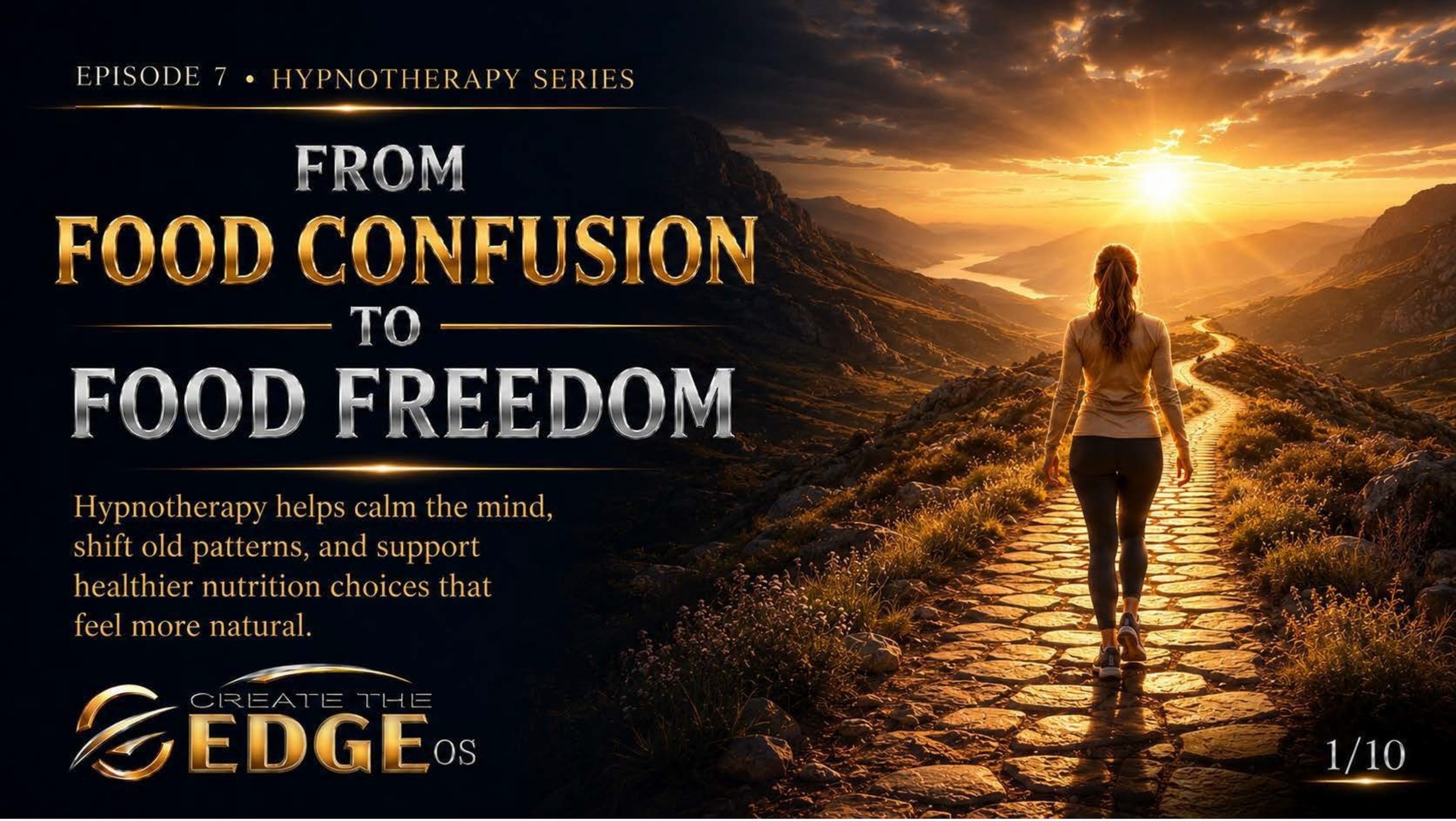
On the slideHypnotherapy helps calm the mind, shift old patterns, and support healthier nutrition choices that feel more natural.
Episode 7 · Slide 1
From Food Confusion to Food Freedom
Episode 7 · Slide 1
Let me ask you something, and I want you to answer honestly: do you even know what you’re “supposed” to eat anymore?
Because if you’re like most people I’ve sat with, the answer is a exhausted, bewildered no. One expert swears by one thing, another swears it’s poison. Carbs are evil, then carbs are fine, then it’s only certain carbs, at certain times, unless the moon is full. Eat six small meals. No — fast for sixteen hours. This food is a miracle; this same food gives you a disease. The noise is deafening, and it never, ever stops. And underneath all of it sits a quietly panicked person just trying to figure out what to put on a plate without feeling like they’re failing a test no one ever explained.
That’s food confusion. And I want you to hear me clearly: it is not your fault. You are not stupid for being confused. You’ve been standing in a hurricane of contradictory information for years, much of it designed to sell you something, and the confusion is the entirely sane response to genuine chaos.
Look at the woman in this image — walking a golden stone path up through the mountains toward a sunrise breaking over a valley. She’s not frozen at a crossroads anymore, paralyzed by which expert to believe. She’s simply… walking. Forward. At peace. That’s where we’re headed: out of the noise and into food freedom.
And read the slide carefully, because it tells you exactly how we get there — and it’s not by adding another rulebook to the pile. Hypnotherapy helps calm the mind, shift old patterns, and support healthier choices that feel more natural.
Notice what’s missing from that sentence: no diet. No forbidden list. No numbers to obsess over. Because here’s the truth the whole noisy industry doesn’t want you to know — the problem was never that you didn’t have enough information. Good heavens, you’re drowning in information. The problem is that all that information lives up in the anxious, confused, chattering surface mind — and it never reaches the deep place where your actual eating choices are made.
So we’re not going to add to the noise. We’re going to do the opposite. We’re going to turn the noise down, calm the confused mind, and reconnect you with something you had as a child and lost somewhere in the hurricane: a quiet, natural, trustworthy sense of how to nourish yourself. It’s still in there. Let’s go find it together.
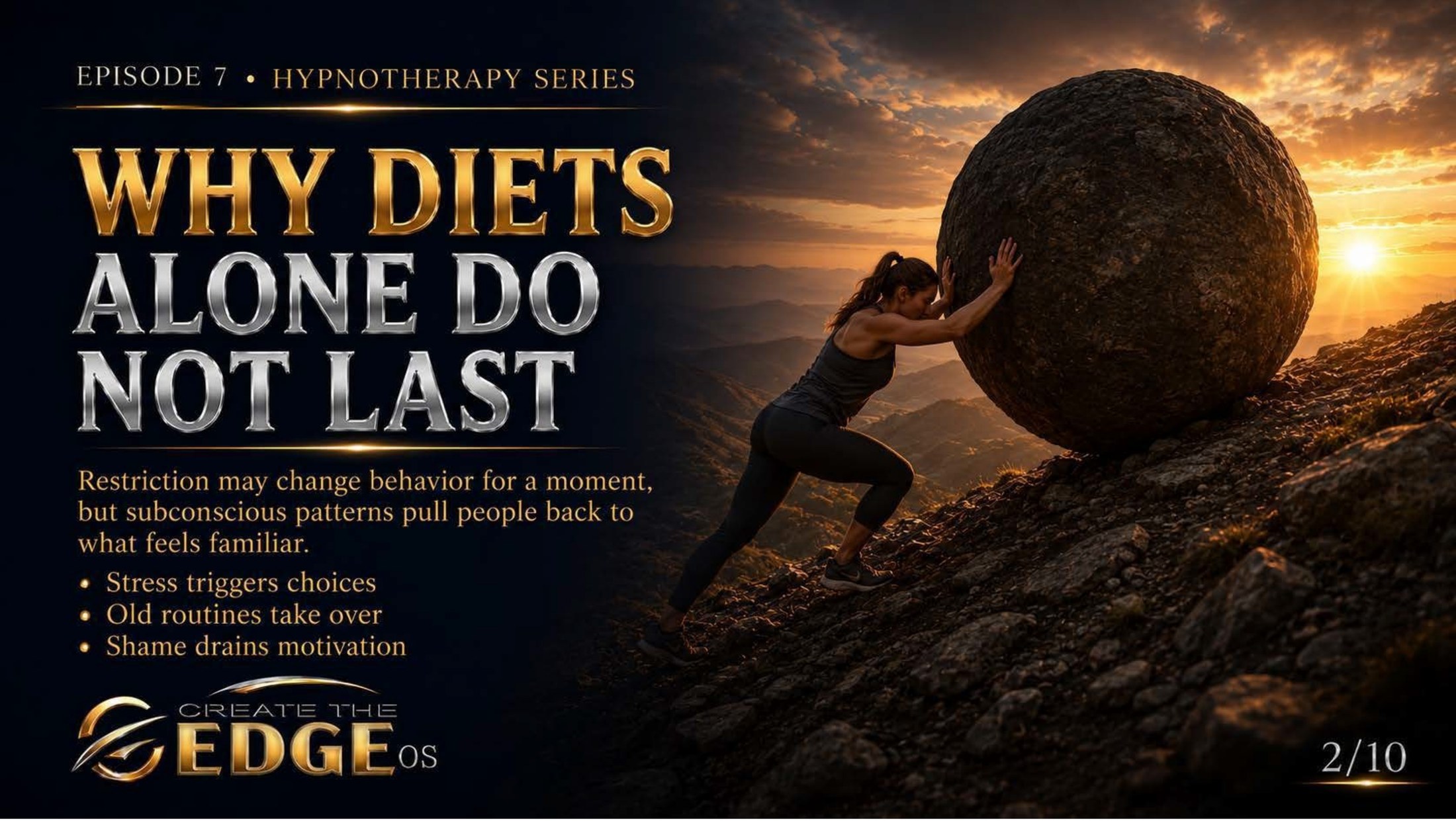
On the slideRestriction may change behavior for a moment, but subconscious patterns pull people back to what feels familiar: stress triggers choices · old routines take over · shame drains motivation.
Episode 7 · Slide 2
Why Diets Alone Don’t Last
Episode 7 · Slide 2
Look at the woman pushing the boulder up the hill again — and let me say something that might be the most freeing sentence you’ve read in years: if every diet you’ve ever tried eventually failed, the diets failed you. You did not fail them. The slide names exactly why: restriction may change behavior for a moment, but subconscious patterns pull people back to what feels familiar.
Here’s the dirty secret of the diet industry, and once you see it you can never unsee it: diets have something like a famously dismal long-term success rate. The overwhelming majority of people who lose weight by restriction gain it back, and often more. Now — if a medicine failed that often, we’d pull it from the shelves. But we don’t blame the diet. We blame the dieter. We say she lacked willpower, she fell off the wagon. We’ve been taught to take a method that fails almost everyone and conclude that the failure is personal. That’s not just wrong — it’s cruel.
Why does restriction fail so reliably? Because a diet works only on the surface — the conscious mind, white-knuckling a set of rules. But the rules are fighting against the entire vast subconscious underneath, and the subconscious, as we learned, clings to what’s familiar. The old patterns are deep grooves; the new restriction is a thin scratch. The moment willpower tires — and willpower always tires — the deep grooves pull you right back. The slide names the three forces doing the pulling:
Stress triggers choices. The diet has no answer for the 9 p.m. stress flood; restriction just makes the stress worse, and stress reaches past every rule.
Old routines take over. The familiar autopilot patterns are still wired in underneath; the diet never touched them, so the moment attention lapses, they resume.
Shame drains motivation. And the cruelest part — the all-or-nothing rules guarantee you’ll “break” them, and breaking them brings shame, and shame collapses the whole effort and sends you back to comfort. The diet is practically designed to produce the shame that defeats it.
So please — set down the boulder, and set down the decade of self-blame that came with it. You were never weak. You were using a tool that fails almost everyone, and then being told the failure was your character. It wasn’t.
We’re going to do something diets can’t: go beneath the surface, to where the patterns actually live, and shift them at the source — so that healthier choices stop requiring a war with yourself and start feeling, at long last, natural. Not restriction. Reconditioning. There’s a world of difference, and it’s the difference between a struggle that always ends the same way and a freedom that finally lasts.
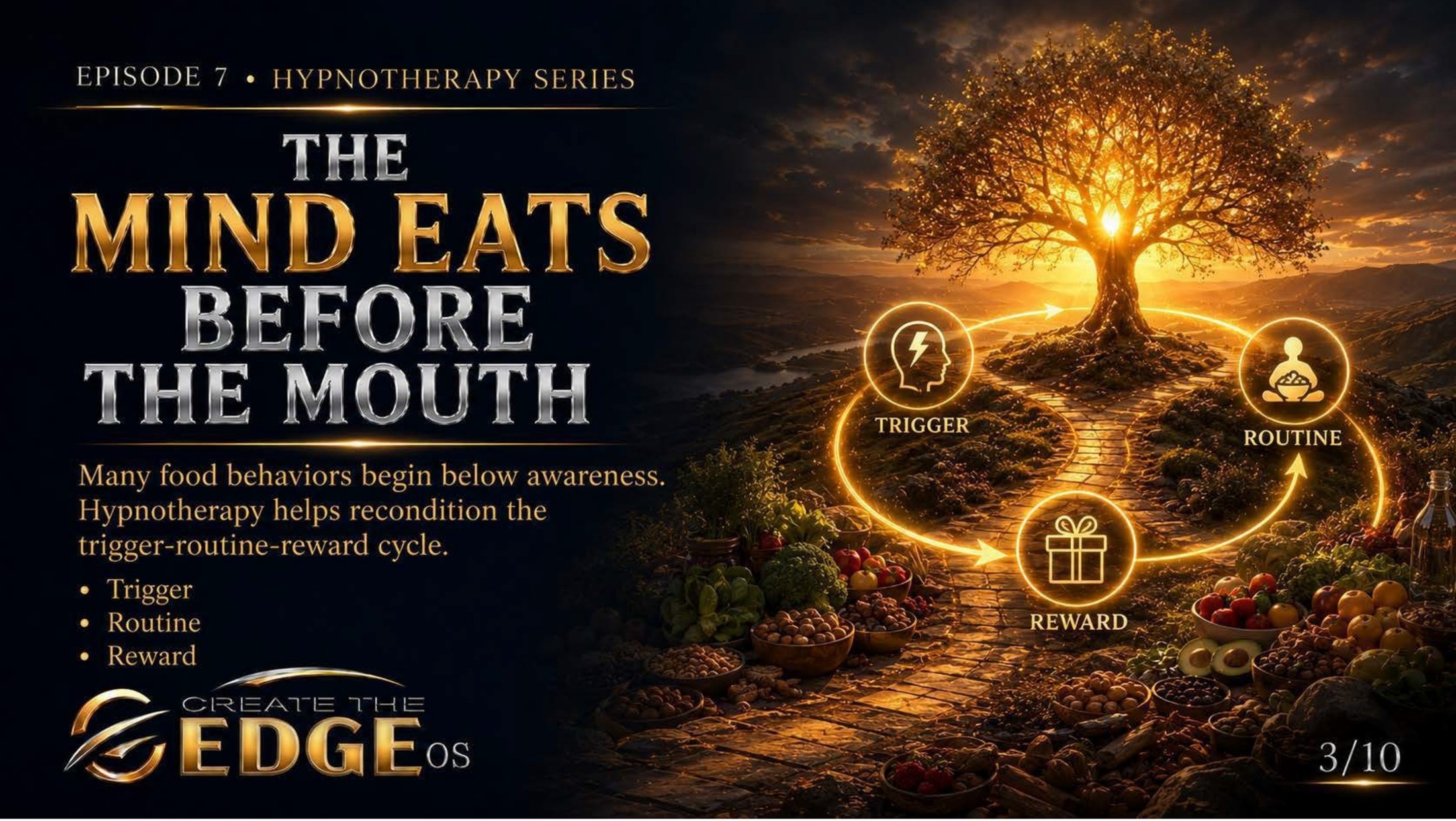
On the slideMany food behaviors begin below awareness. Hypnotherapy helps recondition the trigger-routine-reward cycle: Trigger → Routine → Reward.
Episode 7 · Slide 3
The Mind Eats Before the Mouth
Episode 7 · Slide 3
I love the title of this slide, because it captures something most diet books completely miss: the mind eats before the mouth. Look at the image — the tree of light, the habit loop circling it, and the whole scene surrounded by an abundance of real, beautiful food. The slide tells the truth that changes everything: many food behaviors begin below awareness.
Think about that. By the time the food reaches your mouth, the real decision was already made — made somewhere down in the deep mind, seconds or even minutes earlier, below the level of conscious choice. The mouth is just carrying out an order the mind already gave. Which means all the willpower in the world, applied at the mouth, is arriving far too late. The decision happened upstream, in the dark.
And that decision runs on the loop you already know: Trigger. Routine. Reward. A cue fires below awareness, the routine runs on autopilot, the reward lands and reinforces the whole circuit. You’ve seen this loop govern habits and cravings. Here’s the specific gift of this chapter: the slide says hypnotherapy helps recondition that cycle.
Recondition. Sit with that word, because it’s so much kinder and so much more effective than “restrict.” We’re not slapping rules on top of a loop that’s running underneath. We’re going down into the loop and gently rewiring it at the level where it actually operates — below awareness, where the mind eats before the mouth.
Because here’s the thing: you already have automatic food behaviors. Everyone does. The question isn’t whether your eating runs on autopilot — most of it always will, and that’s fine, that’s normal, you don’t want to consciously deliberate over every bite for the rest of your life. The question is whether the autopilot is set to patterns that serve you or patterns that quietly work against you. And autopilot, unlike willpower, can be reprogrammed.
That’s the whole strategy, and it’s why it lasts when diets don’t. We don’t ask your exhausted conscious mind to fight your automatic patterns forever — a war it will always eventually lose. We change the automatic patterns themselves, down where they live, so that the new, nourishing choices become the autopilot. So that the mind, eating before the mouth, starts ordering something that actually loves you back.
Change happens upstream, in the deep water where the real decisions are made. That’s exactly where we’re going to work — and it’s exactly why this can finally be different.
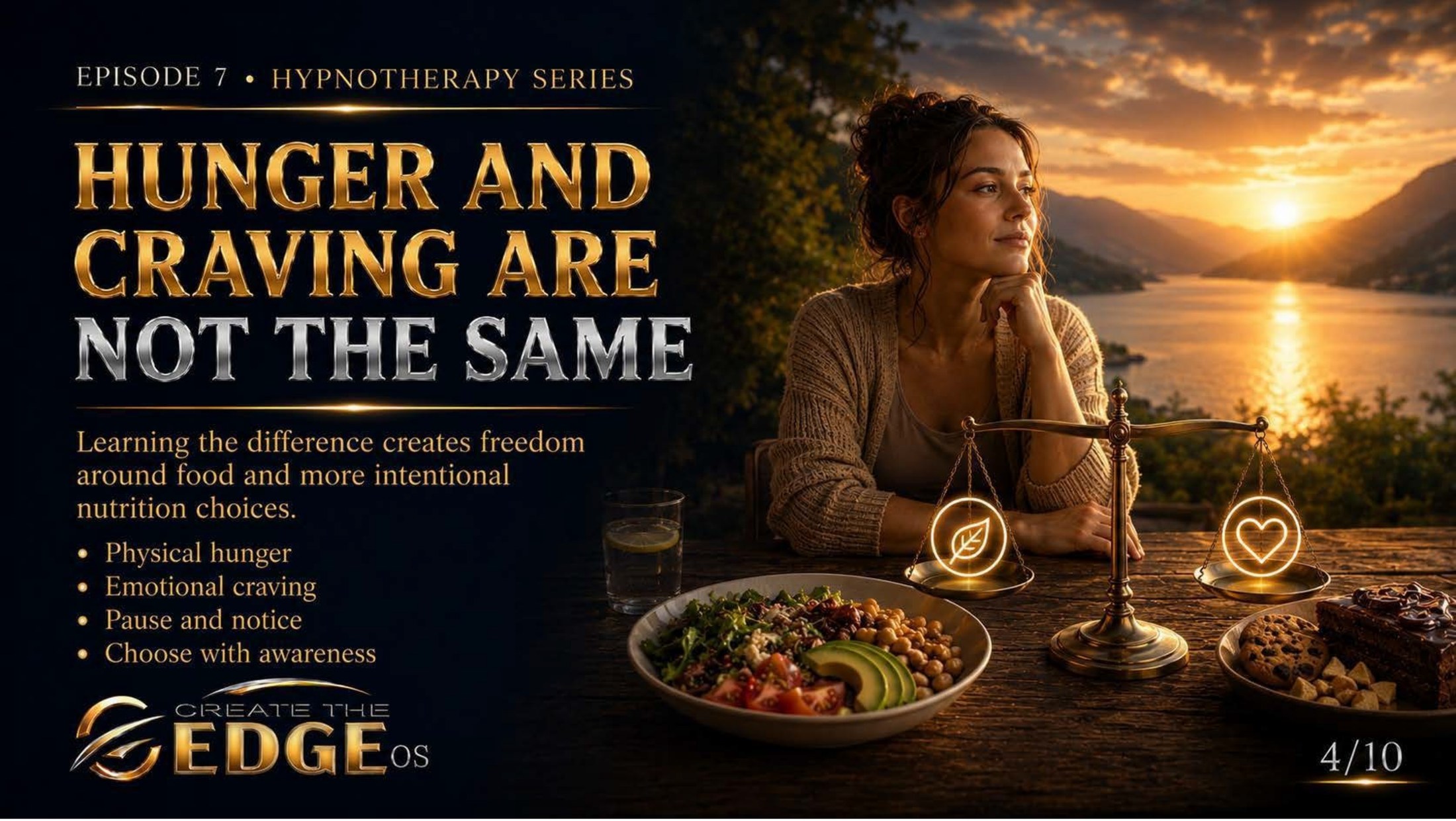
On the slideLearning the difference creates freedom around food and more intentional choices: physical hunger · emotional craving · pause and notice · choose with awareness.
Episode 7 · Slide 4
Hunger and Craving Are Not the Same
Episode 7 · Slide 4
Here is a single distinction that, once you truly grasp it, can transform your entire relationship with food. Look at the image — a woman gazing thoughtfully out at a golden lake, and between two plates, a glowing balance scale weighing a leaf against a heart. That scale is the whole lesson: hunger and craving are not the same.
We use one word — “hungry” — for two completely different experiences, and that single confusion drives an enormous amount of our struggle. Let me untangle them for you, because the slide names both.
Physical hunger is your body’s genuine, biological need for fuel. It builds gradually. It’s felt in the body — the empty stomach, the dip in energy, the quiet clarity that “it’s time to eat.” It’s patient; it can wait a little. It’s satisfied by a range of foods, and once you’re fed, it’s content and goes quiet. Physical hunger is your body being a wise, honest messenger. It deserves to be answered, not ignored or feared.
Emotional craving is a different creature entirely. It comes on suddenly — zero to urgent. It’s felt in the mind and the emotions more than the belly. It’s impatient; it wants relief now. It’s usually specific — not “some food,” but that food, the comfort food, the one that soothes. And crucially, even after you’ve eaten it, the craving often isn’t truly satisfied — because the real need was never food in the first place. It was the feeling underneath, reaching for comfort in the only language it knew.
Do you see how much freedom lives in simply telling these two apart? So much of our struggle comes from treating every urge to eat as if it were physical hunger — and then feeling ashamed when feeding it doesn’t satisfy us, when we “shouldn’t” still want more. But of course feeding it didn’t satisfy you. You were answering loneliness with a sandwich. The sandwich was never going to work, no matter how much you ate, because it was the wrong answer to the actual question.
The slide gives you the practice, and it’s beautifully simple: pause and notice, choose with awareness. When the urge to eat arises, just pause — a breath — and ask, with curiosity rather than judgment: “Is this my body, or my heart? Is this physical hunger, or an emotional craving?”
Neither answer is wrong, and neither is shameful. If it’s physical hunger — wonderful, nourish your body, it’s asking honestly. If it’s an emotional craving — also wonderful, because now you know, and you can choose: tend the real feeling directly, or eat with full awareness instead of confused autopilot. Either way, you’ve traded confusion for clarity, and reaction for choice. That clarity — that simple ability to tell your body from your heart — is one of the truest forms of food freedom there is.
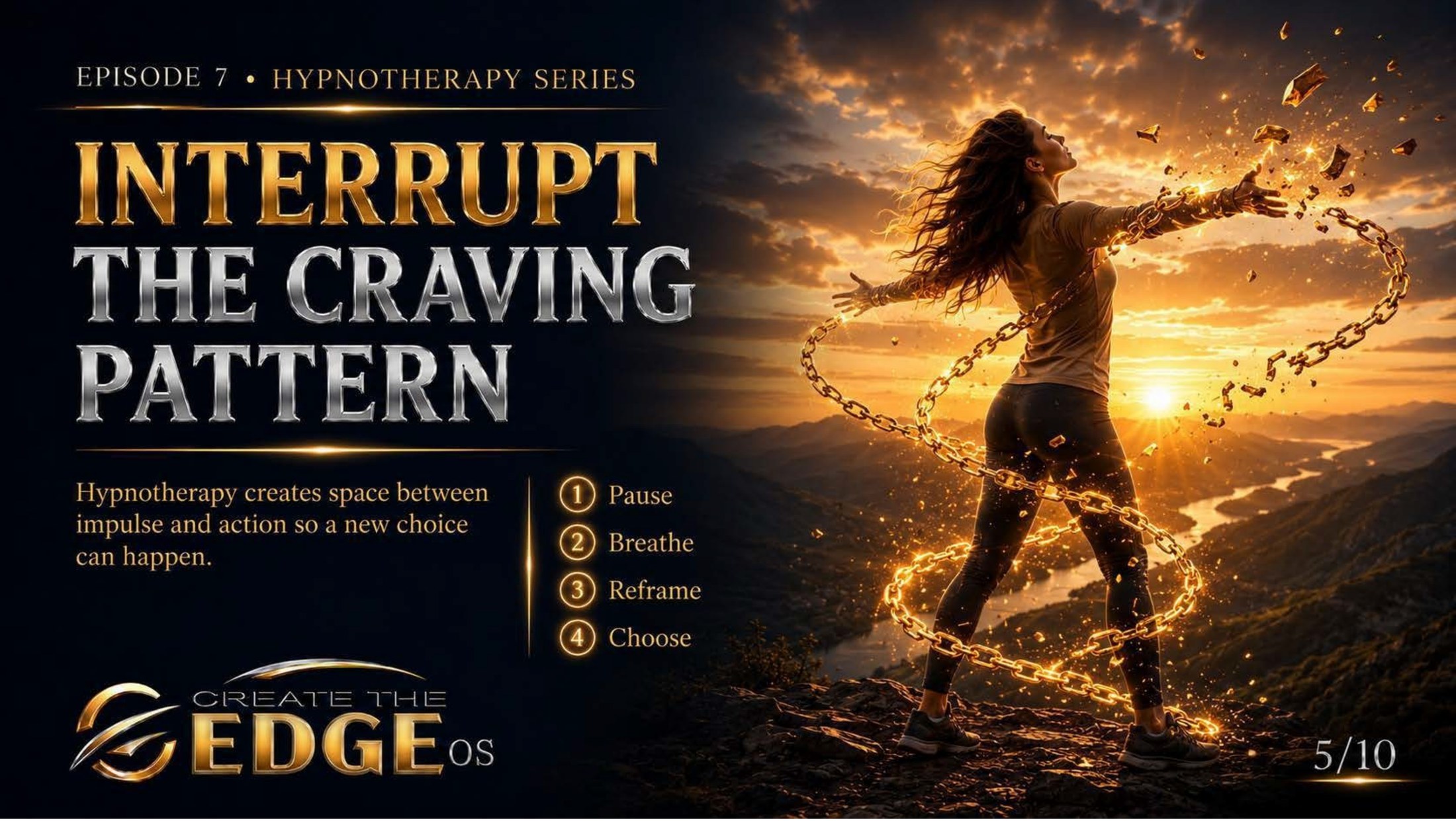
On the slideHypnotherapy creates space between impulse and action so a new choice can happen: Pause · Breathe · Reframe · Choose.
Episode 7 · Slide 5
Interrupt the Craving Pattern
Episode 7 · Slide 5
Once you can tell a craving from true hunger, the next skill is knowing what to do with a craving when it rises — and the answer is not “fight it harder.” Look at the woman in the image, chains of light unwinding and shattering from around her as she opens to the sky. The slide gives the four steps that loosen them: Pause. Breathe. Reframe. Choose. And the key promise: hypnotherapy creates space between impulse and action so a new choice can happen.
That phrase — space between impulse and action — is the entire secret. A craving feels overpowering precisely because it collapses the gap between wanting and doing into nothing. Impulse and action become a single motion; you’re eating before you ever chose to. So we don’t try to defeat the craving by force. We simply reopen the gap. We slip a little space back in between the impulse and the action — and in that space, freedom returns.
Pause. The instant you notice the craving, you pause. That’s it — just a stop, a held breath, a moment of not-yet. This tiny act is revolutionary, because it breaks the automatic motion. The craving expected to go straight to action, and instead it hits a pause. Already, you’ve reclaimed a sliver of choice.
Breathe. Then a few slow breaths. This isn’t a throwaway — it’s physiology. Slow breathing calms the nervous system, and a craving is often riding a wave of stress or activation. Calm the body even slightly, and the craving’s desperate intensity begins to drop from a roar to a voice you can actually reason with.
Reframe. Now, with a little space and a little calm, you ask the real question — the one from the last slide: is this hunger or craving? And if it’s a craving, what do I actually need? You reframe the craving from “an enemy command” into “a message to read.” Naming the true need takes the white heat out of it, almost like magic.
Choose. And now — a genuine choice, made by you. Maybe you tend the real need. Maybe you decide to eat, fully and without guilt, from awareness instead of autopilot. Both are free choices, and both are wins, because the point was never to “win” against the craving — the point was to choose instead of being driven.
Pause. Breathe. Reframe. Choose. Notice that not one of these steps is about gritting your teeth and resisting. They’re about reopening the space where your freedom lives. The chains in that image aren’t breaking because she’s straining against them — they’re dissolving because she stopped struggling and simply stepped into the space. That space is always available to you, in any moment, with any craving. We build it gently, and we strengthen it with practice, until pausing before a craving becomes as natural as the craving itself once was.
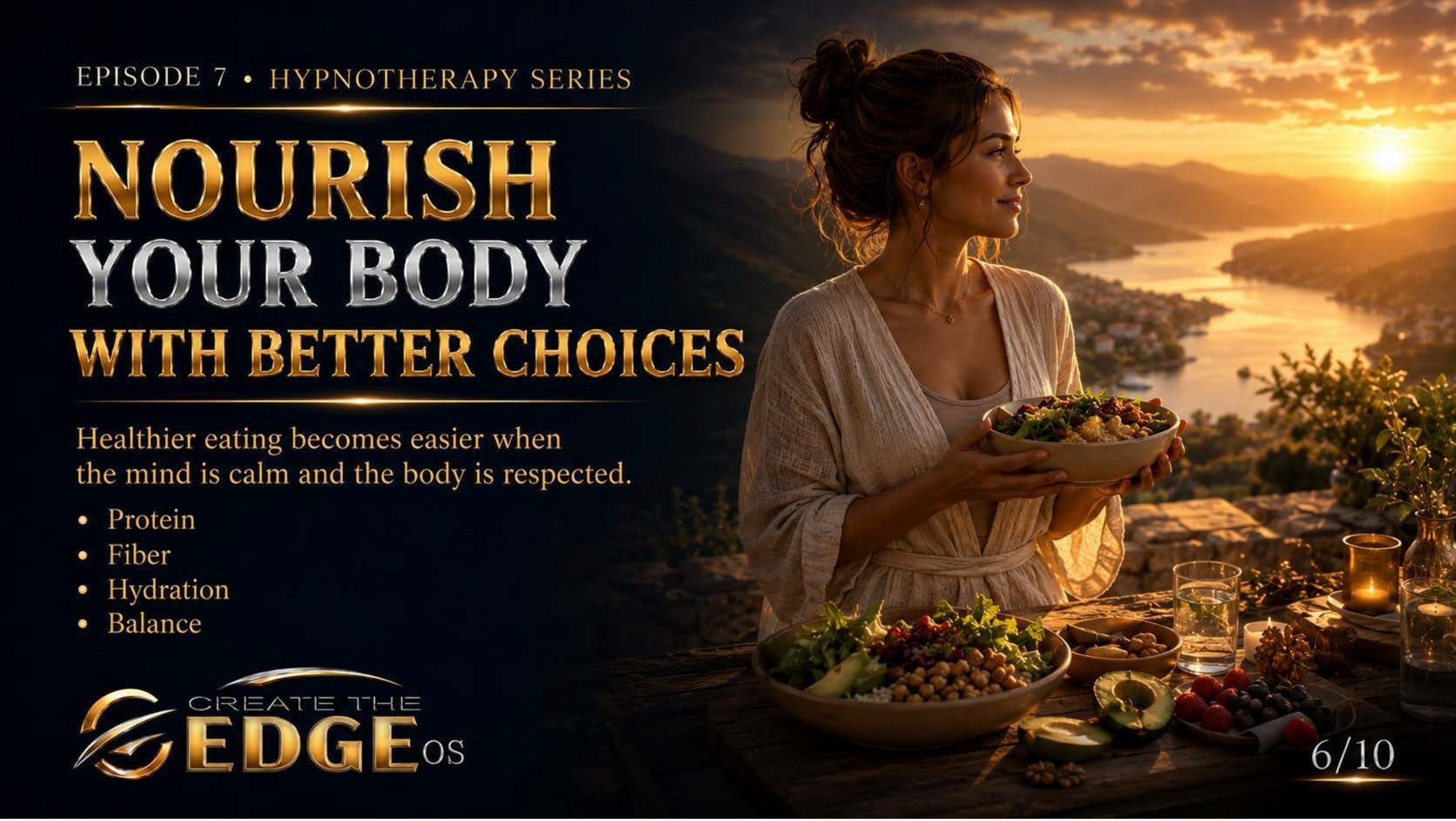
On the slideHealthier eating becomes easier when the mind is calm and the body is respected: protein · fiber · hydration · balance.
Episode 7 · Slide 6
Nourish Your Body With Better Choices
Episode 7 · Slide 6
Now — finally — let’s talk about actual food, but notice the word the slide uses, and notice the word it pointedly does not use. It says nourish. It does not say restrict, forbid, count, or earn. Look at the woman in the image, holding a beautiful bowl of real food, the golden lake glowing behind her, utterly at peace. The slide gives you the whole liberating principle: healthier eating becomes easier when the mind is calm and the body is respected.
Read that again, because it reverses everything the diet world taught you. The diet world says: get the eating right through force, and maybe then you’ll feel calm. This says the opposite, and it’s the truth: get calm and respectful first, and the healthier eating follows more easily. The calm isn’t the reward for good eating. The calm is what makes good eating natural.
And look at how gentle, how un-confusing the slide’s guidance is. After the hurricane of contradictory diet rules, here are just four humble, steady, uncontroversial words: protein, fiber, hydration, balance. That’s it. Not a complicated regimen. Not a forbidden list. Not a single thing you need a degree to understand. Just a few simple anchors of nourishment that nearly every sane voice agrees on — the calm center of the storm.
Protein — building blocks that help you feel satisfied and steady. Fiber — the goodness in plants that helps you feel full and well. Hydration — water, the most overlooked foundation, so often the real answer to what we mistake for hunger. Balance — the gentlest word of all, the one that ends the all-or-nothing madness. Not perfection. Not purity. Balance.
I’m not going to turn this into a nutrition lecture, because that would just be adding to the noise this chapter is trying to quiet. The point is not the specifics — you can always learn more about nourishment from good, calm sources when your mind is settled enough to hear them. The point is that when the inner confusion clears and the shame lifts and the body is respected, choosing nourishing food stops being a battle and starts being an act of self-care.
Think of the difference. When you eat from anxiety and self-hatred, every food choice is a fraught, exhausting test. But when you eat from calm and respect — when you genuinely care for the body you live in — nourishing it becomes the obvious, natural, even pleasurable thing to do. Not because a rule demands it. Because you’d no more neglect a body you respect than you’d neglect a friend you love.
That’s food freedom. Not a perfect diet. A calm mind, a respected body, and a few simple anchors of nourishment — followed not by force, but because they’re what someone who cares for herself naturally chooses.
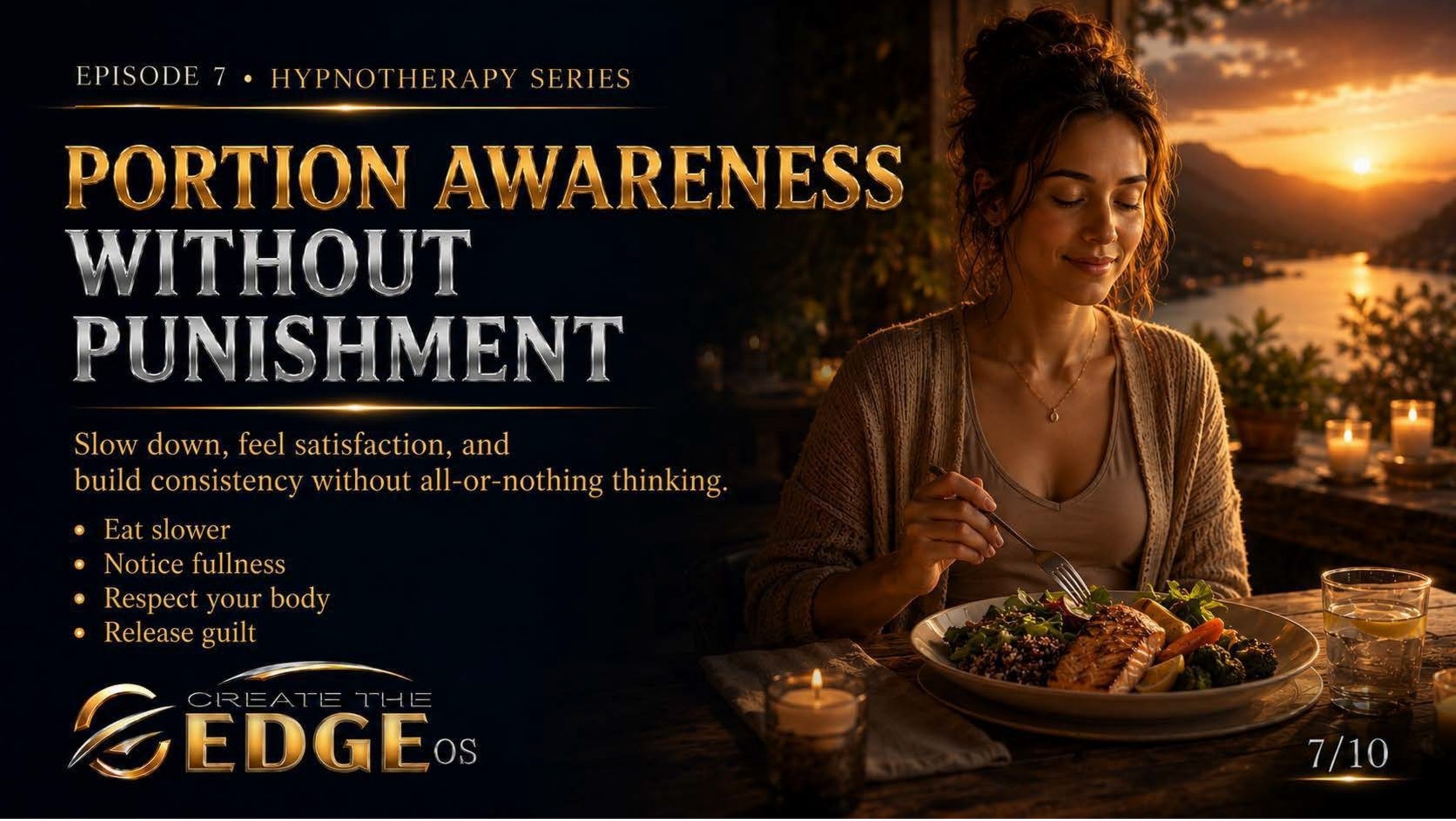
On the slideSlow down, feel satisfaction, and build consistency without all-or-nothing thinking: eat slower · notice fullness · respect your body · release guilt.
Episode 7 · Slide 7
Portion Awareness Without Punishment
Episode 7 · Slide 7
This slide’s title might be my favorite in the whole chapter, because it holds two ideas that the diet world insists can’t coexist: portion awareness without punishment. Look at the woman in the image — eyes closed, a small contented smile, savoring a meal by candlelight over a golden lake. That is not the face of someone restricting. That’s the face of someone enjoying. And the slide tells you the goal: slow down, feel satisfaction, and build consistency without all-or-nothing thinking.
Let me name the trap this rescues you from, because nearly everyone who has ever dieted has lived inside it: all-or-nothing thinking. You know the cycle. You’re “being good,” perfectly on-plan, white-knuckling it. Then you have one thing you “shouldn’t,” and — because the whole thing was all-or-nothing — you’ve now “blown it,” so you might as well abandon the entire day, the entire week, the entire effort. One cookie becomes a collapse. The perfectionism doesn’t protect you from overeating; it causes the overeating, by making every small slip into a total failure.
Awareness without punishment breaks that brutal cycle. Look at the four gentle practices on the slide — not one of them is a rule or a restriction.
Eat slower. This is almost magical in its simplicity. Your body needs time to register that it’s been fed — a real, physical delay between eating and the signal of fullness arriving. When you race through a meal, you blow right past that signal before it ever arrives. Slowing down simply lets your own body do its honest job of telling you when it’s content.
Notice fullness. So many of us long ago lost touch with our body’s quiet “I’m satisfied now” signal — buried it under diet rules, distraction, and the habit of eating until the plate is empty rather than until the body is content. Awareness is simply reconnecting with that signal, learning again to feel it and — gently — to honor it.
Respect your body. The thread running through this whole book. You treat a respected body kindly — you feed it when it’s hungry, you stop when it’s content, you don’t punish it or force it. Respect, not control.
Release guilt. And there it is again — the single most important release in this entire territory. Guilt has never once made anyone healthier; it only feeds the shame-and-restriction loop that keeps the whole struggle spinning. When you can eat — anything, any amount, on any day — without guilt, you finally step off the cycle altogether. You’re not “being good” or “being bad” anymore. You’re just a person, eating, with awareness and without shame.
Slow down. Notice. Respect. Release. This is awareness as kindness, not awareness as surveillance. The goal was never a smaller portion forced by guilt. It was a calmer, more present, more self-respecting way of eating — where consistency grows not from punishment, but from peace.
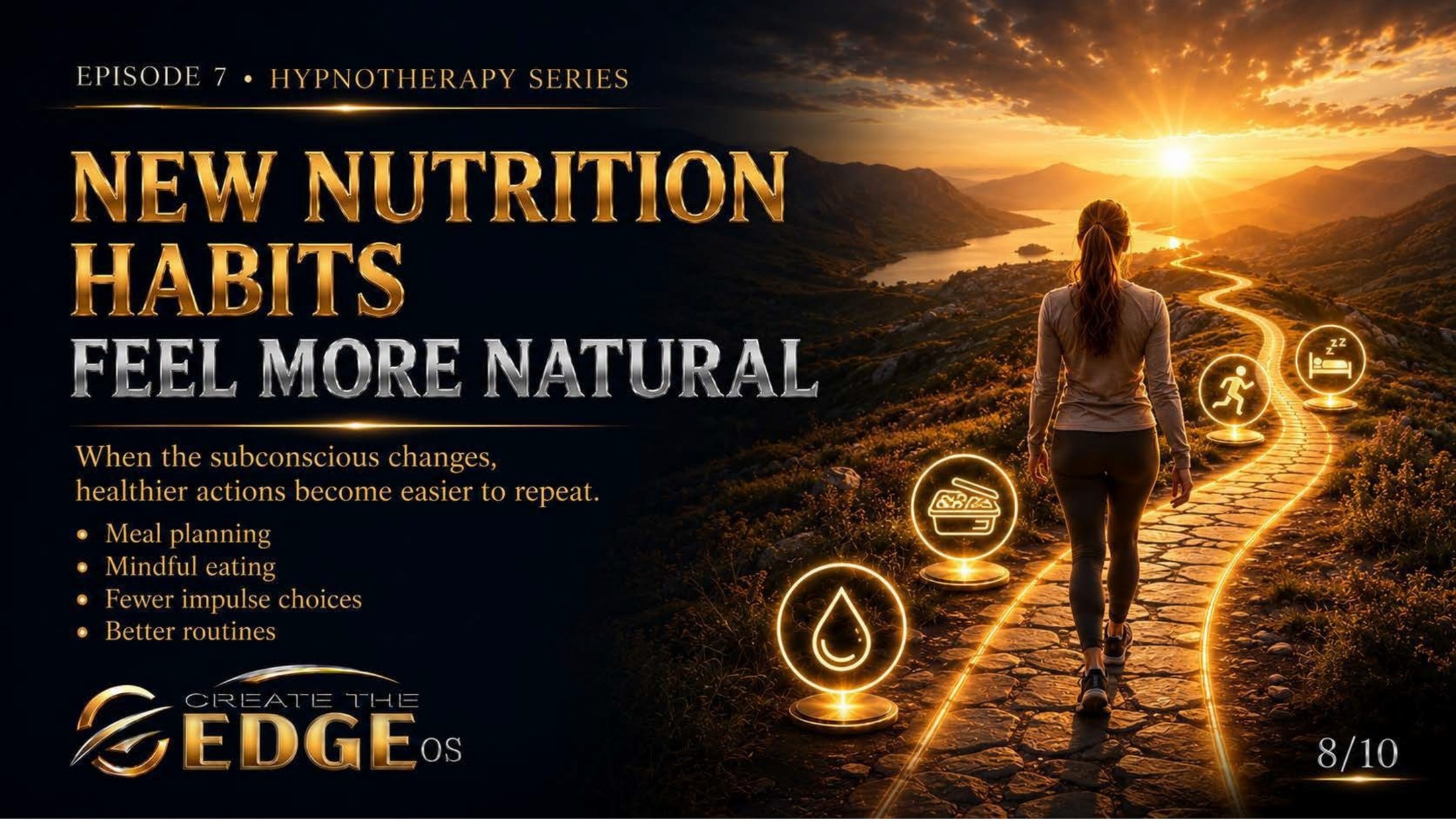
On the slideWhen the subconscious changes, healthier actions become easier to repeat: meal planning · mindful eating · fewer impulse choices · better routines.
Episode 7 · Slide 8
New Nutrition Habits Feel More Natural
Episode 7 · Slide 8
Here’s the moment the deep work pays off — where healthy living stops feeling like a daily uphill fight and starts feeling, simply, like you. Look at the winding golden path in the image, lit by glowing stones, the woman walking it with ease toward the sunrise. The slide names the secret behind that ease: when the subconscious changes, healthier actions become easier to repeat.
This is the whole promise of working at the deep level instead of the surface. When you only change behavior through willpower, every healthy action requires a fresh act of force, forever, until you burn out. But when you change the patterns underneath — recondition the autopilot, calm the confusion, shift the identity — the healthy actions stop requiring force. They start flowing naturally from who you’ve become. Look at the four glowing stones, and notice how ordinary and humane they are.
Meal planning. Not a rigid regimen — just a little gentle forethought, so you’re not making every food decision from the desperate, depleted place of “I’m starving and there’s nothing here.” A bit of calm planning removes a thousand impulse moments before they ever arise. It’s not control. It’s kindness to your future self.
Mindful eating. The practice we keep returning to — being present while you eat, tasting, slowing, noticing. As the subconscious shifts, this stops being a discipline you impose and becomes simply how you naturally tend to eat.
Fewer impulse choices. Watch this one, because it’s the proof the deep work is landing. You don’t white-knuckle your way to fewer impulse choices — you can’t, that’s a losing fight. They simply decrease on their own as the craving patterns get reconditioned and the calm grows. Fewer impulses isn’t the result of more restraint. It’s the result of less internal noise.
Better routines. And gradually, the daily rhythms around food reorganize themselves around the new you — the new autopilot — until nourishing yourself well is just… the routine. The default. The path of least resistance instead of the path of constant struggle.
Plan. Savor. Ease. Repeat. And here’s the promise the slide makes that I want you to truly trust: these become easier to repeat. Not because you’ll summon superhuman discipline, but because you’ll have changed the person doing the choosing. The healthy life stops being a wall you scale every single day — and becomes, simply and naturally, the path you walk. That’s the difference between fighting your way to health and growing into it. One exhausts you. The other carries you.
On the slideWhen identity shifts from criticism to self-care, lasting change becomes easier. This is how change lasts.
Episode 7 · Slide 9
Weight Loss Follows Self-Trust
Episode 7 · Slide 9
We arrive now at the deepest truth of this entire chapter, and it turns everything you’ve ever been taught about willpower and food completely upside down. Look at the woman in the image — standing at the railing above a glowing valley, arms thrown open to the sunrise, utterly free. The slide says it plainly: when identity shifts from criticism to self-care, lasting change becomes easier.
Notice the word that titles this slide: self-trust. Not self-control. Not self-discipline. Not self-denial. Self-trust. And that single word change is a revolution.
Here’s what years of dieting do to a person, beyond any number on a scale: they destroy your trust in yourself. Every diet carries a hidden message — you cannot be trusted around food. Your hunger is the enemy. Your choices must be controlled by external rules, because left to yourself, you’ll fail. And after enough years of that message, you come to believe it. You genuinely no longer trust your own body, your own hunger, your own ability to choose. You’ve been taught to experience yourself as someone who needs to be managed and restrained.
But that was never true. It was the diet’s lie, told to keep you dependent on the next diet. The truth is that underneath all the noise and shame, your body has a deep, ancient wisdom about how to nourish itself — the same wisdom that lets a young child eat when hungry and stop when full, before the world teaches them to override it. That wisdom didn’t disappear. It got buried. And healing is the slow, beautiful work of digging it back out and learning to trust it again.
That’s why the slide says change follows when identity shifts from criticism to self-care. As long as you relate to yourself as a critic — watching, judging, controlling, distrusting — every food choice is a battle of surveillance. But when you shift to self-care — to treating yourself as someone worthy of trust and tenderness — the whole war ends. You’re not policing an untrustworthy prisoner anymore. You’re caring for someone you believe in.
And from that self-trust, real change finally flows — and lasts, as the slide promises — because it’s no longer being forced against your own nature. It’s growing from a place of partnership with yourself instead of war against yourself.
So the deepest food-freedom work isn’t about food at all. It’s about rebuilding the broken trust between you and yourself. Learning, slowly, that you can trust your hunger, your fullness, your choices, your own deep wisdom. That you were never the enemy who had to be controlled. You were always the friend who deserved to be trusted. Come home to that, and food freedom isn’t something you have to chase anymore. It’s simply who you’ve become.
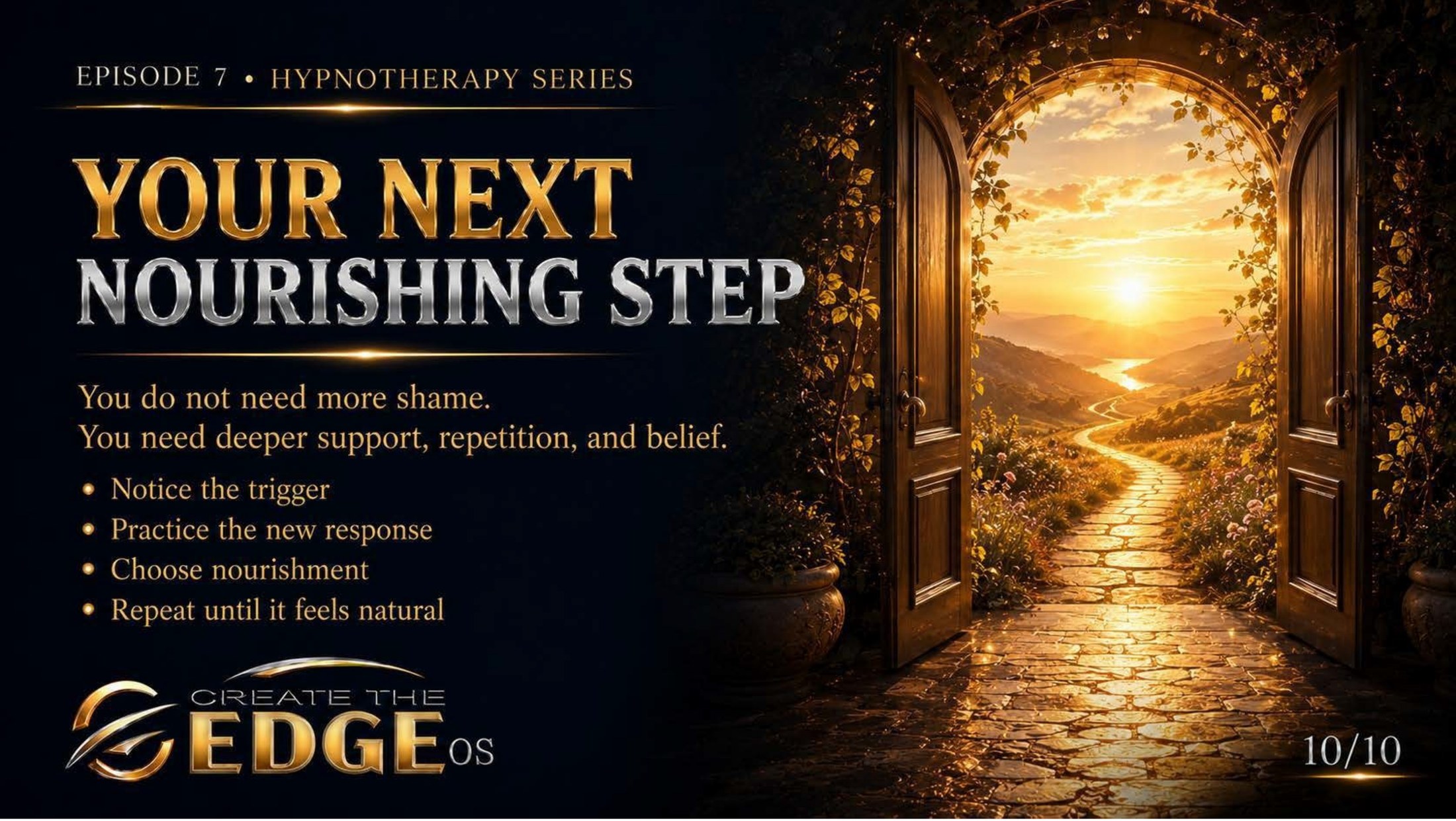
On the slideYou do not need more shame. You need deeper support, repetition, and belief: notice the trigger · practice the new response · choose nourishment · repeat until it feels natural.
Episode 7 · Slide 10
Your Next Nourishing Step
Episode 7 · Slide 10
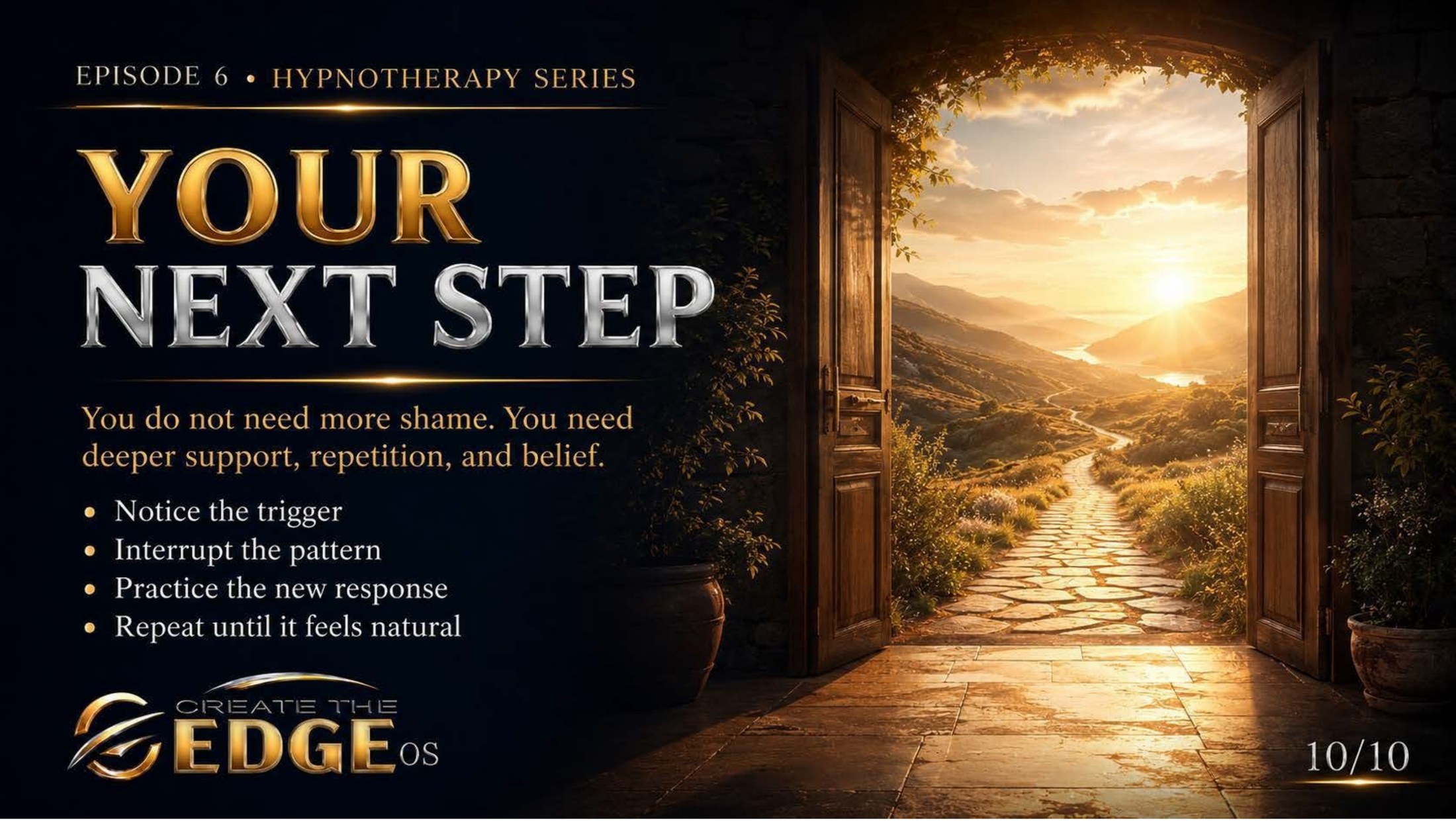
Look at this final image — a great wooden door standing open in an old stone wall, golden light pouring through, a flagstone path winding out into a glowing valley of hills and sunrise. That’s your next nourishing step, and it leads somewhere peaceful. But before we walk the four steps in the workbook below, read the sentence the slide puts front and center, and read it with your hand over your heart: “You do not need more shame. You need deeper support, repetition, and belief.”
After a lifetime in the diet hurricane, please let that sentence land all the way down. You’ve been told you needed more rules, more discipline, more control, more shame about your “failures.” And it never worked, because it was never the medicine. The medicine is support, gentle repetition, and a new belief about who you are around food. Not a bigger stick. A kinder, steadier hand. Now, the four steps.
One: Notice the trigger. With curiosity, not judgment, begin to notice what sets off your eating patterns — the time, the feeling, the situation just before. And practice the clarity from this chapter: is this physical hunger, or an emotional craving? You can’t change a pattern you can’t see, and you can’t answer a need you haven’t named. Noticing is the whole beginning.
Two: Practice the new response. When you catch a craving, run the pattern interrupt — pause, breathe, reframe, choose. Create the space between impulse and action where your freedom lives. You won’t do it perfectly, and that’s completely fine. You’re just practicing reopening the gap.
Three: Choose nourishment. In that space, choose to nourish — your body, with calm and respect, or the real underlying need, directly and kindly. Remember the gentle anchors: protein, fiber, hydration, balance. No forbidden lists. No punishment. Just the natural choices of someone who cares for the body she lives in.
Four: Repeat until it feels natural. And then — the faithful friend, repetition. You practice again and again, not on the perfect day but in the ordinary moments, with patience and self-compassion on the days you stumble. Because you will stumble, and — you know the words by now — we don’t fail, we fall forward. A slip is not a collapse. It’s a teacher. There is no “blowing it” here, because there’s no all-or-nothing wagon to fall off of — only the next nourishing choice, always available, always one breath away.
Notice. Practice. Choose. Repeat — all of it wrapped in support and self-trust instead of shame. That’s the path through the open door.
And friend, I’ve walked out of the food hurricane myself — out of the confusion, the shame, the war with my own body — and into a place where eating finally felt peaceful again. If I found that door, so can you. Not by mustering more shame. By finally giving yourself enough support to walk it. So let’s take the first nourishing step right now, in your own handwriting below. The door is open. The valley is glowing. And I’m right here beside you — no rules between us, no judgment, just the path, the light, and your next gentle step toward freedom.