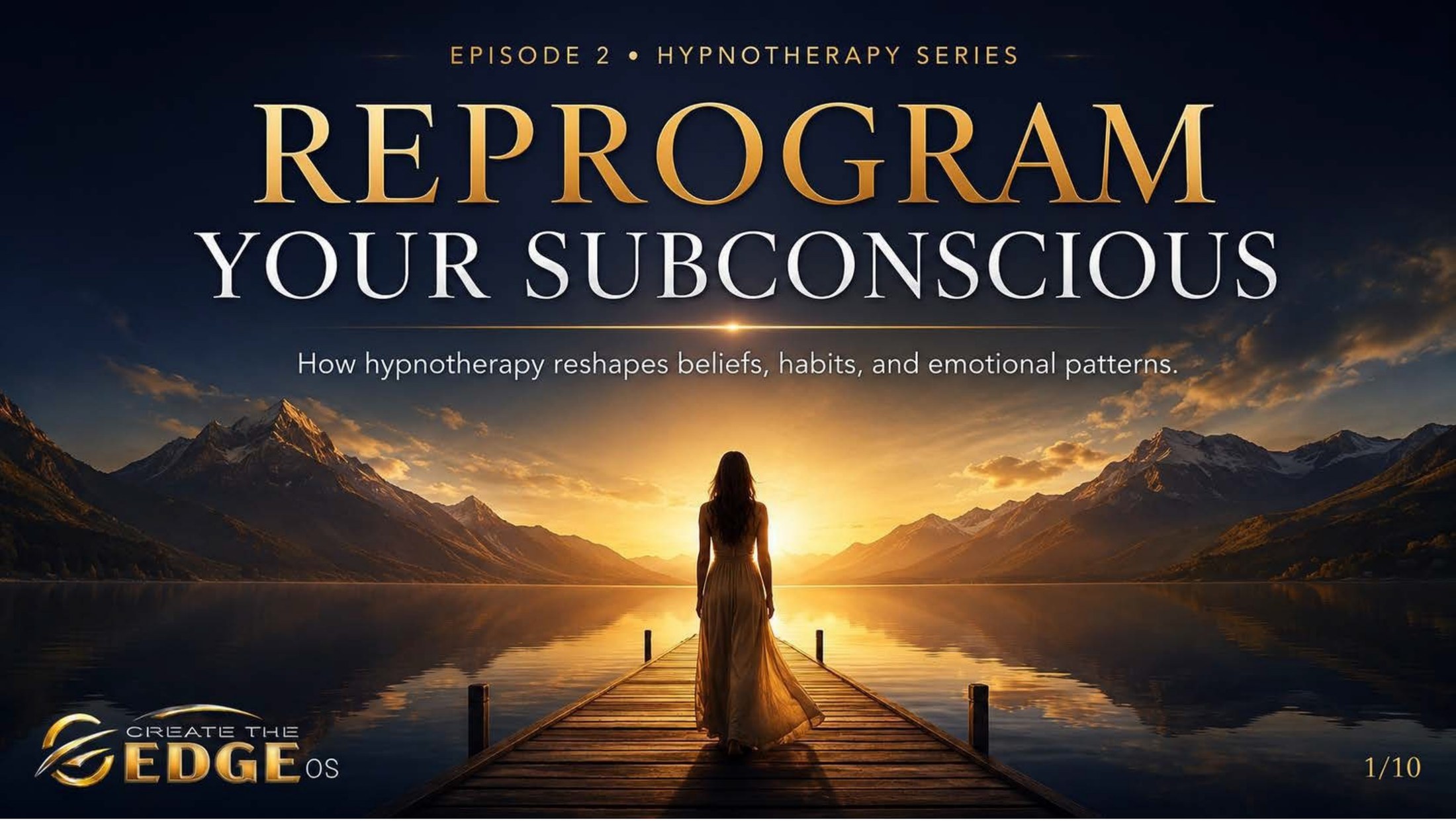
On the slideHow hypnotherapy reshapes beliefs, habits, and emotional patterns.
Episode 2 · Slide 1
Reprogram Your Subconscious
Episode 2 · Slide 1
There she is again — our woman on the dock, walking toward the light over still water, mountains holding the sunrise in their arms.
But notice she’s not standing still this time. She’s moving. In the last chapter she made the decision to begin; here she takes the first real step out over the deep. That’s exactly where you are now, so let me tell you what’s under your feet.
Last chapter we looked at the iceberg — that ninety-five percent of you living below the waterline, running the show in the dark. We agreed that the patterns down there were written long ago, by hands that weren’t always kind, in seasons you didn’t choose. That was the diagnosis. This chapter is the prescription.
Because it’s one thing to learn that you’ve been running on old code. It’s another thing entirely to learn that the code can be rewritten — and that you, ordinary, tired, hopeful you, are allowed to be the one who rewrites it.
That word — reprogram — sounds cold and technical, like something you’d do to a thermostat. So let me warm it up for you. We’re not turning you into a machine. We’re doing the opposite. We’re going down into the basement of your mind where a frightened child once taped a sign to the wall that said “don’t ever try that again, it isn’t safe” — and we’re gently taking the sign down, thanking the child for trying to protect you, and hanging a new one that tells the truth about who you are now.
You’ve carried the old sign for years. You can probably read it without looking. And today we start the quiet, powerful work of writing a better one.
Walk with me out onto the water. I promise it holds.
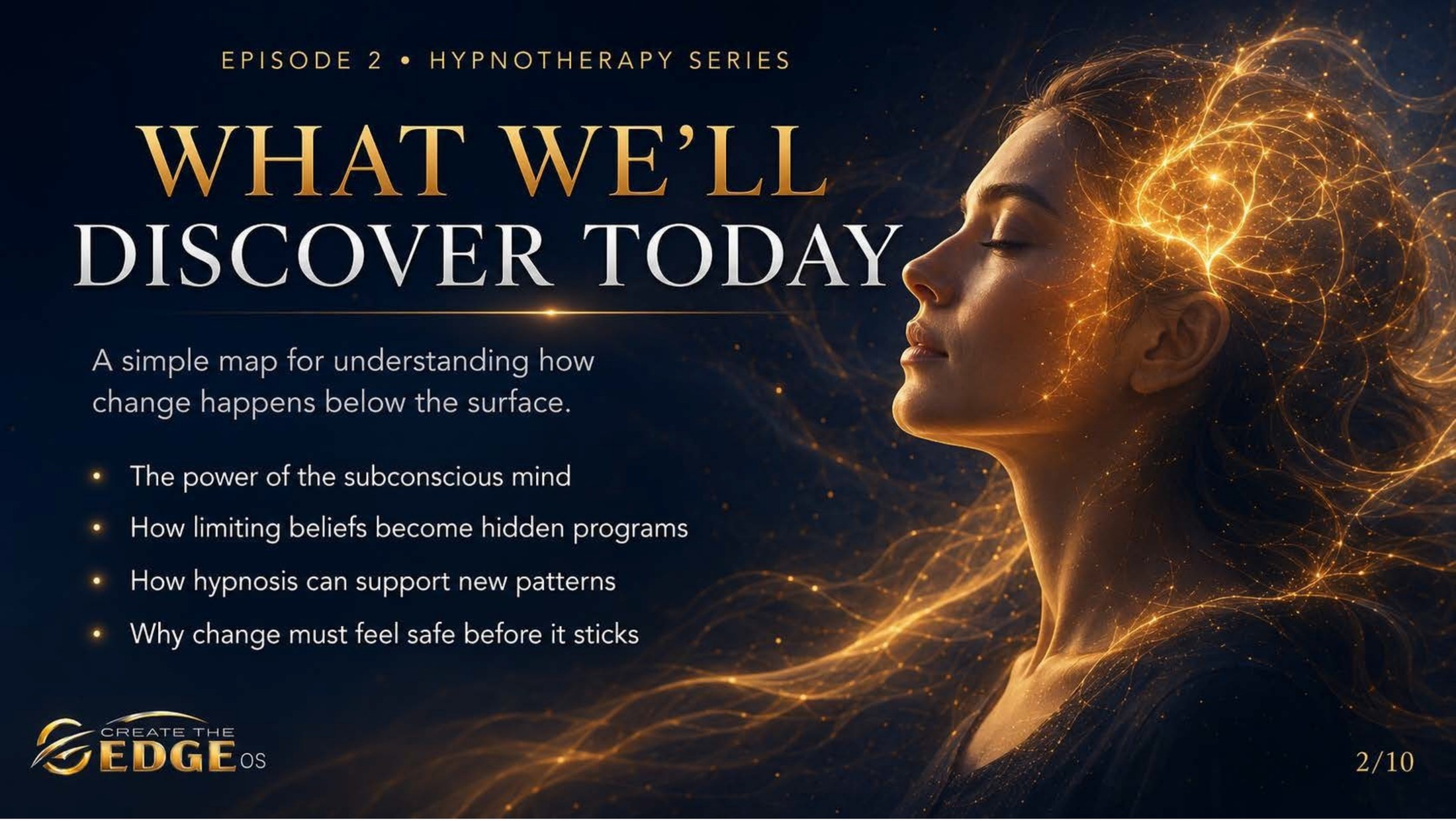
On the slideA simple map for understanding how change happens below the surface: the power of the subconscious mind · how limiting beliefs become hidden programs · how hypnosis can support new patterns · why change must feel safe before it sticks.
Episode 2 · Slide 2
What We’ll Discover Today
Episode 2 · Slide 2
Before we hike a new trail, it helps to look at the map — so here’s ours, four landmarks, and I want you to glance at all four before we set off into the trees.
Look at the woman in this image: eyes closed, serene, and threaded through her hair and her mind, a current of golden light — the unseen wiring of a human being, lit up at last. That’s what we’re here to understand. The wiring. How it got laid, and how it gets rewired.
First, the power of the subconscious mind. We’ll go deeper than the iceberg — into how much of your ordinary day is actually being driven by that deep, automatic part of you. The answer is going to surprise you, and it’s going to set you free.
Second, how limiting beliefs become hidden programs. We’ll watch, in slow motion, how a single painful moment hardens into a rule you live by for thirty years without ever noticing you agreed to it.
Third, how hypnosis supports new patterns. The actual mechanism — not magic, not mystery — the simple, repeatable way the deep mind learns something new.
And fourth — and this is the one almost everyone skips, which is why almost everyone stays stuck — why change must feel safe before it sticks. You can white-knuckle a new habit for a week. But if the deep part of you still believes the old pattern was keeping you alive, it will quietly drag you back every single time. We don’t fight that part. We make peace with it. That’s the secret hiding in plain sight, and we’ll spend real time there.
Four landmarks. One map. By the end of this chapter, you won’t just believe change is possible — you’ll understand the machinery of how. And understanding the how is where fear finally loses its grip.
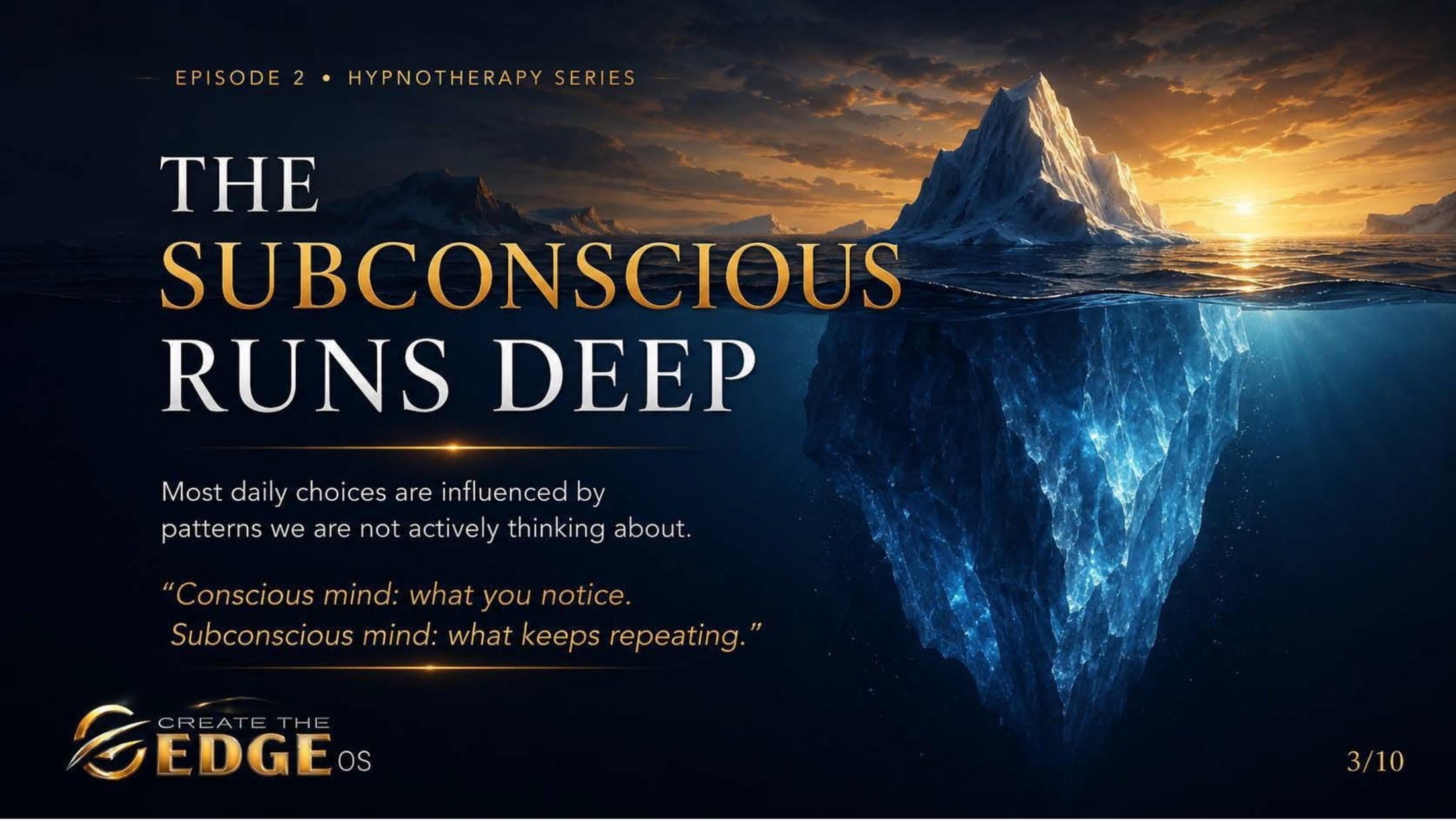
On the slideMost daily choices are influenced by patterns we are not actively thinking about. “Conscious mind: what you notice. Subconscious mind: what keeps repeating.”
Episode 2 · Slide 3
The Subconscious Runs Deep
Episode 2 · Slide 3
Here’s the iceberg again — but read the two lines of gold at the bottom of the image, because they are some of the truest words in this whole book: “Conscious mind: what you notice. Subconscious mind: what keeps repeating.”
Sit with that. What keeps repeating.
Think about your own life for a second. Not the dramatic parts — the repeating parts. The same argument with a different partner. The same job that looked new but somehow turned into the old one. The diet you’ve started, by your own honest count, somewhere north of forty times. The way you reach for your phone the instant you feel a feeling you don’t want. The promise you make to yourself every Sunday night and break by Tuesday afternoon.
We tend to think we’re choosing all of that, fresh, each time. We’re not. Researchers who study this estimate that the overwhelming majority of our daily behavior runs on automatic — patterns firing below the level of “I noticed and decided.” You are not lazily failing to choose better. You are being faithfully, powerfully carried along by a current you can’t see.
And I want to be careful here, because this is where people get hard on themselves. If most of your day is automatic, it’s tempting to feel like a puppet — like you’re not even the author of your own life. But flip it over and look at the other side, because the other side is magnificent.
That automatic system is the same one that lets you drive a car while holding a conversation, that healed the cut on your hand without a single instruction from you, that kept your heart beating through every night you were too exhausted to remember to breathe on purpose. The deep mind is not your enemy. It is the most loyal, tireless servant you will ever have. It has just been running some outdated instructions.
We’re not going to fire it. You can’t, and you wouldn’t want to. We’re going to do something far smarter and far kinder. We’re going to give it better instructions — and then let its incredible power carry you somewhere new for a change.
The current was always going to carry you. This chapter is about pointing it downstream toward the life you actually want.

On the slideA belief is not always truth. Sometimes it is a survival strategy that stayed too long. “I’m not enough.” · “I always fail.” · “Success is unsafe.” · “I have to stay in control.”
Episode 2 · Slide 4
Limiting Beliefs Are Old Programs
Episode 2 · Slide 4
This image stops me every time — the woman sitting at the edge of the water beside an enormous hourglass, the sand running down, watching her own time pass. And above her, the single most liberating sentence I know how to teach: a belief is not always truth. Sometimes it is a survival strategy that stayed too long.
Read that twice, because it just took the knife out of your hand.
We treat our beliefs about ourselves as facts. “I’m not enough” doesn’t feel like an opinion you adopted; it feels like a law of physics, like gravity, like the color of the sky. But it isn’t. Every one of those beliefs was installed — and here’s the part that changes everything — every one of them, at the time, was trying to protect you.
Look at the four old programs on this slide, and let me show you the frightened child who first taped each one to the wall:
“I’m not enough.” Somewhere, small, you reached for approval and got a closed door instead. So the deep mind decided: if I expect less, I’ll hurt less. The belief wasn’t cruelty. It was armor.
“I always fail.” You tried, you fell, and someone was there to make sure you felt it — loudly, maybe in front of a whole classroom. (I told you I know that one in my bones.) So the deep mind decided: if I never really try, I can never really be humiliated again. The belief was a shield.
“Success is unsafe.” This one’s sneaky. Maybe when you shined, you got punished for it — a jealous parent, a friend who pulled away, attention that turned dangerous. So the deep mind decided: stay small, stay safe. The belief was camouflage.
“I have to stay in control.” Maybe your world was chaos, and the only ground under your feet was the white-knuckle grip of managing everything yourself. So the deep mind decided: never let go, never trust, never relax. The belief was a handhold over a long drop.
Do you see it? None of these are character flaws. None of them mean you’re broken. They were all brilliant solutions — to problems that ended years ago. The survival strategy simply forgot to clock out. It’s still standing guard at a door that no longer leads anywhere dangerous.
And here’s the warm, hopeful truth I want you to carry out of this section: you don’t have to hate these old programs to be free of them. You can thank them. Thank you for keeping that little one alive. I’ve got it from here. That gratitude isn’t weakness — it’s the exact key that unlocks the door. Because the deep mind never lets go of a strategy it thinks is protecting you. It only lets go when it finally believes you’re safe.
So let’s go make it believe.
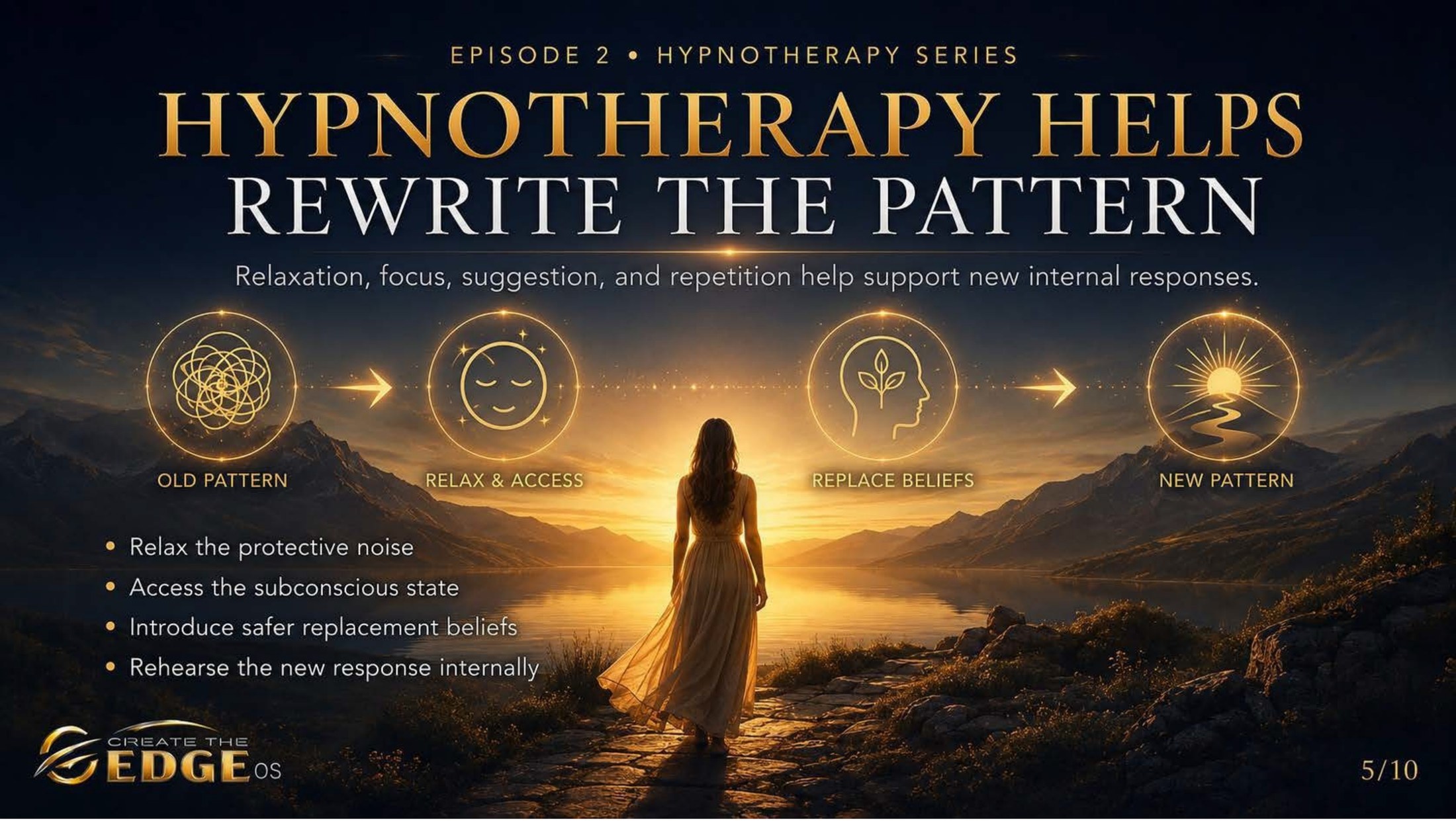
On the slideRelaxation, focus, suggestion, and repetition help support new internal responses. Old Pattern → Relax & Access → Replace Beliefs → New Pattern. Relax the protective noise · access the subconscious state · introduce safer replacement beliefs · rehearse the new response internally.
Episode 2 · Slide 5
Hypnotherapy Helps Rewrite the Pattern
Episode 2 · Slide 5
Now — the how. Look at the four glowing circles marching across this image, an old tangled knot of light on the left transforming, step by step, into a clear golden river on the right. That’s not decoration. That’s the actual path, and it’s only four steps. Let me walk you down it.
One: Relax the protective noise. Remember, the deep mind is standing guard. As long as you’re tense, hurried, defensive — the guard stays at full alert, and nothing new gets past it. So first we quiet the alarm. We slow the breath, soften the body, lower the noise. The guard relaxes its shoulders. The gate eases open.
Two: Access the subconscious state. Now we slip past the chattering surface mind — the one full of opinions and arguments — and into that calm, focused, receptive state we kept describing last chapter. This is the level where the old programs actually live. You can’t reach the basement wiring from the front porch. You have to go down the stairs.
Three: Introduce safer replacement beliefs. Here’s the heart of it, and notice the language on the slide — safer replacement beliefs. We don’t bulldoze the old sign and scream “YOU ARE ENOUGH” at a terrified child. That just frightens the guard back to attention. Instead we offer something the deep mind can actually accept: It’s safe to be enough now. That danger is over. You’re allowed. Gentle. True. Safe.
Four: Rehearse the new response internally. And this is the step everyone underestimates. The deep mind learns by experience — so we let it experience the new way, in vivid imagination, before you ever try it in real life. We rehearse you walking into the room calm. We rehearse you setting the boundary and surviving. We run the new movie again and again, until the deep mind files it under “things I know how to do” instead of “terrifying things I’ve never done.”
Relax. Access. Replace. Rehearse. The knot of light becomes a river. And notice what this isn’t: it isn’t willpower, it isn’t gritting your teeth, it isn’t shaming yourself into change. It’s the opposite of force. It’s the patient, respectful, almost tender process of teaching a loyal old servant a better way to serve you.
That’s the machinery. It’s simpler than the fear made it sound. And it works because it works with your nature instead of against it.
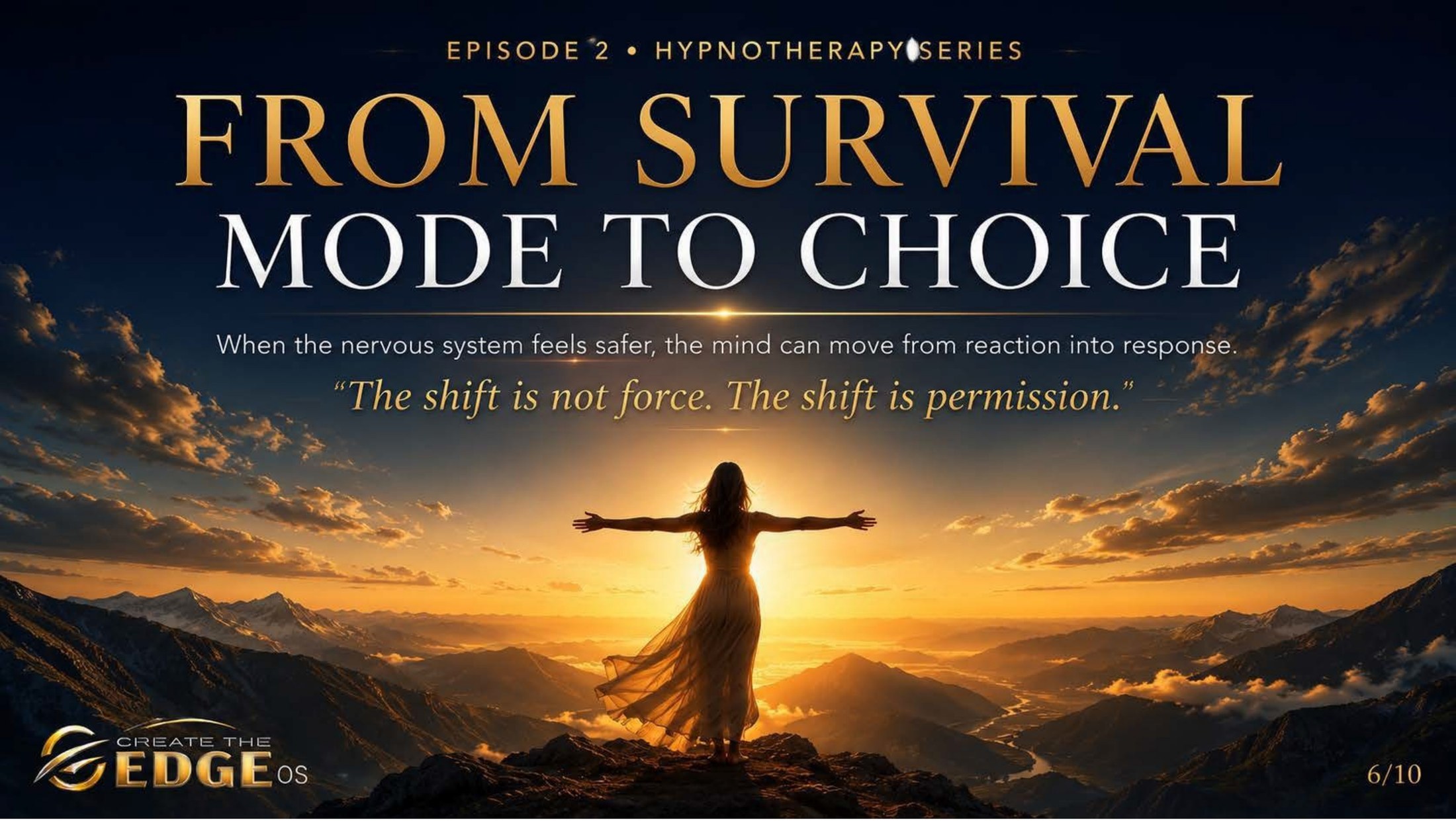
On the slideWhen the nervous system feels safer, the mind can move from reaction into response. “The shift is not force. The shift is permission.”
Episode 2 · Slide 6
From Survival Mode to Choice
Episode 2 · Slide 6
If you only underline one sentence in this entire chapter, make it the gold line on this image: “The shift is not force. The shift is permission.”
Look at her — arms flung wide on the mountaintop, the whole valley glowing below, nothing held back. That is not the posture of someone forcing anything. You cannot force your arms open like that; the moment you force it, it becomes a flinch. That openness only happens when something deeper finally says: you’re safe now. You can let go.
Here’s what almost nobody understands about change, and why so many people try so hard for so long and stay exactly where they are. They’re attacking the problem with force — more discipline, more pressure, more punishment, more “just push through.” And force, aimed at a frightened nervous system, does the one thing you don’t want: it makes the system more frightened. You press harder, the guard digs in harder. You’ve been in a tug-of-war with yourself, and a tug-of-war is the one fight where pulling harder guarantees you stay in place.
The slide names the way out: when the nervous system feels safer, the mind can move from reaction into response.
Reaction is the automatic flinch — the snapped reply, the reached-for drink, the door slammed before you knew your hand was on it. Response is what becomes possible in the tiny, golden gap between the trigger and your choice. Most people never get that gap, because their nervous system is too on-guard to allow it. But widen that gap even a little — by helping the body feel safe — and suddenly you have room to choose. And choice, my friend, is freedom. Choice is the whole ballgame.
So we stop forcing. We start permitting. We stop screaming at the guard and start convincing him the war is over. And the moment he believes it — the moment your deep self feels truly safe — your arms open on their own. You don’t have to pry them. You just have to make it safe enough to stop bracing.
You’ve been bracing for a long time. I know. Let’s start, gently, to teach you that you’re allowed to stop.
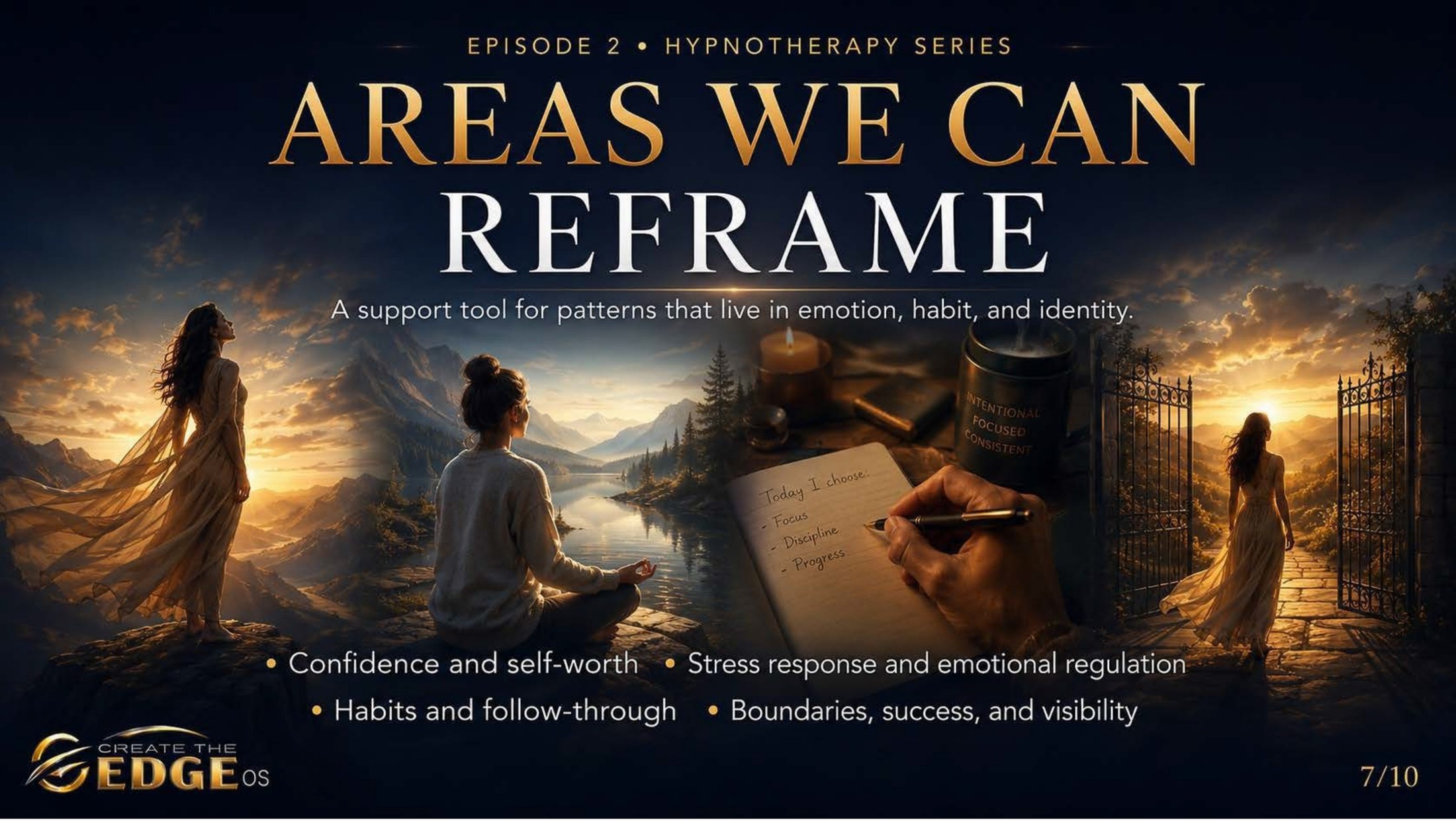
On the slideA support tool for patterns that live in emotion, habit, and identity: confidence and self-worth · habits and follow-through · stress response and emotional regulation · boundaries, success, and visibility.
Episode 2 · Slide 7
Areas We Can Reframe
Episode 2 · Slide 7
So where does all this actually go to work in a real life? Look at the four scenes woven across this image — a woman facing the dawn, another in stillness by the water, a hand writing “Today I choose…” in a journal, a figure walking through an open iron gate into the light. Four doorways. Let me show you who waits at each.
Confidence and self-worth. This is for the one who does brilliant work and still feels like a fraud who’s about to be found out. Who can’t take a compliment without deflecting it like a hot potato. Who has spent a lifetime suspecting that everyone else got a manual she never received. We reframe the belief underneath — and the fraud feeling loses its floor.
Habits and follow-through. This is for the one with the graveyard of abandoned starts — the gym membership, the half-written book, the language app still cheerfully reminding her on day three. (Again: no judgment. I have personally been the graveyard and the gym membership.) When we pull the emotional root under the habit, follow-through stops requiring superhuman willpower, because the part of you that kept sabotaging it finally stops.
Stress response and emotional regulation. This is for the one who goes from zero to flooded in a heartbeat — whose body sounds the air-raid siren over a tone of voice, a traffic jam, an unanswered text. We widen that gap between trigger and reaction until there’s finally room to breathe inside it.
Boundaries, success, and visibility. This is for the one who says yes when her whole body is screaming no. Who shrinks when the spotlight swings her way. Who has confused being good with being small. We reframe the old rule that made visibility dangerous — and she finally gets to take up the space she was always meant to fill.
Notice the words written on that candle-lit jar in the image: intentional. focused. consistent. That’s the quiet posture all four of these doorways ask of you. Not perfection. Not intensity. Just showing up, on purpose, more than once.
And here’s the beautiful thing — you don’t have to walk through all four gates. Most people find that one of these is the gate, the one that’s been locked the longest, the one that’s quietly been blocking all the others. Open that one, and you’ll be amazed how many of the rest swing free on their own.
Which gate is yours? Hold the question gently. By the end of this chapter, you’ll write the answer down.
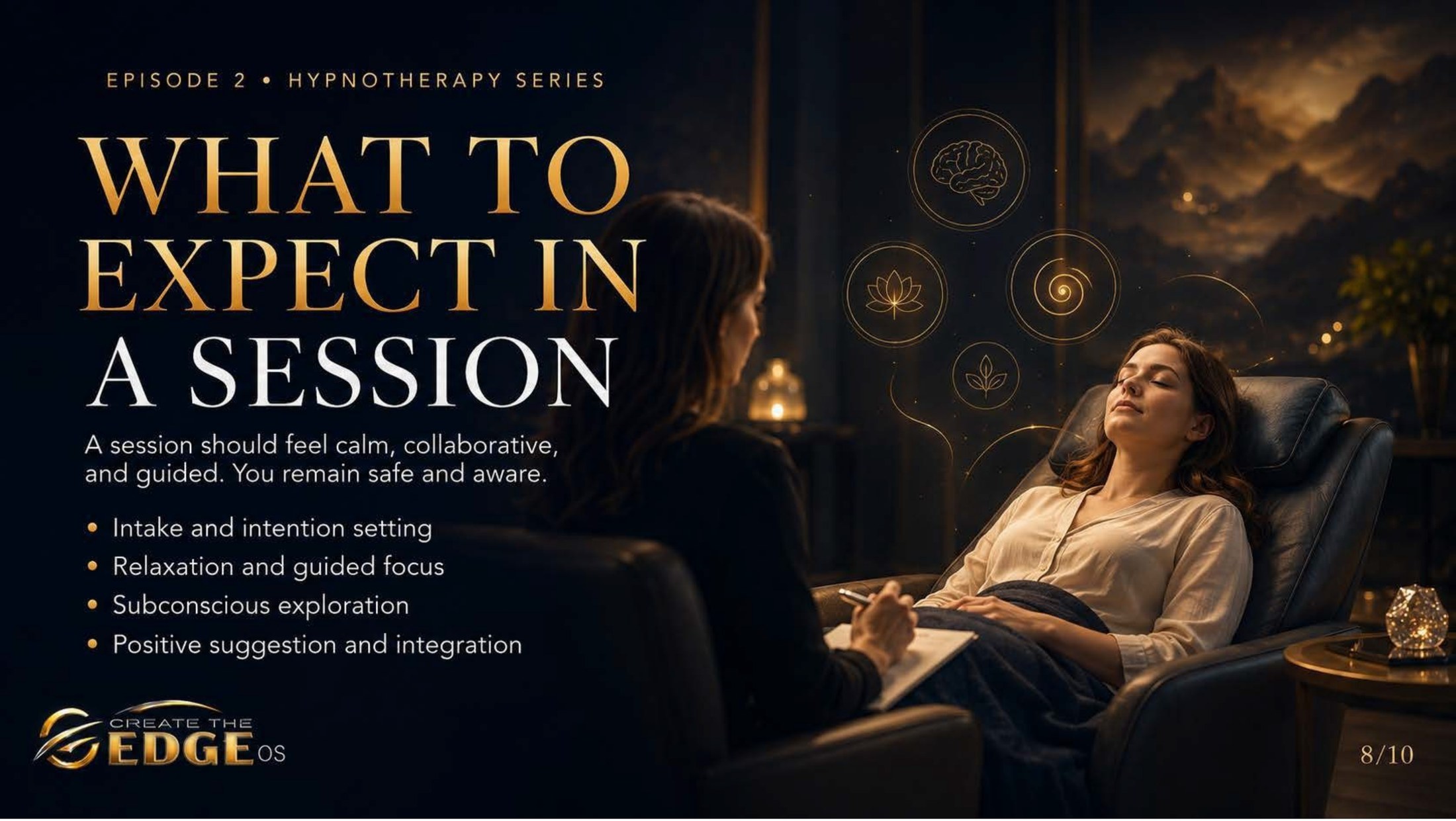
On the slideA session should feel calm, collaborative, and guided. You remain safe and aware: intake and intention setting · relaxation and guided focus · subconscious exploration · positive suggestion and integration.
Episode 2 · Slide 8
What to Expect in a Session
Episode 2 · Slide 8
Let me take you inside the room, so the unknown stops being scary. Look at the image — one woman reclined and at peace, another seated nearby with a notebook, soft light, mountains in the window. This is what the work actually looks like. No swinging watch. No drama. Two human beings and a quiet hour. Here’s the shape of it.
Intake and intention setting. We begin by simply talking. What brought you here? What’s the pattern you’re tired of? What would your life feel like if it shifted? We set a clear intention — a destination — because the deep mind, like a good driver, does its best work when it knows where we’re going. This part is collaborative. You’re not a patient on a table; you’re a partner in the room.
Relaxation and guided focus. Then we soften. My voice guides you down into that calm, focused state — the comfortable chair, the slow breath, the gathered light. There’s nothing to do here but follow and let go. Most people are surprised by how good it feels simply to be allowed to rest this deeply.
Subconscious exploration. In that open state, we gently visit the pattern — not to relive the pain, but to understand it, to find the frightened child who first taped up the sign. We do this with enormous care. You stay safe. You stay aware. You can speak the whole time. We never force a door; we only open the ones that are ready.
Positive suggestion and integration. And then we plant the new thing — the safer belief, the rehearsed response, the truer story — in soil that’s finally soft enough to receive it. We let the deep mind try on the new pattern until it starts to feel less like a costume and more like skin. Then, slowly, we come back up, carrying it with us.
Read the line on the slide one more time: you remain safe and aware. Always. This is not something that happens to you while you’re gone. It’s something you do, fully present, with a guide beside you. You are the one in the chair, and you are the one in charge — the whole way through.
That’s the room. Nothing in it to fear. Quite a lot in it to hope for.
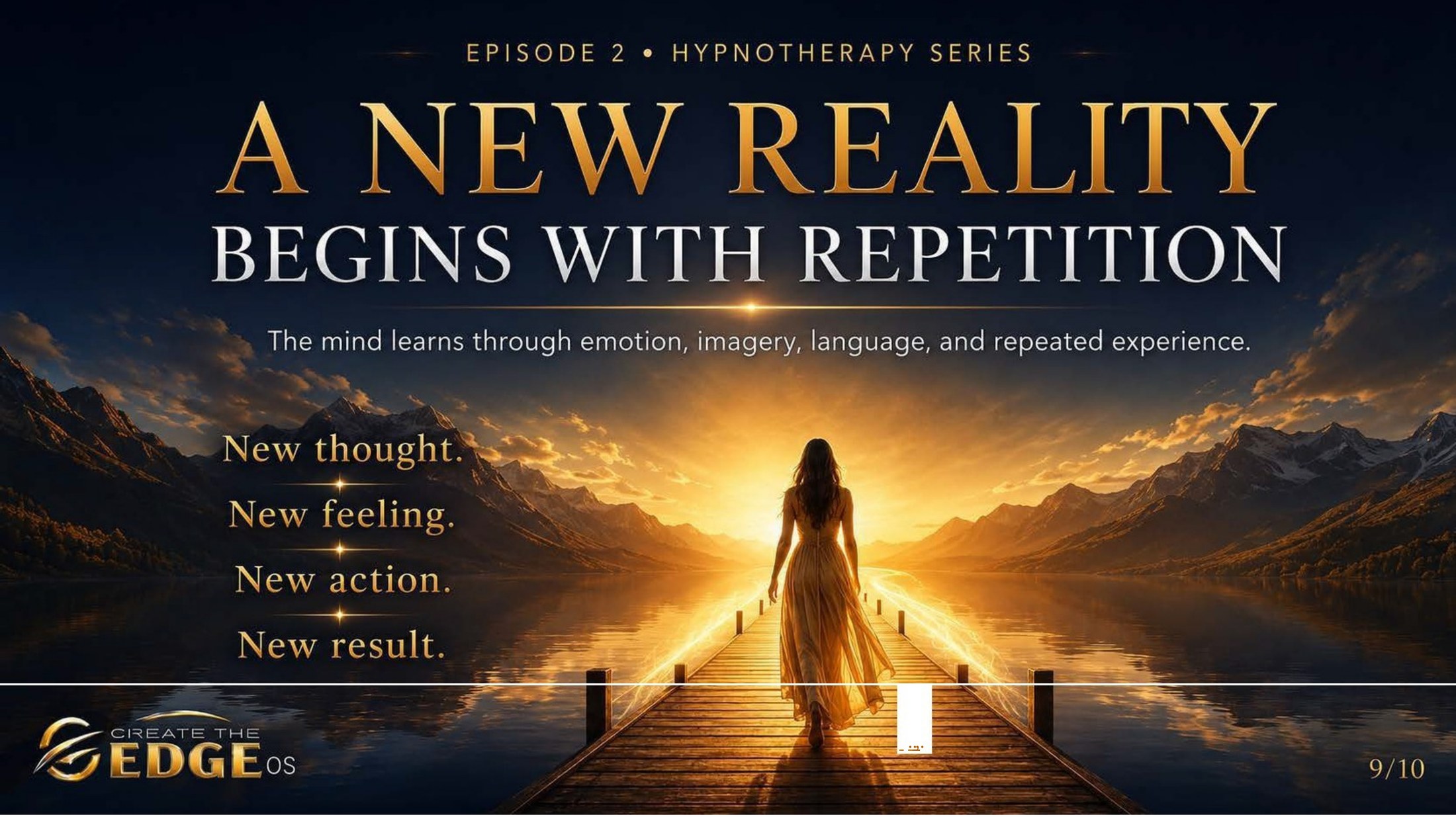
On the slideThe mind learns through emotion, imagery, language, and repeated experience. New thought. New feeling. New action. New result.
Episode 2 · Slide 9
A New Reality Begins With Repetition
Episode 2 · Slide 9
Here she is once more on the golden dock — but look closely, because this time the path beneath her feet is glowing, lit from within, a river of light carrying her toward the sun. That light didn’t appear in a single flash. It was built, step by step, by repetition. And that’s the truth this slide hands you, the one nobody likes to hear and everybody needs to: a new reality begins with repetition.
I wish I could tell you transformation is one dramatic breakthrough — one session, one good cry, one lightning bolt, and you’re reborn. Sometimes there is a breakthrough, and it’s beautiful. But the breakthrough is the spark. Repetition is the fire that keeps it lit.
Look at the staircase on the left side of the image, four golden steps: New thought. New feeling. New action. New result. That’s the actual sequence of becoming someone new, and it runs in that exact order, every time.
It starts with a new thought — a single different idea about who you are. Maybe I am allowed to rest. Thin and wobbly at first, like a path you’ve never walked.
Repeat the thought and it grows a new feeling — the idea drops from your head into your body, and one day “I’m allowed to rest” stops being a sentence and starts being a sensation.
The feeling makes possible a new action — you actually rest, you actually set the boundary, you actually walk into the room calm. The first time it’s terrifying. The tenth time it’s merely uncomfortable. The fiftieth time it’s just… Tuesday.
And the action, repeated, delivers a new result — a life that looks different, because it was lived differently, one repeated choice at a time.
The mind learns the way the slide says — through emotion, imagery, language, and repeated experience. That’s not a limitation. That’s the instruction manual. It means you don’t need to be more talented or more disciplined than anyone else. You just need to walk the new path often enough that it lights up under your feet.
So please, be patient with yourself on the days the old path still looks more familiar. Of course it does — you walked it for thirty years. The new one only needs to be walked more often, not perfectly. Every single repetition is a brick of gold laid down in the dark. And one ordinary morning you’ll look down and realize the whole road is glowing.
Keep walking. The light is coming up to meet you.
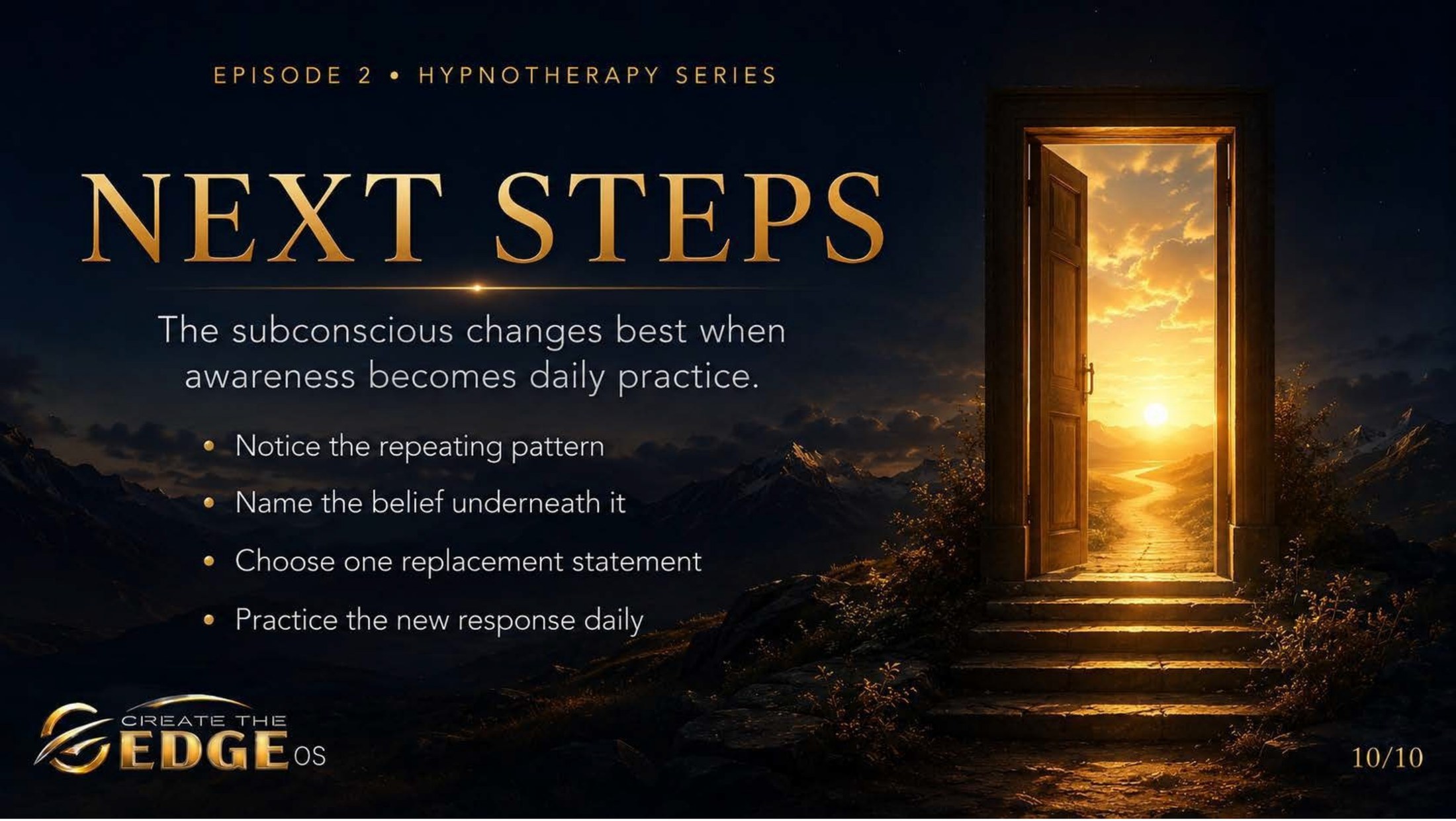
On the slideThe subconscious changes best when awareness becomes daily practice: notice the repeating pattern · name the belief underneath it · choose one replacement statement · practice the new response daily.
Episode 2 · Slide 10
Next Steps
Episode 2 · Slide 10
There’s the open door again, sunrise pouring through it, a lantern-lit path climbing toward the light. And this time the four steps through it aren’t for some future appointment — they’re for today, for you, for the journal waiting at the bottom of this page. This is where reading becomes practice. Let’s walk it together right now.
One: Notice the repeating pattern. Not the dramatic crisis — the repeat. What’s the loop you keep finding yourself in? The same fight, the same fear, the same self-sabotage at the same moment? You can’t change a pattern you can’t see. So first, with the gentle curiosity of a scientist rather than the cruelty of a judge, you simply name what keeps happening.
Two: Name the belief underneath it. Now go one floor down. Underneath the pattern is a program — one of those old signs taped to the basement wall. Is it “I’m not enough”? “Success is unsafe”? “I have to stay in control”? Find the sentence the frightened child wrote. Naming it out loud robs it of half its power, because in the light it stops looking like the truth and starts looking like what it is — an old strategy that stayed too long.
Three: Choose one replacement statement. Then you write the new sign. Not a lie, not a scream — a safer truth the deep mind can actually accept. Not “I’m the most confident person alive,” but “It’s safe to be seen now.” Not “I never fail,” but “I’m allowed to try, and falling teaches me.” Gentle. True. Possible.
Four: Practice the new response daily. And then — repetition. Every day, you walk the new path. You catch the old pattern starting, you name the old belief, and you choose the new statement, on purpose, out loud if you can. Awareness becomes daily practice. That’s the whole secret on this slide: the subconscious changes best not through one heroic effort, but through small, faithful, daily returns.
Notice. Name. Choose. Practice. Four steps, and not one of them requires you to be anyone other than who you already are. They just ask you to show up — intentional, focused, consistent — and lay one more golden brick.
The door is open. The path is lit. And the very first brick gets laid right below, in your own handwriting, in the workbook on this page.
Don’t just close the book and mean to start someday. “Someday” isn’t on the calendar. Pick up the pen. Lay the first brick now. I’m right here, holding the door.